



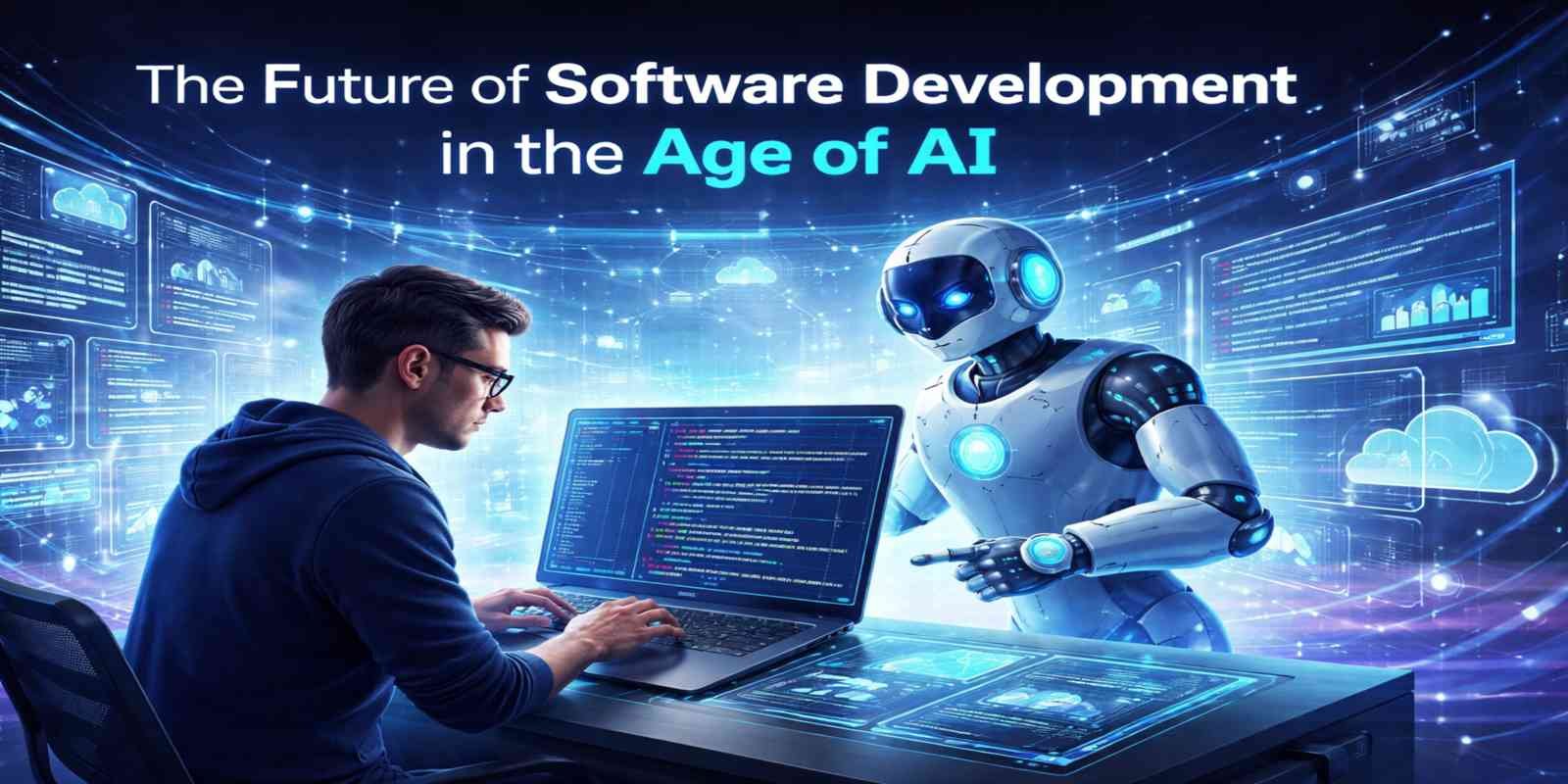
Software development is undergoing one of the most significant transformations in its history. What began decades ago with punch cards and assembly language has evolved into high-level frameworks, cloud platforms, and global collaborative development. Today, the industry stands at the edge of another major leap—the integration of Artificial Intelligence (AI) into every stage of the software development lifecycle. The age of AI is not a distant future; it is already reshaping how software is imagined, designed, built, tested, deployed, and maintained.
This transformation is not about replacing developers. Instead, it is about redefining their role, amplifying productivity, and unlocking new possibilities that were previously impractical or impossible. The future of software development in the age of AI will be faster, smarter, more adaptive, and more deeply connected to real-world problem solving.
From Traditional Coding to Intelligent Development
For decades, software development followed a largely manual process. Developers wrote code line by line, debugged errors through trial and error, and relied heavily on experience and documentation. While tools improved over time—IDEs, frameworks, and version control systems—the fundamental workflow remained human-driven.
AI changes this paradigm. Intelligent systems can now analyze massive codebases, learn from millions of examples, and assist developers in real time. Code is no longer written in isolation; it is increasingly co-created with AI-powered tools. This shift marks the transition from traditional coding to intelligent development, where software creation becomes a collaborative process between humans and machines.
Organizations such as OpenAI and Google have demonstrated that AI models can understand programming logic, generate functional code, and even explain complex systems. These capabilities are laying the foundation for a new era of development.
AI as a Coding Assistant, Not a Replacement
One of the biggest fears surrounding AI in software development is job displacement. However, history shows that technological advancements rarely eliminate professions entirely; instead, they transform them. AI is best understood as a coding assistant, not a replacement for developers.
AI-powered tools can:
- Generate boilerplate code and repetitive structures
- Suggest optimizations and best practices
- Detect bugs and vulnerabilities early
- Refactor legacy code for better performance
By handling routine and time-consuming tasks, AI frees developers to focus on higher-level responsibilities such as system architecture, business logic, security design, and user experience. The human role shifts from “writing code” to directing intelligence.
Just as calculators did not eliminate mathematicians, AI will not eliminate developers. Instead, it will raise the baseline of productivity and quality across the industry.
Accelerating the Software Development Lifecycle
The traditional software development lifecycle—requirements, design, coding, testing, deployment, and maintenance—can be slow and resource-intensive. AI has the potential to optimize every phase of this cycle.
During requirements analysis, AI can analyze user data, behavior patterns, and market trends to help define more accurate and user-centric features. In the design phase, AI can recommend architectural patterns based on scalability, performance, and security needs. During coding, AI assists with generation and validation. In testing, it can automatically create test cases and simulate edge scenarios. In maintenance, AI can predict failures and recommend proactive fixes.
As a result, development cycles that once took months may be completed in weeks or even days. This acceleration allows businesses to innovate faster and respond more effectively to changing market demands.
AI and the Rise of Smarter Software Systems
AI is not only changing how software is built—it is changing what software can do. Modern applications are increasingly expected to be intelligent, adaptive, and personalized.
AI-driven software can:
- Learn from user behavior and adapt interfaces dynamically
- Predict outcomes and recommend actions
- Automate decision-making processes
- Continuously improve through feedback loops
This shift is pushing developers to think beyond static functionality. The future of software lies in learning systems—applications that evolve over time rather than remaining fixed after deployment.
Developers must therefore understand not only traditional programming concepts but also data modeling, ethical AI design, and responsible automation.
Human Creativity and AI Efficiency
While AI excels at pattern recognition, speed, and scale, it lacks human intuition, creativity, and ethical judgment. The most successful software solutions of the future will emerge from a balance between human creativity and AI efficiency.
Humans define the problem, understand social and cultural context, and make value-based decisions. AI provides speed, analysis, and optimization. Together, they form a powerful partnership.
In this collaborative model, developers act as:
- Problem solvers
- System thinkers
- Ethical guardians
- Translators between business needs and technical solutions
The future developer is not replaced by AI but elevated by it.
Changing Skill Sets for Future Developers
As AI becomes integral to software development, the skills required to succeed in the field will also evolve. While programming languages remain important, they will no longer be the sole measure of expertise.
Future-ready developers will need:
- Strong problem-solving and logical thinking skills
- Understanding of AI-assisted development workflows
- Ability to evaluate and validate AI-generated outputs
- Knowledge of security, privacy, and ethical considerations
- Communication skills to work across multidisciplinary teams
Continuous learning will become essential, as tools and technologies evolve rapidly. Developers who embrace adaptability will thrive in the AI-driven future.
AI, Ethics, and Responsibility in Software Development
With great power comes great responsibility. AI-driven software systems can significantly impact privacy, security, employment, and social structures. Developers will play a critical role in ensuring AI is used responsibly.
Ethical challenges include:
- Bias in AI-generated decisions
- Data privacy and consent
- Over-automation and loss of human oversight
- Transparency and explainability of AI systems
The future of software development must prioritize ethical AI design, ensuring that technology serves humanity rather than undermines it. Developers will increasingly be expected to consider not just “Can we build this?” but “Should we build this?”
AI and the Democratization of Software Development
AI is also lowering the barrier to entry for software creation. Non-technical users can now describe problems in natural language and receive functional solutions. This democratization empowers entrepreneurs, educators, and small businesses to create digital tools without deep programming expertise.
However, this does not diminish the need for professional developers. Instead, it increases demand for experts who can build robust platforms, ensure security, and integrate AI-generated components into reliable systems.
The future ecosystem will include both creators and curators of software, with developers playing a central role in maintaining quality and trust.
The Business Impact of AI-Driven Development
From a business perspective, AI-driven software development offers significant advantages. Faster development cycles reduce costs, while smarter software improves customer satisfaction and operational efficiency.
Organizations that adopt AI early gain a competitive edge by:
- Delivering products faster
- Improving software quality
- Reducing maintenance overhead
- Enabling data-driven decision-making
As AI becomes mainstream, businesses will increasingly expect developers to understand how technology aligns with strategic goals. Technical expertise alone will not be enough; business awareness will be equally important.
Conclusion: A New Era of Software Development
The future of software development in the age of AI is not about machines replacing humans—it is about collaboration, amplification, and evolution. AI is transforming software development into a more intelligent, efficient, and impactful discipline.
Developers who adapt to this change will find unprecedented opportunities to innovate, solve complex problems, and shape the digital future. Those who resist may struggle, not because AI replaces them, but because the world moves forward without them.
The age of AI marks the beginning of a new era—one where software development becomes not just a technical activity, but a powerful force for progress, guided by human values and enhanced by artificial intelligence.


