



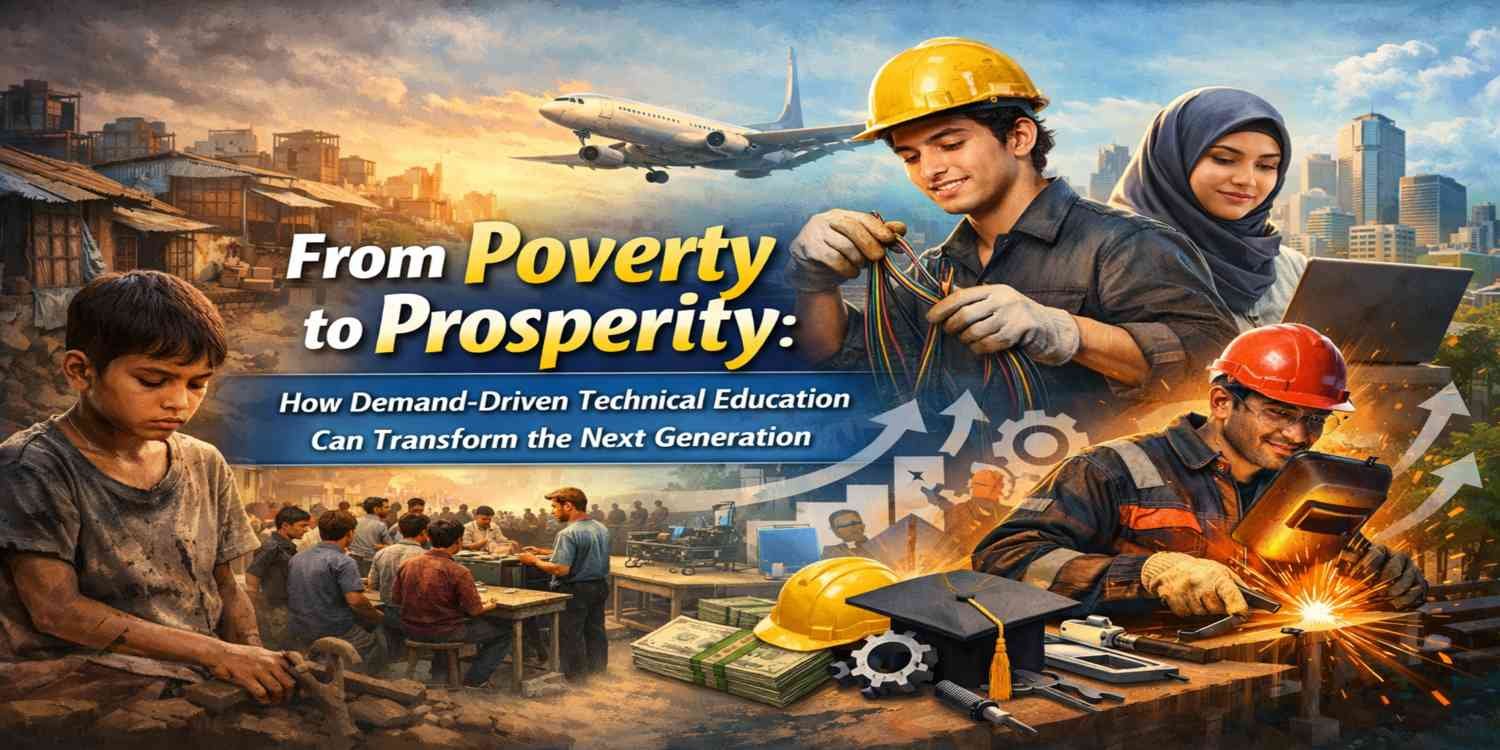
Poverty is not only a shortage of money. It is a shortage of options. When a family has no stable income, every decision becomes a compromise—education is interrupted, nutrition suffers, healthcare is delayed, and the next generation inherits the same limitations. The real tragedy is that poverty often repeats itself, not because people lack intelligence or effort, but because they lack access to skills that the market actually rewards.
The most realistic and proven pathway from poverty to prosperity is demand-driven technical education—training people in practical skills that are genuinely needed by industries and service markets, both locally and internationally. When technical education is connected to real job demand, it becomes more than learning. It becomes income, dignity, confidence, and social mobility. It transforms individuals, families, and entire nations.
Understanding the Root Problem: Education Without Earnings
In many countries, including Bangladesh, a major challenge is that education and employment are often disconnected. Students spend years studying, but graduate without job-ready skills. Many young people hold certificates yet struggle to find work, while industries complain that they cannot find skilled technicians. This mismatch creates two painful realities at the same time:
- Unemployment and frustration among youth, even after education
- Shortage of skilled manpower, even when jobs exist
When education does not lead to earnings, families lose faith. Some students drop out early, thinking education is useless. Others complete degrees but remain underemployed. The result is wasted time, wasted talent, and continued poverty.
Demand-driven technical education solves this by starting with one simple question:
“What skills are needed right now—and what skills will be needed in the next 5–10 years?”
What Demand-Driven Technical Education Really Means
Demand-driven technical education is not training for training’s sake. It is not “learning something because it sounds good.” It is education designed around real market demand—meaning the skills taught have direct pathways to jobs, freelancing income, entrepreneurship, or overseas employment.
This approach includes:
- Identifying high-demand trades and technical professions
- Designing short, practical, competency-based courses
- Including hands-on practice with real tools and real projects
- Ensuring industry involvement (so training matches real work)
- Linking graduates to jobs, apprenticeships, or contracts
In simple words:
It teaches what people can earn from—not just what people can memorize.
Why Technical Education Is the Fastest Anti-Poverty Strategy
Poverty reduces when income rises. Income rises when productivity rises. Productivity rises when people gain skills that increase their value in the marketplace.
A person with a demandable technical skill can:
- Earn more than an unskilled worker
- Find work faster
- Work independently (freelancing, contracting, self-employment)
- Start a small business with minimal capital
- Compete for overseas jobs
This is why technical education is a poverty-breaking tool. It does not depend on charity, political promises, or temporary relief. It builds the capacity to earn.
Consider a few examples:
- A trained electrician can serve homes, factories, and construction projects.
- A certified welder can work in shipyards, workshops, and industrial plants.
- A plumber with practical skill will never remain unemployed for long.
- A CNC machine operator can enter manufacturing jobs with higher wages.
- A refrigeration and AC technician is needed in every city and every season.
These are not theoretical careers. These are daily demands in real markets.
The “Demandable Skills” That Transform Lives
To transform the next generation, the focus must be on skills that employers and customers pay for. These can be grouped into three powerful categories:
1) Construction and Infrastructure Skills
Bangladesh is building constantly—roads, bridges, buildings, industries, power plants. So the demand for skilled hands is permanent.
High-demand skills include:
- Electrician (residential and industrial)
- Plumber and pipe fitter
- Mason and concrete worker
- Tiles technician and finishing worker
- Steel fixer and shuttering carpenter
- Welding (MIG/TIG/Arc)
- Scaffolding and safety technician
2) Industrial and Manufacturing Skills
From garments to plastics, food to steel, manufacturing needs technicians more than it needs paperwork.
High-demand skills include:
- Mechanical fitter and maintenance technician
- Industrial electrician
- PLC and automation basics
- CNC operator and machine technician
- Quality control technician
- Forklift and warehouse equipment operation
- Industrial safety (basic ISO 45001 awareness and practice)
3) Digital and Service Skills
Not everyone must work on a construction site or factory floor. Digital skill can create income from a laptop, even from rural areas.
High-demand skills include:
- Computer office applications (professional level)
- Graphic design and video editing
- Digital marketing (Facebook, Google, SEO)
- Web development (basic to advanced)
- Freelancing skills and client communication
- Basic accounting software operation
A nation does not need everyone to become a doctor or engineer. A nation needs a balanced workforce—skilled technicians, competent operators, disciplined service workers, and innovative entrepreneurs.
How Technical Education Transforms a Person—Not Just Their Income
Technical education does more than produce earnings. It shapes character and mindset in powerful ways:
- Confidence: Skill creates self-belief. A skilled person does not fear the future.
- Discipline: Practical training teaches time, precision, and responsibility.
- Respect: Society respects competence. Skilled workers gain dignity.
- Independence: Skills allow people to earn without begging or dependency.
- Problem-solving: Technical work trains the brain to solve real issues.
For poor families, this transformation matters. A skilled son or daughter becomes the stability of the entire household.
The National Impact: A Skilled Generation Builds a Strong Economy
When a country invests in demand-driven technical education, the national outcomes are huge:
1) Reduced Youth Unemployment
If training is aligned with market needs, graduates find work quickly. Unemployment drops. Social frustration reduces. Crime risk reduces. Families become stable.
2) Stronger Industrial Productivity
Factories and projects run smoothly when skilled manpower is available. Quality improves. Waste reduces. Efficiency increases. That boosts competitiveness and exports.
3) Higher Remittance Through Skilled Manpower Export
Unskilled workers earn less overseas. Skilled workers earn more, save more, and send more money back home. Remittance grows, and foreign currency reserves strengthen.
4) Growth of Small Businesses
Technical skills create entrepreneurs: small workshops, service companies, repair centers, freelancing agencies, construction teams. This expands the economy from the grassroots level.
Why Union-Level Training Centers Can Change the Whole Country
A major weakness in many systems is that training remains city-based. Rural youth cannot afford city rent, transport, or long study periods. So they drop out or remain unemployed.
One of the strongest poverty-alleviation strategies is:
Establishing real, practical technical training centers in every union.
Imagine what happens if every union has a training center that offers:
- 3–6 month competency programs
- Hands-on workshops and tools
- Local apprenticeship partnerships
- Assessment and certification
- Job placement support
- Small loan linkages for graduates who want to start work
This would create a pipeline of skilled manpower across the whole country—not just in cities. Rural areas would develop. Migration pressure would reduce. Local economies would grow.
The Missing Piece: Industry Partnership and Job Placement
Many training programs fail for one reason: they train people, but do not connect them to jobs.
Demand-driven technical education must include:
- Industry advisory boards (local factories, contractors, businesses)
- Apprenticeship agreements
- On-site internships
- Practical exams based on real work standards
- Job fairs and placement support
- Tracking outcomes: how many got jobs, how many increased income
Training success should be measured by one key metric:
How many trainees are earning within 90 days of completion?
Policy and Social Mindset: Respect Skill, Not Just Status
Another barrier is social attitude. Many families push children only toward “status degrees” while looking down on technical trades. This mindset must change.
A skilled technician often earns more than a jobless graduate. The real respect should go to competence, not just titles.
We need a social shift:
- Respect plumbers, welders, electricians, and mechanics
- Celebrate skills competitions and technical excellence
- Promote entrepreneurship as a proud career path
- Encourage parents to value skill-based education
A nation rises when it honors productive work.
Building a Future-Ready Curriculum
Demand keeps changing. Technical education must evolve with technology.
That means training centers should include:
- Updated tools and equipment
- Trainers with industry experience
- Basic digital literacy in all programs
- Safety culture and workplace discipline
- Communication skills (Bangla + basic English workplace terms)
- Financial literacy (savings, budgeting, simple business planning)
A skilled worker who can communicate, follow safety, and manage money will rise faster than one who cannot.
A Practical Roadmap for Families and Youth
If you want to move from poverty to prosperity, here is a simple roadmap:
- Stop asking “Which subject is easy?” Ask, “Which skill is demanded?”
- Choose a skill based on local and overseas demand
- Train practically—hands-on, not only theory
- Do apprenticeship under a real technician or workshop
- Build a portfolio: photos of work, client feedback, small projects
- Keep upgrading skills every year
- Learn basic money management and customer communication
- If possible, start small business or service, even part-time
- Stay disciplined—skill + honesty builds reputation
- Think long-term—skill compounds like investment
Conclusion: Technical Education Is the Bridge to Dignity and Prosperity
A poverty-free future is not a dream. It is a strategy. The strongest strategy is to create a generation that can produce value, solve real problems, and earn with dignity. Demand-driven technical education is the bridge between potential and prosperity.
If Bangladesh wants to transform its population into an economic powerhouse, it must treat technical education as a national priority—not as a second option. Every union should have real training opportunities. Every youth should have a path to skills, work, and income. Every family should believe that practical education is honorable and powerful.
When skills become widespread, poverty loses its grip. Families become stable. Youth become confident. Industries grow. Exports rise. Remittance increases. And a new generation steps forward—not to beg for jobs, but to build the nation with skilled hands and capable minds.
From poverty to prosperity is possible—when education is aligned with real demand, and skills are treated as national strength.


