



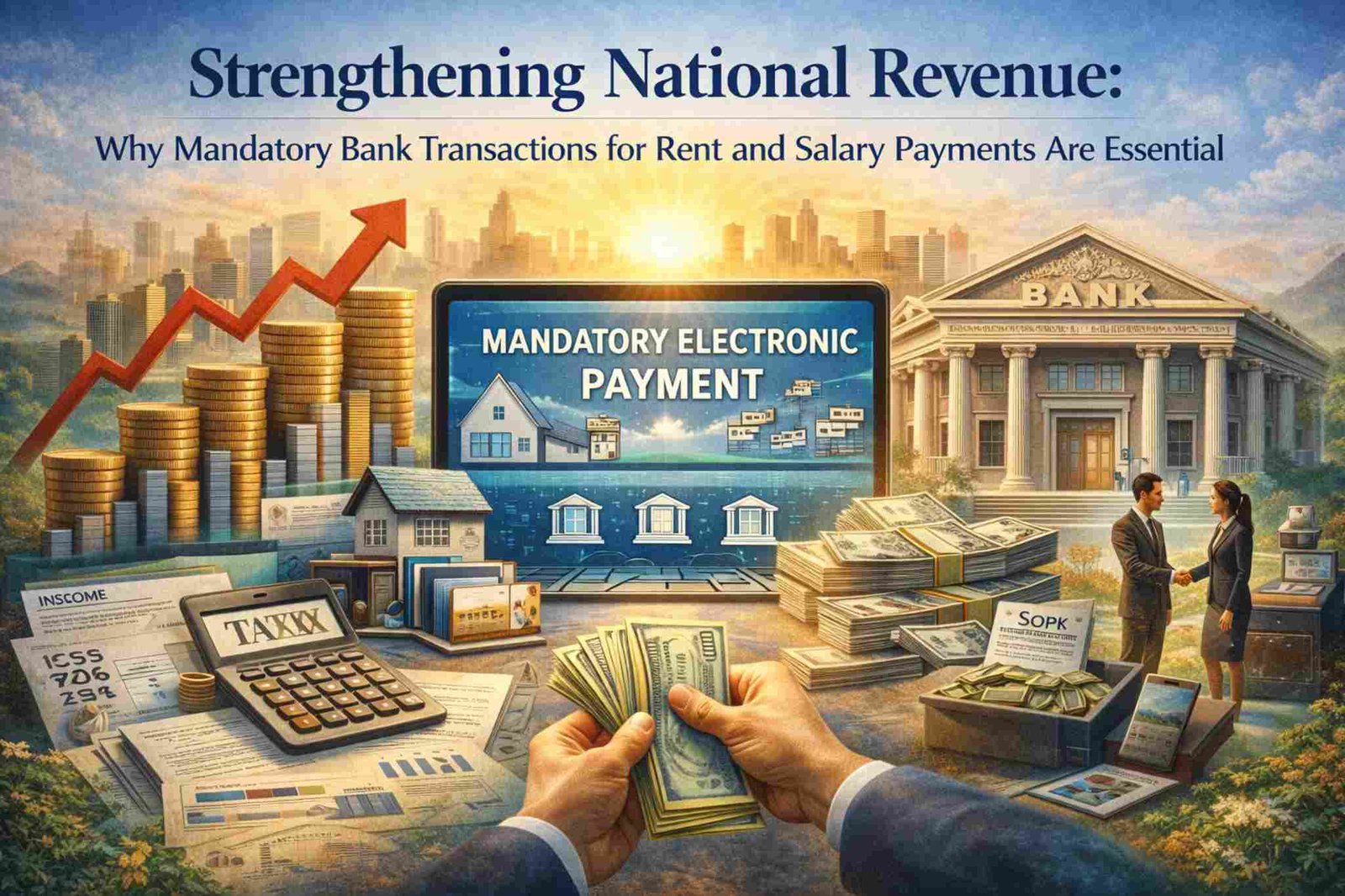
Tax revenue is the backbone of any nation’s economic stability. It funds infrastructure, healthcare, education, social protection programs, and national security. Yet in many developing economies, tax collection remains significantly below potential due to informality, cash-based transactions, and weak documentation systems.
One of the most practical and transformative reforms to increase tax revenue collection is simple but powerful: ensure that house rent, office rent, shop rent, and salary payments are made exclusively through bank accounts.
This reform directly addresses tax evasion, expands the formal economy, and strengthens financial transparency. It is not merely a financial adjustment; it is a structural reform capable of reshaping national revenue systems.
The Problem: Cash-Based Informal Transactions
In many countries, especially in South Asia and parts of Africa, a large portion of economic activity remains outside the formal banking system. House rents are paid in cash. Shop rentals are settled informally. Office leases are underreported. Salaries are sometimes paid without documentation.
This creates several serious issues:
- Tax Evasion Becomes Easy – Cash transactions leave little trace, making it difficult for tax authorities to verify actual income.
- Underreporting of Rental Income – Property owners may declare only a portion of rental income.
- Unrecorded Employment – Employers may understate salary expenses or avoid payroll taxes.
- Weak Financial Data – Governments lack accurate data for economic planning.
As a result, governments face revenue shortages, forcing them to borrow more or increase indirect taxes that burden ordinary citizens.
The Solution: Mandatory Bank-Based Transactions
Requiring all house rent, office rent, shop rent, and salary payments to be made through bank accounts creates a traceable and transparent financial ecosystem.
When payments move through formal banking channels:
- Every transaction is recorded.
- Income becomes verifiable.
- Tax authorities can cross-check data.
- The economy gradually formalizes.
This reform does not increase tax rates. Instead, it increases compliance.
How Bank Transactions Increase Tax Revenue
1. Transparent Rental Income Tracking
Rental income is often a major source of undeclared earnings. By mandating bank transfers:
- Monthly rent deposits create clear income records.
- Property owners cannot easily underreport income.
- Automated data matching between banks and tax authorities becomes possible.
This significantly expands the tax base without introducing new taxes.
2. Formalizing Salary Payments
Salary payments through bank accounts ensure:
- Payroll transparency
- Proper income tax deduction at source
- Social security and provident fund contributions
- Accurate employee income reporting
Cash salary systems allow businesses to understate payroll costs and avoid tax obligations. Bank payments reduce such practices.
3. Strengthening Financial Inclusion
Mandatory banking for rent and salaries encourages citizens to:
- Open bank accounts
- Use digital payments
- Build credit histories
- Access financial services
Financial inclusion stimulates economic growth and expands taxable economic activity.
4. Improving Economic Data Accuracy
Governments rely on economic data for policy decisions. Bank-based transactions provide real-time financial insights, allowing:
- Better GDP estimation
- Improved fiscal planning
- Targeted subsidy allocation
- Smarter monetary policy
A data-driven economy is more stable and efficient.
Digital Economy and Cashless Transition
Moving toward mandatory bank transactions aligns with global trends toward digital economies.
Digital payments:
- Reduce corruption
- Decrease transaction costs
- Improve efficiency
- Increase security
Mobile banking, internet banking, and digital wallets can support this transition, especially in rural areas.
However, implementation must be gradual and inclusive to avoid disruption.
International Examples
Several countries have successfully improved tax compliance by reducing cash-based transactions:
- Sweden and other Nordic countries operate largely cashless economies with high tax compliance.
- India’s digital payment push significantly increased the number of formal transactions.
- South Korea’s electronic tax invoicing system improved revenue transparency.
These examples demonstrate that digital financial systems strengthen tax collection efficiency.
Economic Benefits Beyond Tax Collection
Mandatory bank transactions offer broader economic advantages:
1. Reduced Corruption
Cash-based systems enable bribery and hidden income. Digital trails discourage corrupt practices.
2. Lower Risk of Theft
Cash handling increases physical risk. Bank transfers improve security.
3. Easier Loan Access
Recorded income allows individuals and businesses to qualify for bank loans.
4. Stronger Investment Climate
Transparent financial systems attract foreign investment.
Addressing Implementation Challenges
Transitioning to mandatory bank-based transactions requires careful planning.
1. Expand Banking Infrastructure
Rural areas must have access to banking services and digital payment systems.
2. Reduce Transaction Costs
Banks should minimize service fees to encourage compliance.
3. Strengthen Data Privacy
Financial data protection laws must safeguard citizens’ privacy.
4. Public Awareness Campaigns
Citizens must understand the benefits of formal transactions.
Policy Framework for Implementation
A successful reform strategy could include:
- Mandatory bank transfer for all rent above a specified threshold.
- Mandatory payroll bank transfer for all registered businesses.
- Tax incentives for compliant property owners.
- Penalties for large cash-based rental transactions.
- Integration of bank data with tax systems.
- Digital payment promotion campaigns.
Gradual implementation ensures economic stability.
Impact on National Revenue
Even modest compliance improvements can significantly increase revenue.
If:
- 30% of rental income currently goes undeclared,
- 20% of salary payments are partially hidden,
Formalizing these sectors could increase tax collection substantially without raising tax rates.
Increased revenue allows governments to:
- Invest in infrastructure
- Improve education systems
- Expand healthcare
- Reduce public debt
Thus, financial transparency directly supports national development.
Supporting Small Businesses During Transition
Small businesses may initially resist due to fear of higher tax burden. Government support can include:
- Simplified tax filing systems
- Reduced compliance complexity
- Training on digital payments
- Temporary tax incentives for formalization
Formalization should not be punitive; it should be supportive.
Long-Term Cultural Change
Moving away from cash requires cultural transformation. Trust in institutions must increase. Citizens must see tangible benefits from improved tax collection, such as better public services.
When people observe improved infrastructure, safety, and social programs funded by tax revenue, compliance becomes socially accepted.
Economic Stability and Fiscal Strength
A strong revenue base reduces reliance on external borrowing. It improves credit ratings, lowers interest costs, and strengthens national sovereignty.
Countries with stable tax systems can withstand economic shocks more effectively.
Conclusion: Transparency as the Foundation of Growth
To increase tax revenue collection sustainably, governments must focus on compliance rather than rate hikes. Ensuring that house rent, office rent, shop rent, and salary payments are made exclusively through bank accounts is a practical, high-impact reform.
This policy:
- Expands the tax base
- Reduces evasion
- Formalizes the economy
- Improves financial inclusion
- Strengthens governance
Economic reform begins with transparency. A traceable financial system builds trust, improves accountability, and generates the revenue necessary for national progress.
A stronger tax system does not begin with higher taxes. It begins with smarter systems.
By mandating bank-based transactions for rent and salary payments, governments can transform informal economies into transparent, growth-driven systems — laying the foundation for sustainable national development.


