


Poverty remains one of the most persistent challenges facing humanity. Despite technological advancement, global trade expansion, and economic growth in many regions, millions of people still struggle to meet basic needs. Poverty is not simply a shortage of income; it is a shortage of opportunity, access, empowerment, and structured support. Sustainable poverty reduction requires more than temporary financial aid — it requires systemic transformation.
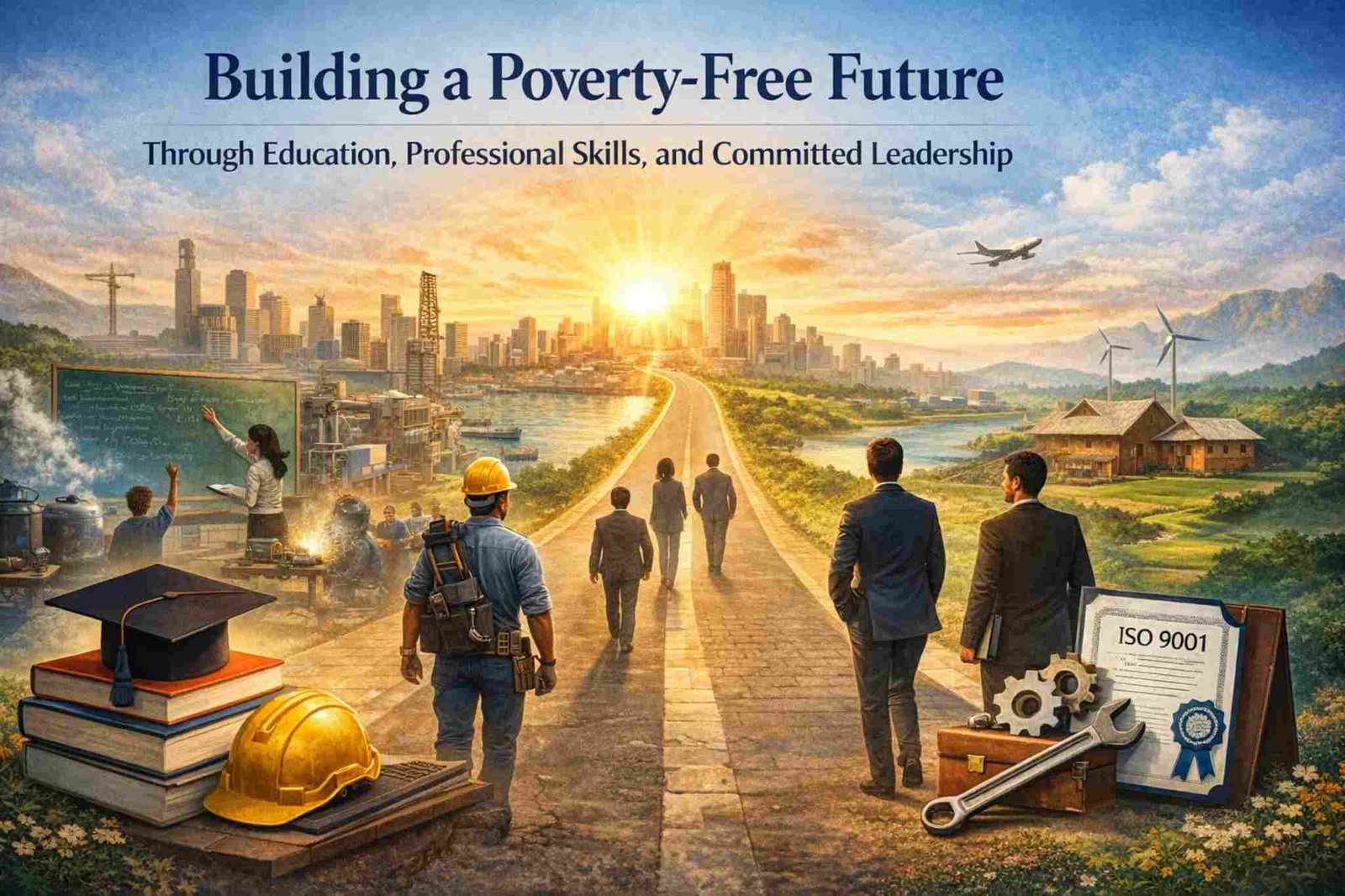
A poverty-free future can be built on three powerful foundations: Education, Professional Skills, and Committed Leadership. When these elements are integrated into national policy and community practice, they create long-term prosperity rather than short-lived relief.
Education: The Cornerstone of Empowerment
Education is the starting point of transformation. It equips individuals with the knowledge, awareness, and critical thinking skills necessary to improve their lives. An educated population is better able to make informed decisions about health, finance, career choices, and civic participation.
Access to quality education reduces inequality. Children from disadvantaged families who receive proper schooling are more likely to secure stable employment, break intergenerational poverty cycles, and contribute to national development. Education enhances confidence, broadens perspective, and fosters innovation.
However, the value of education lies not merely in enrollment rates, but in quality. Education systems must adapt to modern economic realities. Students need analytical skills, digital literacy, communication abilities, and problem-solving competence. Memorization-based systems cannot prepare learners for a competitive global economy.
Moreover, inclusive education is essential. Girls’ education, rural schooling, and access for marginalized communities dramatically increase economic participation. When women and disadvantaged groups receive equal learning opportunities, family income rises, health outcomes improve, and national productivity expands.
Investment in education yields long-term economic dividends. Nations that prioritize schooling build human capital — the most valuable asset in a knowledge-driven economy.
Professional Skills: Converting Knowledge into Economic Power
While education builds awareness, professional skills create income. A major cause of persistent poverty is the mismatch between academic qualifications and market demands. Many graduates struggle to find employment because they lack practical, job-ready skills.
Professional skill development bridges this gap. Technical training in manufacturing, engineering, information technology, healthcare, construction, renewable energy, agriculture, and entrepreneurship directly connects individuals to economic opportunity.
Vocational training institutions and industry-aligned certification programs play a critical role in workforce development. When training programs are designed in collaboration with industry leaders, graduates enter the workforce prepared to contribute immediately.
Professional skills also encourage entrepreneurship. Skilled individuals can launch small enterprises, provide services, and generate employment within their communities. This decentralized economic growth strengthens local economies and reduces urban migration pressure.
Furthermore, skill development increases national competitiveness. Countries with skilled labor forces attract foreign investment, expand exports, and strengthen industrial capacity. When workforce productivity rises, wages increase, and poverty declines.
Digital skills deserve special attention in the modern era. Access to online education, freelancing platforms, remote work, and digital entrepreneurship allows individuals to participate in global markets regardless of geographic location. Technology democratizes opportunity when supported by proper training and infrastructure.
Professional skill development must therefore be continuous. Lifelong learning ensures that workers adapt to technological change and evolving industry standards.
Committed Leadership: Transforming Vision into Action
Education and skills alone cannot eliminate poverty without effective leadership. Policies must be implemented, resources must be managed responsibly, and long-term strategies must be sustained beyond political cycles.
Committed leadership means prioritizing national development over personal interest. It means creating transparent governance systems, reducing corruption, and ensuring accountability in public spending. When public funds are invested efficiently in education, infrastructure, healthcare, and industrial growth, economic benefits multiply.
Leadership at every level matters — from national policymakers to institutional administrators, corporate executives, and community organizers. Strong leadership establishes measurable goals, monitors progress, and corrects inefficiencies.
History demonstrates that countries achieving rapid poverty reduction often benefited from disciplined leadership. Long-term industrial strategies, education reform, infrastructure development, and consistent policy implementation require determination and persistence.
Committed leadership also builds public trust. Citizens are more willing to participate in economic initiatives, invest in businesses, and comply with regulations when governance systems are fair and transparent.
Furthermore, leadership must be inclusive. Poverty reduction policies must prioritize youth employment, women’s empowerment, rural development, and small business support. When development benefits are widely distributed, social stability improves and economic growth becomes sustainable.
The Interconnection Between Education, Skills, and Leadership
These three pillars do not operate independently. Their strength lies in integration.
Education creates informed citizens capable of learning advanced skills. Professional skills generate income and economic productivity. Committed leadership ensures systems function efficiently and fairly.
Without education, skill development remains limited. Without skills, education cannot translate into economic power. Without leadership, both education and skills fail to produce systemic change.
Together, they create a virtuous cycle:
- Educated individuals pursue skill development.
- Skilled individuals contribute to economic growth.
- Effective leadership reinvests economic gains into education and innovation.
This cycle gradually eliminates poverty through empowerment rather than dependency.
Industrial Growth and Employment Generation
Sustainable poverty reduction requires economic expansion. Industrial growth provides employment opportunities, increases exports, and strengthens national revenue.
Governments must create favorable business environments by simplifying regulations, improving infrastructure, and ensuring reliable energy supply. Private sector investment in manufacturing, technology, and service industries generates large-scale employment.
Small and medium enterprises (SMEs) deserve particular support. They often employ significant portions of the workforce and stimulate local economies. Access to credit, business training, and digital tools empowers entrepreneurs to expand operations.
Employment stability is critical for poverty reduction. Consistent income allows families to invest in education, healthcare, and housing — creating upward mobility over time.
Rural Development and Decentralized Opportunity
In many developing nations, poverty is concentrated in rural areas. Lack of infrastructure, limited access to markets, and insufficient training opportunities hinder rural prosperity.
Decentralized education and skill training centers can reduce rural poverty. Agricultural modernization, agro-processing industries, renewable energy projects, and rural entrepreneurship programs create local economic ecosystems.
When rural youth gain access to professional skills, migration pressure on cities decreases. Balanced regional development ensures inclusive growth.
Ethical Governance and Accountability
Economic growth alone does not guarantee poverty elimination. Growth must be inclusive and transparent. Ethical governance ensures that development benefits reach intended communities.
Anti-corruption measures, transparent procurement processes, digital financial systems, and public accountability mechanisms strengthen institutional trust. Data-driven monitoring of poverty reduction programs improves efficiency.
Ethical leadership also fosters social cohesion. When citizens believe that opportunities are distributed fairly, social conflict decreases and cooperation increases.
The Role of Technology and Innovation
Technology accelerates poverty reduction by expanding access to education, financial services, healthcare, and employment.
Online learning platforms increase educational reach. Mobile banking improves financial inclusion. E-commerce platforms allow small businesses to access global markets. Renewable energy technologies provide affordable power to remote communities.
Innovation-driven economies generate high-value jobs. Investment in research and development enhances national competitiveness and economic resilience.
Transforming Mindsets: From Dependence to Empowerment
Sustainable poverty alleviation requires a cultural shift. Instead of relying solely on assistance, individuals and institutions must embrace productivity and continuous improvement.
Education nurtures critical thinking. Skill development builds confidence. Leadership cultivates discipline and responsibility. Together, they promote a culture of empowerment.
Communities that prioritize self-improvement and cooperation progress faster than those dependent on external aid.
Policy Recommendations for Sustainable Poverty Reduction
To build a poverty-free future, governments and institutions should consider:
- Increasing investment in quality education and teacher training.
- Aligning vocational training with industry needs.
- Expanding digital infrastructure and internet access.
- Supporting SMEs and entrepreneurship.
- Strengthening anti-corruption mechanisms.
- Promoting inclusive policies for women and youth.
- Encouraging public-private partnerships.
- Establishing measurable poverty reduction targets.
- Implementing continuous monitoring and evaluation systems.
- Promoting ethical leadership development programs.
Conclusion: A Future Built on Strength and Integrity
Poverty is not an unsolvable problem. It is a challenge that demands structured solutions and unwavering commitment.
Building a poverty-free future requires more than financial assistance. It requires educating minds, developing professional competence, and nurturing committed leadership. These pillars create empowerment, stability, and opportunity.
When nations invest in human capital, uphold ethical governance, and maintain disciplined leadership, poverty declines steadily. Education empowers individuals. Professional skills generate income. Committed leadership ensures progress continues.
The path forward is clear. Empower people with knowledge. Equip them with professional skills. Lead with integrity and dedication.
A poverty-free future is not a dream — it is a disciplined, achievable outcome when education, skills, and leadership work together in harmony.


