


In the modern global economy, leading a multinational corporation is one of the most complex and demanding responsibilities in business. A CEO today does not merely oversee operations; they guide strategy across continents, manage diverse cultures, ensure regulatory compliance in multiple jurisdictions, drive technological transformation, and maintain investor confidence in volatile markets.
The title “CEO” is not simply a position of authority — it is a position of accountability.
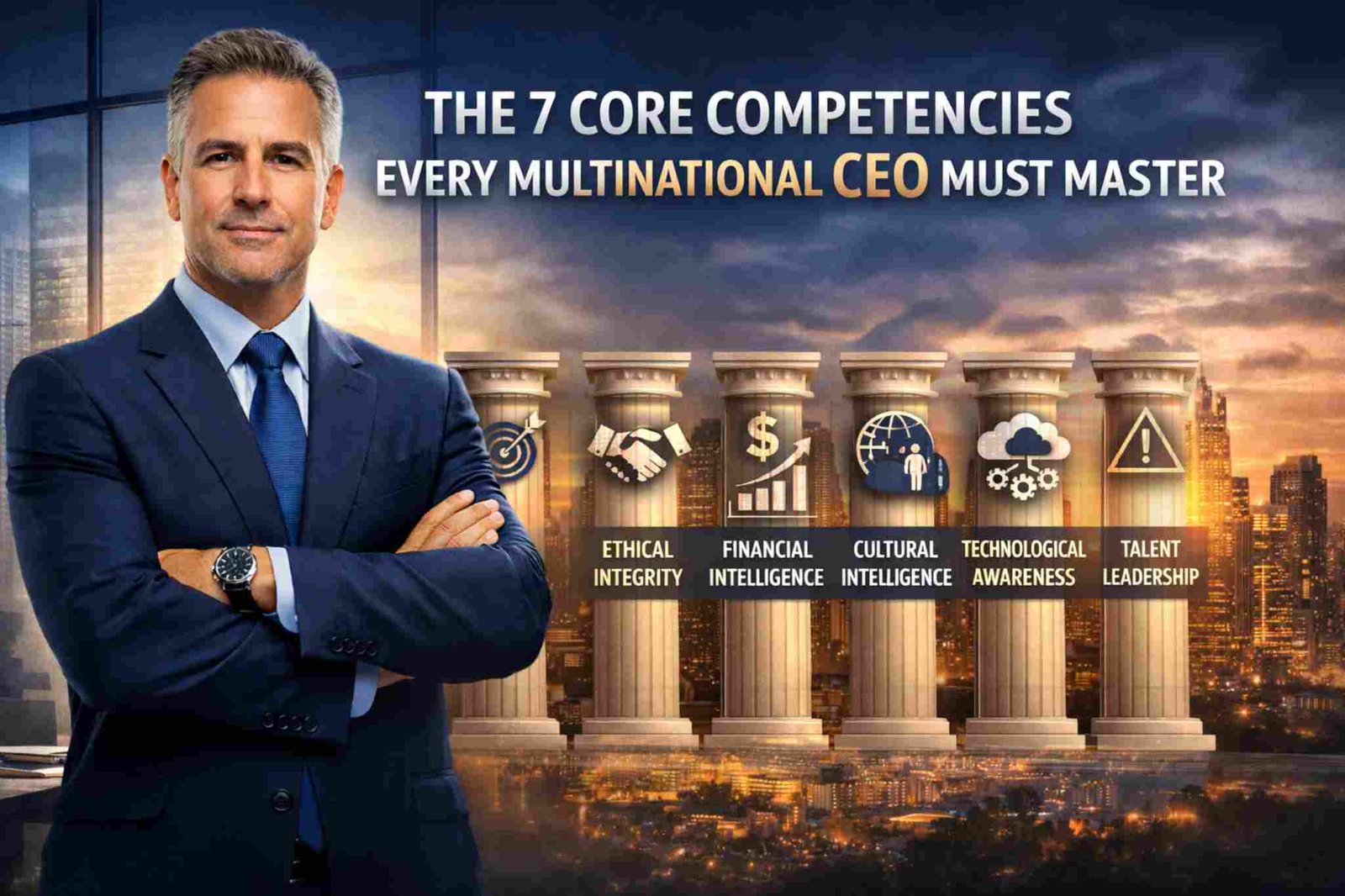
To lead successfully at this level, certain competencies are non-negotiable. While technical knowledge and industry experience are important, sustainable corporate leadership depends on mastering seven core competencies. These competencies differentiate average executives from transformative global leaders.
This article explores the 7 Core Competencies Every Multinational CEO Must Master to lead effectively in an increasingly complex world.
1. Strategic Vision and Long-Term Thinking
A multinational CEO must see beyond the present. Strategy is not about reacting to daily issues; it is about shaping the future.
Strategic vision includes:
- Identifying global market trends
- Anticipating industry disruption
- Understanding geopolitical risk
- Forecasting technological evolution
- Aligning long-term goals with organizational capability
In multinational operations, markets shift rapidly. Currency fluctuations, trade policies, digital transformation, and emerging competitors can quickly alter the business landscape.
A CEO must constantly ask:
- Where will the industry be in 5–10 years?
- What threats are approaching?
- What opportunities are emerging?
Without strategic foresight, companies become reactive rather than proactive.
True strategic leaders do not wait for disruption. They prepare for it.
2. Ethical Integrity and Corporate Governance
Reputation is one of the most valuable assets of any multinational company. It takes decades to build and minutes to destroy.
Ethical integrity includes:
- Transparent financial reporting
- Strong compliance systems
- Anti-corruption frameworks
- Responsible sourcing policies
- Accountability in decision-making
Multinational corporations operate under multiple regulatory systems. Failure in compliance can lead to legal penalties, investor distrust, and reputational damage.
An ethical CEO ensures:
- Strong internal controls
- Clear governance structures
- Independent oversight mechanisms
- Whistleblower protection systems
Integrity is not optional at this level. It defines sustainability.
Companies led by ethical CEOs attract better investors, stronger employees, and loyal customers.
3. Financial Intelligence and Capital Allocation
A CEO must understand finance at a strategic level.
This does not mean performing accounting tasks, but mastering:
- Profitability analysis
- Cash flow management
- Capital investment decisions
- Risk-adjusted return evaluation
- Debt and equity structures
- Shareholder value creation
Multinational decisions often involve billions of dollars — acquisitions, global expansions, infrastructure investment, research and development funding.
A financially intelligent CEO ensures capital is allocated where it generates long-term value, not short-term headlines.
Financial discipline protects organizations during downturns and enables growth during expansion cycles.
Without financial competence, strategic vision cannot be executed.
4. Global Cultural Intelligence and Adaptability
Multinational corporations operate across diverse cultures, languages, and regulatory systems.
A CEO must possess cultural intelligence:
- Respecting local norms
- Understanding regional business practices
- Managing cross-border teams
- Negotiating internationally
- Balancing global consistency with local flexibility
Leadership style that works in one country may fail in another.
A globally competent CEO adapts communication, management approach, and operational strategy based on cultural realities while maintaining unified corporate values.
Cultural ignorance leads to internal conflict and external misunderstanding.
Adaptability strengthens global cohesion.
5. Technological Awareness and Digital Transformation Leadership
The modern CEO must understand digital transformation.
Technology influences:
- Supply chains
- Customer engagement
- Data analytics
- Artificial intelligence
- Automation
- Cybersecurity
Ignoring technological evolution places organizations at risk of obsolescence.
A digitally aware CEO does not need to be a programmer but must understand:
- ERP systems
- Cloud infrastructure
- Data-driven decision-making
- Automation strategy
- Digital risk management
Technology is no longer a support function — it is a strategic driver.
CEOs who embrace digital transformation create competitive advantage. Those who resist it accelerate decline.
6. Talent Development and Organizational Leadership
A CEO does not operate alone. Organizational success depends on people.
Talent leadership includes:
- Building high-performance executive teams
- Identifying future leaders
- Succession planning
- Creating performance-driven culture
- Encouraging innovation
Multinational corporations often employ thousands or even hundreds of thousands of people.
The CEO must ensure:
- Clear communication of vision
- Strong leadership alignment
- Employee engagement
- Ethical workplace culture
- Diversity and inclusion
People perform better when they trust leadership.
Great CEOs do not control people — they empower them.
Leadership is influence, not authority.
7. Crisis Management and Resilience
Every multinational corporation faces crises:
- Economic downturns
- Political instability
- Supply chain disruption
- Cybersecurity threats
- Regulatory changes
- Global pandemics
Crisis reveals leadership strength.
Resilient CEOs demonstrate:
- Calm decision-making under pressure
- Transparent communication
- Swift strategic adjustment
- Strong stakeholder coordination
In crisis situations, four elements become visible:
- Strategic clarity
- Ethical consistency
- Emotional control
- Decisive execution
Resilience ensures survival.
Strong leaders convert crisis into opportunity for improvement.
Integrating the 7 Competencies
Each competency supports the others.
Strategic vision without financial intelligence is unrealistic.
Financial intelligence without ethical integrity is dangerous.
Technology leadership without talent development is ineffective.
Cultural intelligence without resilience is fragile.
The most successful multinational CEOs integrate all seven competencies into a balanced leadership framework.
They think globally.
They act ethically.
They allocate wisely.
They adapt intelligently.
They lead digitally.
They empower people.
They remain resilient.
The Evolution of Modern CEO Expectations
In the past, CEOs focused primarily on profit maximization.
Today, expectations have expanded to include:
- Environmental sustainability
- Workplace safety
- Corporate social responsibility
- Diversity and inclusion
- Stakeholder capitalism
Modern CEOs must balance profitability with responsibility.
Investors now evaluate ESG (Environmental, Social, Governance) performance alongside financial results.
Leadership today is multidimensional.
Building These Competencies
Becoming a multinational CEO does not happen overnight. It is the result of years of preparation.
Future CEOs can develop these competencies by:
- Taking cross-functional roles
- Managing international projects
- Studying finance deeply
- Building governance knowledge
- Learning global regulatory frameworks
- Embracing digital transformation early
- Leading diverse teams
Experience builds perspective.
Perspective builds judgment.
Judgment builds leadership.
The CEO Mindset Shift
The transition to multinational CEO requires a mindset transformation:
From operational focus → to strategic direction
From personal performance → to organizational success
From authority → to responsibility
From short-term targets → to long-term value
The higher the role, the greater the accountability.
Leadership at this level is service, not privilege.
Conclusion: Mastery Defines Leadership
The global business environment is volatile, complex, and competitive.
Only leaders who master these seven core competencies can sustain long-term multinational success:
- Strategic Vision
- Ethical Integrity
- Financial Intelligence
- Cultural Intelligence
- Technological Awareness
- Talent Leadership
- Crisis Resilience
Together, these competencies form the foundation of responsible, sustainable, and transformative corporate leadership.
A multinational CEO is not merely a manager of resources. They are:
- Architects of long-term strategy
- Guardians of corporate reputation
- Stewards of capital
- Champions of innovation
- Mentors of future leaders
- Protectors of organizational stability
Mastering these competencies is not optional — it is essential.
The world does not need more executives.
It needs responsible, visionary, and ethical leaders.
And those who commit to mastering these seven competencies will not only lead corporations — they will shape industries and influence global progress.


