



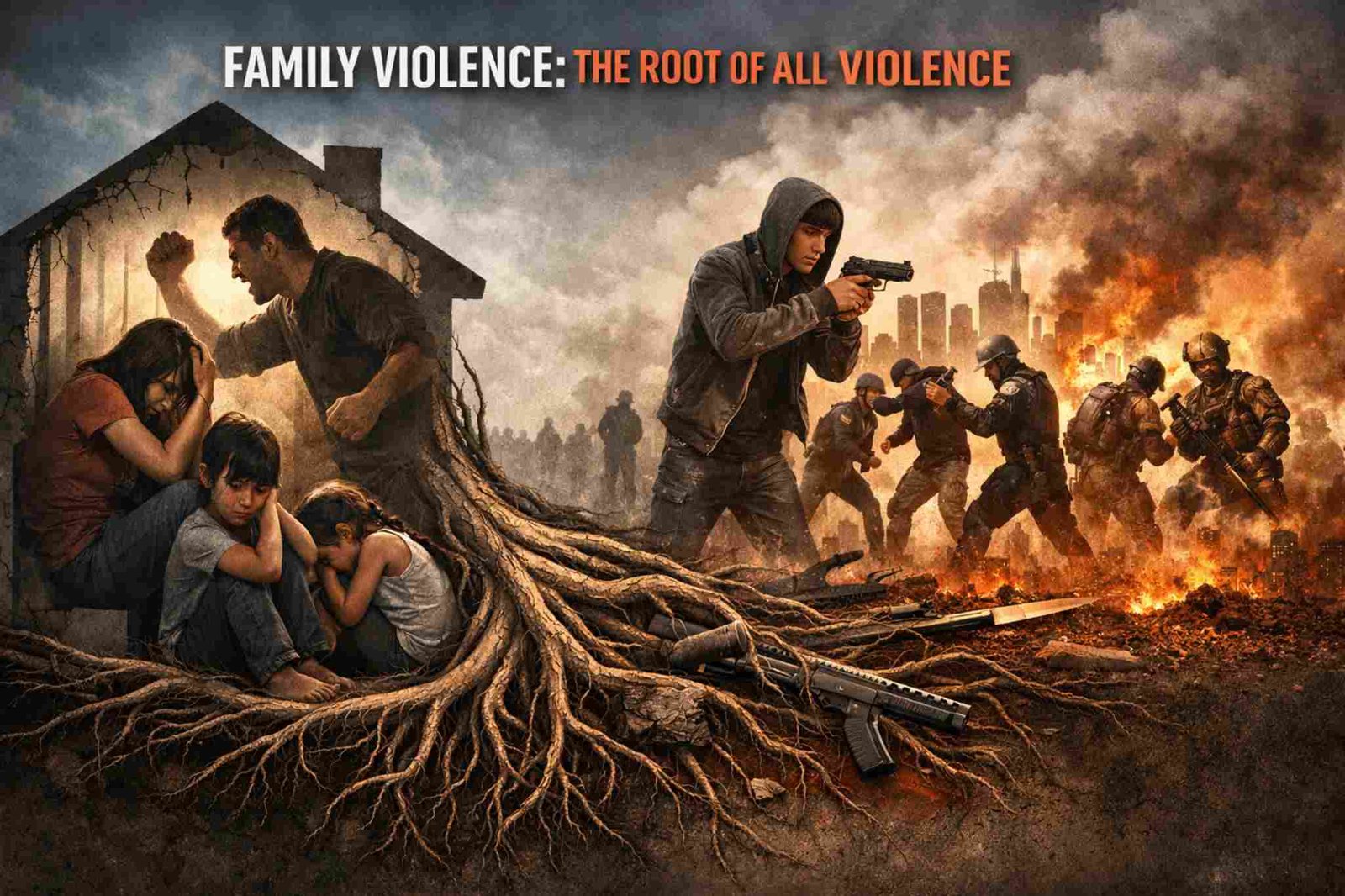
Violence rarely begins on the streets. It rarely starts in politics, in gangs, or in war rooms. More often, it begins quietly—behind closed doors, inside homes that should have been safe. Family violence, whether physical, emotional, psychological, or verbal, plants the earliest seeds of aggression in the human heart. When a child grows up witnessing fear, humiliation, and abuse, those experiences shape how they understand power, relationships, and conflict. In this way, family violence becomes the hidden foundation from which broader social violence grows.
The Home: A Child’s First School of Behavior
The family is the first classroom of life. Before schools teach reading and writing, before society teaches laws and rules, children learn from their parents and caregivers. They observe how adults speak to one another, how disagreements are handled, how anger is expressed, and how love is demonstrated.
If a child repeatedly witnesses shouting, hitting, threats, or emotional manipulation, they begin to normalize those behaviors. What is repeated becomes familiar; what is familiar becomes acceptable. A child who sees violence as a tool for control may grow into an adult who uses aggression to resolve conflict. Thus, the home becomes the earliest training ground for either peace or hostility.
Psychological Impact on Children
Family violence leaves deep psychological scars. Children exposed to domestic conflict often experience anxiety, fear, depression, and insecurity. Their sense of safety is broken. The people who are supposed to protect them become the source of danger. This contradiction creates emotional confusion and trauma.
Research across the world consistently shows that children who grow up in violent households are more likely to exhibit aggressive behavior in school, struggle with emotional regulation, and develop trust issues in adulthood. Many become either perpetrators or victims of violence later in life. The cycle continues because the trauma was never addressed at its root.
Violence as a Learned Behavior
Human beings learn through observation and imitation. When a child sees that anger leads to dominance or that fear leads to obedience, they internalize these patterns. Violence becomes a learned strategy.
For example:
- A boy who sees his father intimidate his mother may believe masculinity equals control.
- A girl who grows up being verbally abused may believe humiliation is a normal part of relationships.
- Siblings raised in constant conflict may learn to solve disputes through physical aggression rather than communication.
These learned behaviors extend beyond the home. They appear in schools as bullying, in workplaces as harassment, and in communities as criminal violence.
From Domestic Conflict to Community Violence
Family violence does not stay confined within walls. Its effects spill into society. When large numbers of children grow up in unstable, abusive environments, communities begin to reflect that instability.
In schools, children exposed to domestic abuse are more likely to engage in fights or disruptive behavior. In neighborhoods, unresolved trauma can fuel gang involvement or substance abuse. In extreme cases, violent upbringing contributes to serious crimes. While not every abused child becomes violent, the risk increases significantly.
When families are broken by violence, society becomes fractured as well. The connection between home life and public safety is stronger than many realize.
The Intergenerational Cycle of Violence
One of the most tragic aspects of family violence is its cyclical nature. A child who grows up witnessing abuse may unconsciously replicate the same behavior as an adult. Without intervention, violence becomes generational.
Consider this cycle:
- A child witnesses parental violence.
- The child internalizes aggression as normal.
- As an adult, the child enters relationships where violence is repeated.
- The next generation grows up in the same environment.
Breaking this cycle requires awareness, education, and early intervention. Otherwise, violence becomes a family tradition rather than a family exception.
Emotional Abuse: The Invisible Violence
Family violence is not limited to physical harm. Emotional and psychological abuse can be equally destructive. Constant criticism, humiliation, threats, neglect, and manipulation erode a child’s confidence and identity.
Children who are told they are worthless may grow up with anger toward the world. Those who are constantly controlled may seek control in harmful ways. Emotional abuse shapes personality development in profound ways, often leading to long-term mental health challenges.
Because emotional abuse leaves no visible scars, it is frequently overlooked. Yet its consequences are deeply rooted in future patterns of behavior.
The Role of Poverty and Stress
Economic hardship, unemployment, and social pressure can increase tension within families. Financial stress may trigger frustration, which can escalate into conflict. However, poverty alone does not cause violence. Many low-income families maintain loving and peaceful homes.
The key difference lies in emotional intelligence, communication skills, and coping mechanisms. Families that manage stress through dialogue and mutual support build resilience. Families that respond with aggression pass on instability.
Therefore, reducing family violence requires not only economic development but also emotional education and parenting support.
Gender-Based Violence and Cultural Norms
In many societies, harmful cultural norms contribute to domestic violence. If a culture normalizes male dominance or discourages women from speaking out, abuse may go unchecked. When children observe such inequality, they absorb those beliefs.
Changing cultural attitudes toward gender roles, power, and discipline is essential. Promoting equality, respect, and shared decision-making within families builds a healthier foundation for society.
Education as Prevention
Education plays a powerful role in preventing family violence. Schools can teach conflict resolution, emotional regulation, empathy, and communication skills. Parenting programs can guide families on positive discipline and healthy relationship practices.
When parents understand child psychology and learn non-violent methods of discipline, the home environment improves. Teaching children about boundaries and respect helps them build healthier relationships later in life.
Education creates awareness, and awareness reduces repetition of harmful patterns.
Mental Health Support and Counseling
Many individuals who commit violence within families carry unresolved trauma from their own childhood. Without counseling or support, pain transforms into anger. Accessible mental health services can interrupt this transformation.
Family counseling, therapy, and community support programs provide tools to manage conflict constructively. When families seek help early, violence can be prevented before it escalates.
Law and Accountability
Strong legal frameworks are necessary to protect victims and deter abusers. Laws against domestic violence, child abuse, and neglect send a clear message that family violence is unacceptable. However, laws alone are not enough.
Enforcement must be fair and consistent. Victims must feel safe reporting abuse. Support systems—such as shelters, legal aid, and counseling—must be available.
Accountability combined with compassion and rehabilitation offers a path toward lasting change.
Media Influence and Public Awareness
Public awareness campaigns can challenge the normalization of violence within families. Media plays a powerful role in shaping attitudes. When television, film, and social platforms portray respectful relationships, they help shift cultural expectations.
Open conversations about domestic violence reduce stigma. When communities acknowledge the problem, they become more willing to address it.
Building Peace Begins at Home
If family violence is the root of broader societal violence, then peace must begin at home. A peaceful society is built from peaceful families. Respectful communication, shared responsibilities, emotional support, and positive discipline create children who grow into stable adults.
Parents who model calm conflict resolution teach children that disagreements do not require aggression. Homes that prioritize love and safety nurture empathy rather than hostility.
The Economic Cost of Family Violence
Beyond emotional suffering, family violence carries significant economic costs. Healthcare expenses, legal proceedings, lost productivity, and social services strain national resources. Preventing domestic violence is not only a moral responsibility but also an economic necessity.
Investing in family support programs, education, and mental health services ultimately reduces long-term societal costs.
Breaking the Silence
One major barrier to addressing family violence is silence. Many victims fear shame, retaliation, or social judgment. Communities must create safe spaces where victims can speak without fear.
Religious institutions, schools, community leaders, and local organizations can play vital roles in encouraging dialogue and providing assistance.
A Call for Collective Responsibility
Ending family violence requires collective effort. Governments must strengthen policies and support services. Educational institutions must teach emotional intelligence. Communities must promote healthy cultural norms. Families must commit to respectful relationships.
No single solution can eliminate violence entirely, but addressing it at its origin—the family—offers the most effective starting point.
Conclusion: Healing the Root to Heal the World
Violence in society is not random; it often reflects patterns formed in childhood. When homes are filled with fear, society absorbs that fear. When homes are filled with respect, society reflects that respect.
Family violence is indeed the root from which many other forms of violence grow. To create safer communities, stronger nations, and a more peaceful world, we must nurture safe and loving homes. Healing begins not in courtrooms or battlefields, but in living rooms, kitchens, and bedrooms where children form their first understanding of human relationships.
If we transform the family environment—replacing aggression with understanding and control with compassion—we plant the seeds of peace. And from those seeds, a non-violent society can truly grow.


