



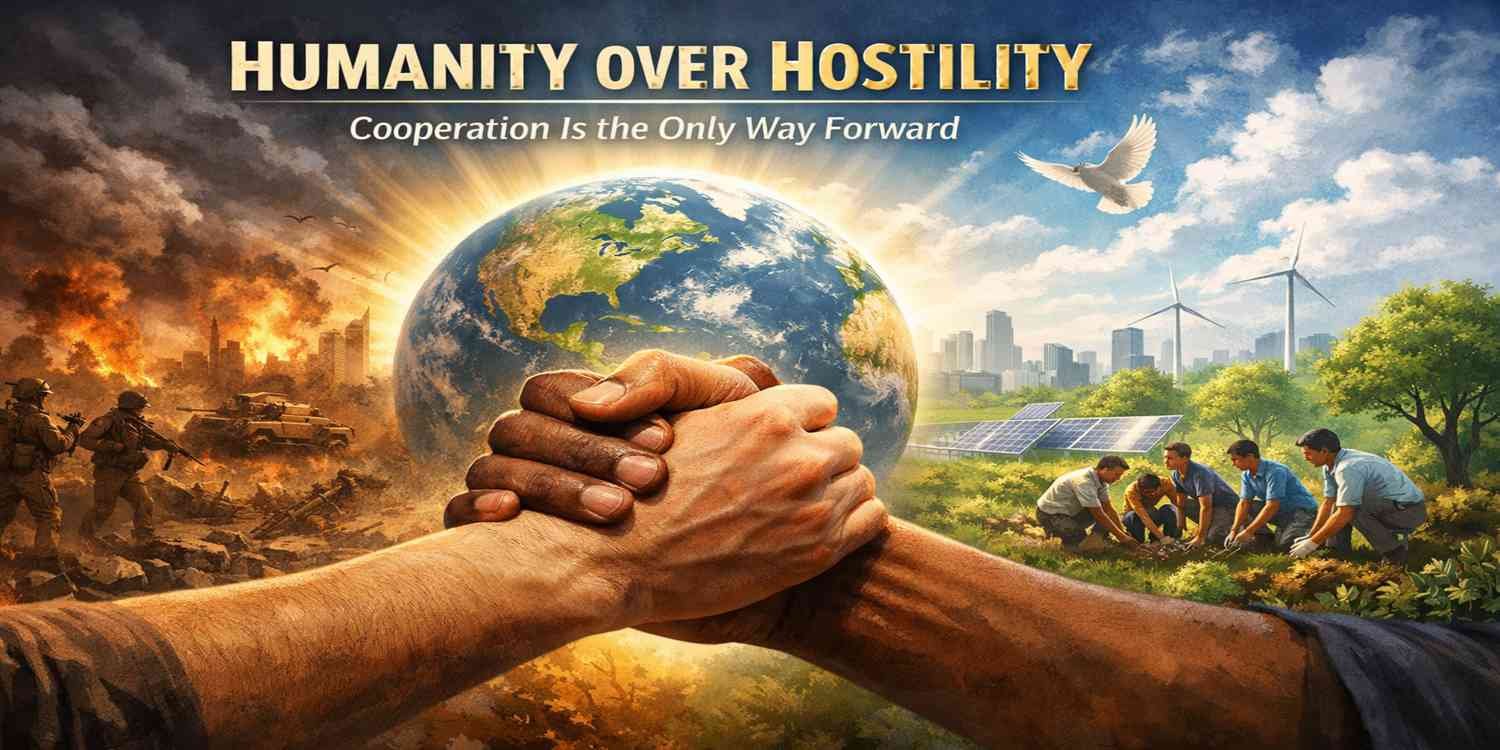
In every era of history, humanity has stood at crossroads where choices defined its future. Today, the world faces one of the most critical crossroads of all time. Climate change, wars, economic inequality, pandemics, technological disruption, and social fragmentation threaten not just nations, but the very idea of a shared human future. Yet despite facing common dangers, humanity continues to respond with hostility—division over dialogue, power over principle, and competition over cooperation.
This path is not only morally flawed; it is dangerously unsustainable. The reality is simple and unavoidable: humanity cannot survive through hostility. Cooperation is no longer a moral preference—it is a necessity for survival.
The Age of Shared Crises
Never before has the world been so interconnected. A virus emerging in one corner of the globe can halt economies worldwide. Carbon emissions in one country raise sea levels threatening distant nations. Financial instability in a major economy sends shockwaves across continents. Technological misuse in one region can destabilize global security.
These crises do not recognize borders, religions, ideologies, or races. They affect farmers and factory workers, children and elders, rich and poor alike. Yet the global response to shared crises often remains fragmented—countries hoarding resources, leaders blaming rivals, societies retreating into “us versus them” narratives.
This contradiction defines our era: global problems met with local selfishness.
And it is precisely why humanity continues to stumble instead of advance.
Hostility Has Never Been a Sustainable Strategy
History offers countless examples of civilizations that collapsed under the weight of internal conflict and external aggression. Empires rose through cooperation—organized labor, shared values, collective purpose—but fell when greed, division, and power struggles overtook unity.
Wars have never solved humanity’s deepest problems. They redistribute suffering, destroy infrastructure, traumatize generations, and divert resources away from education, healthcare, and innovation. Even the “victors” of wars inherit broken societies and long-term instability.
Hostility may offer short-term control, but it guarantees long-term loss.
When nations compete instead of collaborate, they duplicate failures instead of sharing solutions. When communities fight internally, they weaken themselves against external challenges. When individuals prioritize ego over empathy, societies fracture.
Hostility consumes energy; cooperation multiplies it.
Cooperation: Humanity’s Greatest Survival Tool
From an evolutionary perspective, cooperation is not weakness—it is humanity’s greatest strength. Early humans survived not because they were the strongest animals, but because they worked together. They shared food, knowledge, protection, and responsibility.
Every major advancement in civilization—agriculture, cities, science, medicine, education—was born from collective effort. Knowledge itself is a cooperative achievement, built across generations and cultures.
Even modern technological breakthroughs depend on global cooperation: scientists sharing data, engineers building on each other’s work, nations collaborating on research.
When humanity cooperates, progress accelerates. When it competes destructively, progress stalls—or reverses.
The Illusion of Power Through Division
Many political, economic, and social systems continue to thrive on division. Fear is used as a tool. Differences are exaggerated. Identity is weaponized. People are taught to see neighbors as threats rather than partners.
This strategy benefits a small number of power holders while weakening societies as a whole. Divided people are easier to control. Distracted societies are easier to exploit. Angry populations are less likely to demand accountability.
But division comes at a terrible cost: eroded trust, rising mental health crises, broken communities, and a generation growing up without faith in institutions or humanity itself.
True power does not come from dominating others.
True power comes from building systems where everyone has a stake in survival and success.
Cooperation in the Face of Global Challenges
Climate Change
No country can solve climate change alone. Emissions reduction, renewable energy development, disaster preparedness, and environmental protection require shared responsibility. When nations delay action or prioritize short-term profit, the cost is paid globally—often by the poorest and most vulnerable.
Public Health
The COVID-19 pandemic exposed both the strength and weakness of global cooperation. Where information was shared and resources coordinated, lives were saved. Where nationalism and misinformation dominated, suffering multiplied.
Economic Inequality
Extreme inequality fuels instability, crime, migration crises, and social unrest. Cooperative economic models—fair trade, responsible supply chains, shared innovation—can lift entire regions instead of concentrating wealth in a few hands.
Technology and Artificial Intelligence
Technology can either deepen inequality or enhance human potential. Without cooperative global ethics, AI and automation risk becoming tools of exploitation rather than empowerment.
Each of these challenges reinforces the same truth: fragmented solutions fail; cooperative solutions endure.
Relearning Empathy in a Polarized World
Empathy is the foundation of cooperation. Yet modern society often discourages empathy, replacing it with outrage, speed, and superficial judgment—especially in digital spaces.
People are reduced to labels. Complex human experiences are simplified into slogans. Dialogue is replaced by debate, and debate by attack.
Relearning empathy does not mean abandoning principles. It means recognizing the humanity in others, even when we disagree. It means understanding that behind every opinion is a lived experience shaped by circumstances, fear, hope, and survival instincts.
Empathy humanizes conflict—and once conflict is humanized, cooperation becomes possible.
Leadership Rooted in Cooperation, Not Control
The future demands a new model of leadership—one that values collaboration over confrontation and service over supremacy.
Cooperative leaders:
- Build alliances instead of enemies
- Invest in long-term well-being rather than short-term gains
- Encourage dialogue across differences
- Measure success by collective progress, not personal dominance
Such leadership is not naïve. It is strategic, resilient, and forward-thinking.
The strongest leaders are those who unite people around shared goals: dignity, sustainability, peace, and opportunity.
Education as the Seed of a Cooperative Future
Children learn cooperation before they learn competition. It is society that later teaches them to compete at all costs.
Education systems must re-center values such as collaboration, ethics, emotional intelligence, and global citizenship. Teaching science without responsibility, economics without empathy, or technology without ethics creates skilled individuals—but not humane societies.
A cooperative future begins in classrooms that teach students not just how to succeed, but how to succeed together.
Choosing Humanity Every Day
Cooperation is not only a global or political act—it is a daily personal choice.
It is choosing dialogue over argument.
Helping over hurting.
Listening over judging.
Sharing over hoarding.
Every act of cooperation, however small, strengthens the fabric of humanity. Every act of hostility weakens it.
The future will not be decided only in international summits or government offices. It will be shaped in homes, workplaces, schools, online spaces, and communities—where people either choose to stand together or tear each other apart.
Conclusion: The Only Way Forward
Humanity is running out of time for old habits and outdated mindsets. The challenges we face are too large, too interconnected, and too urgent for hostility to remain our default response.
We can continue fighting—over borders, beliefs, resources, and power—and ensure collective decline.
Or we can choose cooperation and secure a future where humanity not only survives, but thrives.
Humanity over hostility is not idealism. It is realism.
It is the only path that aligns with our shared fate on a fragile planet.
The world does not need more winners and losers.
It needs partners.
It needs courage.
It needs cooperation.
Because in the end, if humanity falls, no one wins.
-Md Khairul Alom


