



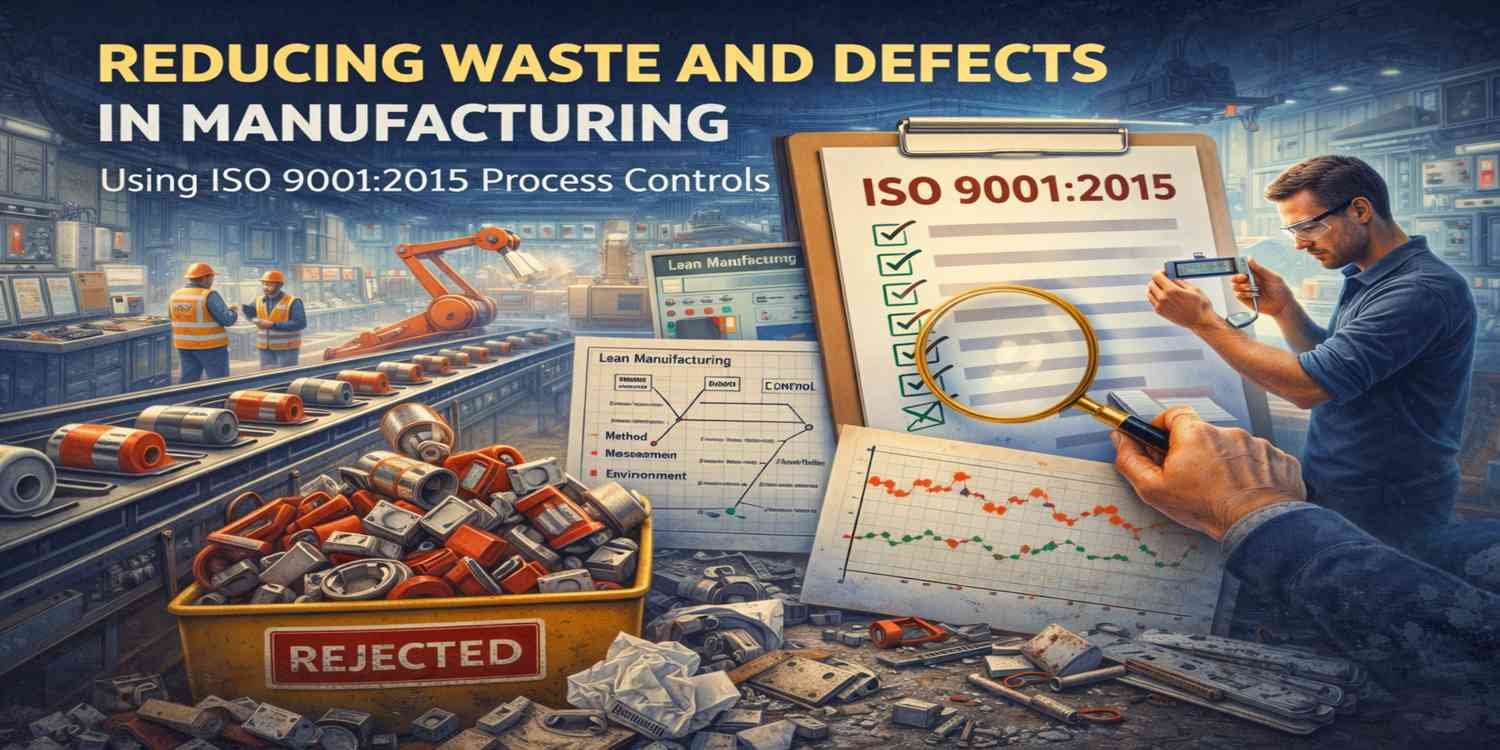
In manufacturing, waste and defects are more than quality problems—they are direct threats to profitability, customer satisfaction, and long-term sustainability. Every rejected product, rework activity, excess material, or unplanned downtime represents lost resources, lost time, and lost trust. Many organizations attempt to address these issues through inspections or stricter supervision, but such approaches often treat symptoms rather than root causes.
ISO 9001:2015 offers a far more powerful solution. Instead of relying on final inspection alone, the standard emphasizes process control, risk-based thinking, standardization, and continual improvement. When properly implemented, ISO 9001:2015 becomes a strategic tool to systematically reduce waste and defects across the entire manufacturing value chain.
This article explores how ISO 9001:2015 process controls help manufacturers minimize waste, prevent defects, improve efficiency, and achieve sustainable operational excellence.
Understanding Waste and Defects in Manufacturing
Before exploring ISO controls, it is important to understand what waste and defects actually mean in a manufacturing context.
Common Types of Waste
Manufacturing waste often includes:
- Overproduction
- Excess inventory
- Material scrap
- Rework and rejection
- Unnecessary movement or handling
- Waiting time and downtime
- Energy and utility wastage
These wastes increase production cost without adding value to the customer.
Defects as a Process Failure
Defects are not random events. They are the result of:
- Poor process design
- Lack of standardization
- Inadequate training
- Weak process controls
- Unmanaged risks
ISO 9001:2015 addresses these root causes rather than blaming individuals or relying solely on inspection.
ISO 9001:2015 and the Process Approach
At the heart of ISO 9001:2015 lies the process approach (Clause 4.4). Manufacturing activities are viewed as interconnected processes rather than isolated tasks.
Each process has:
- Inputs (materials, information, resources)
- Activities (transformation steps)
- Outputs (products or services)
- Controls (procedures, checks, criteria)
When processes are clearly defined, monitored, and controlled, variability is reduced—and so are waste and defects.
Process Mapping: The First Step Toward Waste Reduction
One of the most effective tools encouraged by ISO 9001 is process mapping.
Why Process Mapping Matters
Process mapping helps organizations:
- Visualize material and information flow
- Identify bottlenecks and duplication
- Detect non-value-added activities
- Understand handover points between departments
Many forms of waste remain hidden simply because processes are poorly understood.
ISO Clause Link
- Clause 4.4 – Quality Management System and its processes
By mapping processes from raw material receipt to finished goods dispatch, organizations can redesign workflows to reduce unnecessary movement, waiting time, and handling damage.
Standard Operating Procedures (SOPs): Preventing Variation
Uncontrolled variation is one of the biggest causes of defects. When operators perform the same task differently, outcomes become unpredictable.
Role of SOPs in ISO 9001
ISO 9001:2015 requires processes to be carried out under controlled conditions (Clause 8.5). SOPs ensure:
- Consistent methods
- Defined parameters and tolerances
- Clear responsibilities
- Reduced dependence on individual habits
Impact on Waste and Defects
Well-written SOPs:
- Reduce rework and rejection
- Minimize trial-and-error production
- Lower scrap rates
- Improve first-time-right production
Standardization does not reduce flexibility—it reduces chaos.
Risk-Based Thinking: Preventing Defects Before They Occur
One of the most powerful upgrades in ISO 9001:2015 is risk-based thinking (Clause 6.1).
From Detection to Prevention
Traditional quality systems focus on detecting defects after production. ISO 9001 shifts the focus to anticipating failures before they happen.
Examples of Manufacturing Risks
- Raw material quality variation
- Machine breakdowns
- Operator skill gaps
- Measurement errors
- Supplier reliability issues
By identifying these risks, manufacturers can implement preventive controls such as:
- Incoming material inspection plans
- Preventive maintenance schedules
- Training programs
- Process capability monitoring
Reducing defects at the source is always cheaper than correcting them later.
Control of Production and Service Provision (Clause 8.5)
Clause 8.5 is the core operational clause for manufacturing process control.
Key Control Requirements
ISO 9001:2015 requires:
- Defined production criteria
- Suitable equipment and infrastructure
- Qualified personnel
- Monitoring and measurement at appropriate stages
Practical Impact
When production parameters such as temperature, pressure, speed, or dimensions are controlled and monitored:
- Process drift is minimized
- Out-of-spec production is prevented
- Scrap generation decreases
- Rework costs fall significantly
Controlled processes produce predictable results—and predictable results reduce waste.
Equipment Maintenance and Process Stability
Unplanned machine downtime and equipment malfunction are major sources of waste.
ISO Requirements
- Clause 7.1.3 – Infrastructure
- Clause 8.5.1 – Controlled conditions
ISO 9001 requires organizations to maintain infrastructure necessary for conformity.
Benefits of Preventive Maintenance
- Reduced breakdown-related scrap
- Stable process parameters
- Improved product consistency
- Lower emergency repair costs
Maintenance is not a cost—it is a defect prevention strategy.
Supplier Control: Preventing Incoming Waste
Many manufacturing defects originate from poor-quality raw materials.
ISO Control of Externally Provided Processes
- Clause 8.4 – Control of externally provided processes, products, and services
ISO 9001 requires organizations to:
- Evaluate and select suppliers
- Define quality requirements
- Monitor supplier performance
Impact on Waste Reduction
Effective supplier control:
- Reduces incoming rejection
- Prevents production disruption
- Minimizes material wastage
- Improves overall process yield
A controlled supply chain is essential for waste-free manufacturing.
Training and Competence: Reducing Human Error
Human error is a significant contributor to defects, especially in manual or semi-automated processes.
ISO Requirements
- Clause 7.2 – Competence
- Clause 7.3 – Awareness
ISO 9001 emphasizes that employees must be competent based on education, training, or experience.
Benefits
- Fewer mistakes during setup and operation
- Better adherence to SOPs
- Improved problem-solving ability
- Reduced rework and scrap
Training transforms workers from error sources into quality controllers.
Inspection, Monitoring, and Measurement
Inspection alone cannot create quality, but strategic monitoring can prevent losses.
ISO Requirements
- Clause 9.1 – Monitoring, measurement, analysis, and evaluation
Effective monitoring includes:
- In-process inspections
- Statistical process control (SPC)
- First-article inspection
- Final product verification
Waste Reduction Impact
Early detection:
- Prevents large-scale rejection
- Stops defective batches before completion
- Saves time, energy, and materials
The earlier a defect is detected, the cheaper it is to correct.
Corrective Action and Root Cause Analysis
ISO 9001:2015 treats defects as learning opportunities rather than failures.
Clause 10.2 – Nonconformity and Corrective Action
Organizations must:
- Identify root causes
- Implement corrective actions
- Prevent recurrence
Tools Used
- 5 Why Analysis
- Fishbone (Ishikawa) diagrams
- Pareto analysis
By eliminating root causes, organizations prevent repeated waste and recurring defects.
Data-Driven Decision Making
Guesswork creates waste. Data reduces it.
ISO Emphasis on Evidence
ISO 9001:2015 requires decisions to be based on data analysis.
Examples of Useful KPIs
- Defect rate
- Scrap percentage
- Rework hours
- Overall Equipment Effectiveness (OEE)
- Customer complaint trends
Tracking these indicators allows management to focus improvement efforts where waste is highest.
Continual Improvement: Sustaining Waste Reduction
Waste reduction is not a one-time project—it is an ongoing journey.
ISO Clause 10 – Improvement
ISO 9001 encourages:
- Small, incremental improvements
- Employee involvement
- Learning from failures
Organizations that embed continual improvement culture consistently outperform those relying on one-time fixes.
Integration with Lean Manufacturing
ISO 9001 aligns naturally with Lean principles.
Shared Goals
- Eliminate waste
- Improve flow
- Increase value to the customer
ISO provides the management system framework, while Lean provides operational tools. Together, they create a powerful system for defect-free manufacturing.
Conclusion: ISO 9001 as a Waste-Reduction Strategy
Reducing waste and defects in manufacturing requires more than inspection—it requires disciplined process control, risk awareness, and continuous learning. ISO 9001:2015 provides a structured, practical, and globally recognized framework to achieve these goals.
When implemented effectively, ISO 9001:
- Prevents defects rather than detecting them
- Reduces material, time, and energy waste
- Improves consistency and efficiency
- Strengthens customer confidence
- Enhances long-term profitability
In a competitive manufacturing environment, ISO 9001:2015 is not merely a certification—it is a strategic tool for operational excellence and sustainable growth.
-Md Khairul Alom


