



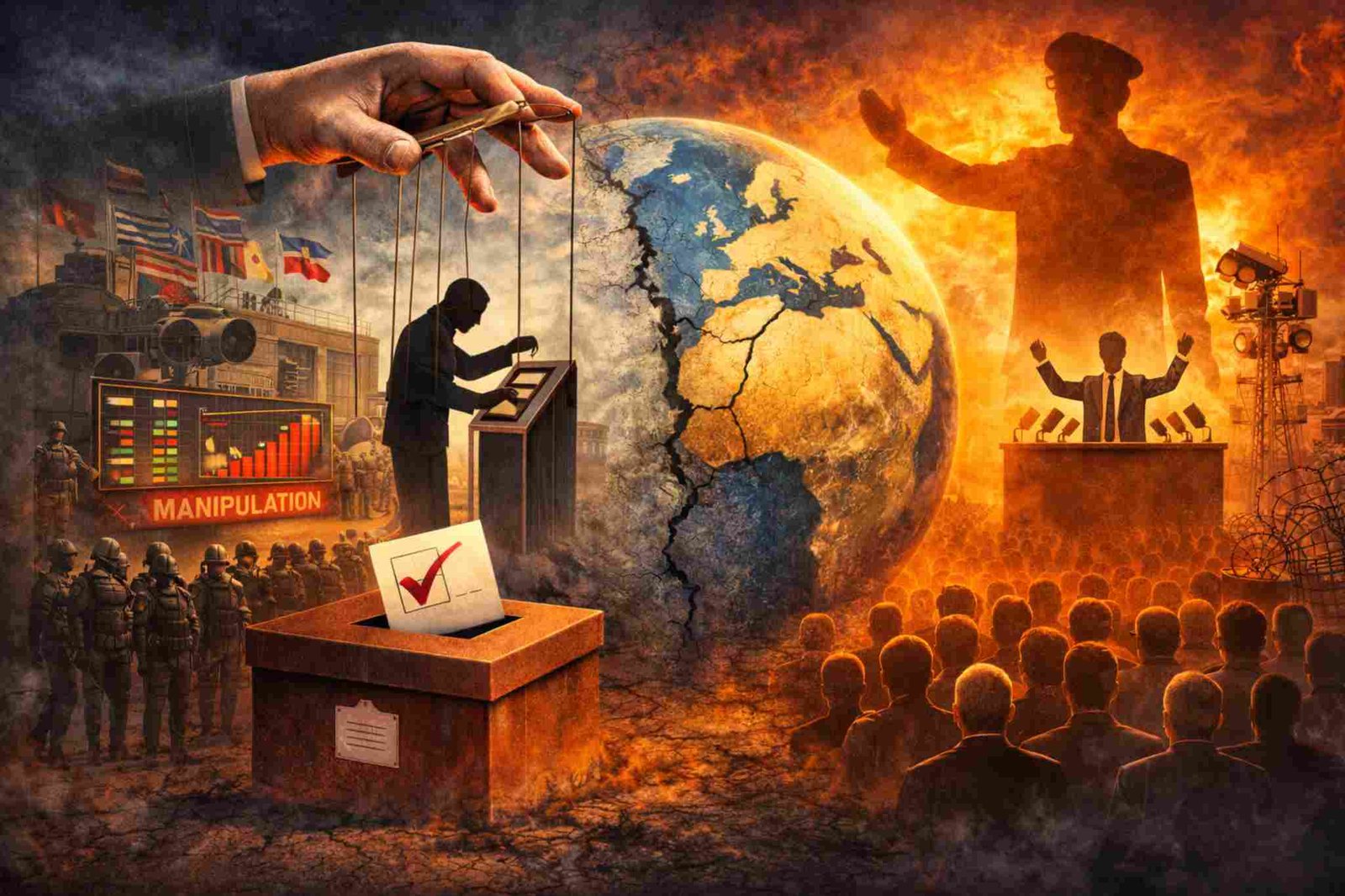
In theory, democracy is one of humanity’s most powerful political achievements. It promises equality before the law, participation in decision-making, accountability of leaders, and peaceful transfer of power through free and fair elections. Constitutions across the world proudly declare sovereignty of the people, and election days are often celebrated as symbols of civic empowerment. Yet, behind this democratic façade lies a growing contradiction. In many countries, democracy exists largely on paper, while power is exercised through manipulation, control, and engineered consent.
Vote manipulation and election engineering have become some of the most serious threats to the global democratic order. Unlike military coups or outright dictatorships, these practices operate quietly, often under the cover of legality. Elections are held, ballots are cast, and results are announced—but the outcome is frequently predetermined. This subtle distortion is more dangerous than overt authoritarianism because it erodes democracy from within while preserving its outward appearance.
This article explores how vote manipulation and election engineering undermine democratic principles, distort political accountability, weaken institutions, and destabilize societies globally.
Understanding Vote Manipulation and Election Engineering
Vote manipulation refers to deliberate actions taken to alter electoral outcomes dishonestly. This may include ballot stuffing, voter intimidation, tampering with voter lists, miscounting votes, misuse of state resources, or suppressing opposition voters. Election engineering, on the other hand, is often more sophisticated and systemic. It involves shaping electoral laws, boundaries, media narratives, and administrative processes in ways that favor certain political actors while maintaining a veneer of legality.
Unlike crude election fraud of the past, modern election engineering relies on institutional control rather than visible coercion. Electoral commissions may be politically captured, courts may legitimize unfair practices, and media may amplify ruling narratives while marginalizing dissent. The result is an election that is technically legal but substantively unfair.
Democracy Reduced to Ritual
When elections are manipulated, democracy is reduced to a ritual rather than a meaningful choice. Citizens participate in voting not because their voices matter, but because the system requires the appearance of participation. This transforms voting from an act of empowerment into one of resignation.
Over time, voters begin to internalize the belief that outcomes are predetermined. This leads to political apathy, declining voter turnout, and disengagement—especially among young people. Democracy loses its emotional and moral force, becoming an empty procedure rather than a living social contract.
This erosion of trust does not remain confined to elections alone. It spreads to courts, legislatures, law enforcement, and public institutions, creating a culture where legality replaces legitimacy.
The Illusion of Stability and Its Hidden Costs
Supporters of election engineering often justify manipulation in the name of stability, continuity, or national interest. They argue that controlled elections prevent chaos, extremism, or political fragmentation. In the short term, manipulated systems may indeed appear stable. Protests are contained, leadership remains predictable, and policy direction is controlled.
However, this stability is deceptive. When leaders are insulated from genuine electoral accountability, governance quality declines. Corruption becomes normalized, policy failures go unpunished, and public grievances accumulate without democratic outlets for expression. Over time, suppressed dissatisfaction resurfaces in more dangerous forms—mass protests, institutional breakdowns, or sudden political collapse.
History repeatedly shows that systems built on manipulated consent are inherently fragile. Stability achieved through deception is not stability at all; it is deferred instability.
Institutional Decay and the Collapse of Accountability
At the heart of democracy lies accountability—the ability of citizens to reward or punish leaders through elections. Vote manipulation destroys this mechanism. When leaders no longer fear electoral consequences, they lose incentives to govern responsibly.
Parliaments become symbolic bodies rather than sites of genuine debate. Electoral commissions turn into administrative tools instead of independent guardians. Courts may reinterpret laws to legitimize unfair practices, weakening judicial independence. Civil servants learn that loyalty matters more than competence.
This institutional decay has long-term consequences. It reduces policy innovation, discourages merit-based leadership, and fosters rent-seeking behavior. Once institutions are compromised, reversing the damage becomes extremely difficult, even if political leadership later changes.
Media Control and Manufactured Consent
Modern election engineering heavily relies on information control. Rather than banning opposition outright, systems manipulate visibility. State-aligned media dominate narratives, while independent journalism is undermined through legal pressure, economic constraints, or digital harassment.
Social media manipulation, misinformation campaigns, and algorithmic amplification further distort public perception. Voters are not denied information entirely; instead, they are flooded with biased or misleading narratives that shape preferences subtly but effectively.
This environment produces manufactured consent, where citizens appear to support outcomes that were engineered rather than freely chosen. The danger here is psychological: people may believe they are exercising free will when, in reality, choices have been carefully constrained.
Global Implications: Democracy as a Hollow Export
The global cost of election manipulation extends beyond national borders. When democracies become performative rather than substantive, international norms weaken. Governments that manipulate elections still participate in global forums, sign democratic charters, and lecture others on governance.
This hypocrisy undermines international credibility. Democratic promotion loses moral authority, and authoritarian practices gain legitimacy under the guise of “sovereign democracy” or “local context.” As a result, democratic backsliding spreads across regions, not through force, but through imitation.
Foreign investment, diplomatic relations, and development cooperation also suffer. Investors value predictability, rule of law, and institutional integrity—qualities undermined by manipulated political systems. Over time, economic costs compound alongside political decay.
Impact on Youth and Future Generations
Perhaps the most damaging consequence of election manipulation is its effect on young people. Democracy is learned not only through textbooks but through lived experience. When youth observe elections that change nothing, they internalize cynicism rather than civic responsibility.
Talented individuals disengage from politics or leave their countries altogether, contributing to brain drain. Others may turn toward radical ideologies, believing that peaceful participation is futile. In both cases, the democratic future is weakened.
A generation raised under engineered elections inherits a distorted understanding of citizenship—one where loyalty replaces participation and silence replaces debate.
Democracy Versus Legalism: The False Shield of Procedure
One of the most troubling aspects of modern election engineering is its reliance on legalism. Manipulated systems often comply with the letter of the law while violating its spirit. Laws are amended, districts redrawn, and procedures adjusted to ensure favorable outcomes—all within formal legality.
This creates a dangerous precedent: democracy becomes defined by procedures rather than principles. As long as elections follow technical rules, outcomes are deemed legitimate, even if competition is fundamentally unfair.
True democracy, however, requires more than legality. It demands equality of opportunity, freedom of expression, transparency, and genuine competition. When law is used as a shield for manipulation, democracy loses its ethical foundation.
Can Democratic Integrity Be Restored?
Reversing the damage caused by vote manipulation is challenging but not impossible. It requires more than electoral reforms; it demands institutional rebuilding and cultural change. Independent electoral bodies, free media, strong civil society, and impartial courts are essential—but insufficient without political will.
International pressure can help, but lasting reform must be domestically driven. Citizens must reclaim elections not as rituals, but as instruments of accountability. Education, transparency, and civic engagement play critical roles in this process.
Most importantly, democracy must be understood not as an event held every few years, but as a continuous practice of participation, debate, and oversight.
Conclusion: Democracy Beyond Paper
Democracy cannot survive as a symbolic exercise. When power is maintained through manipulation rather than consent, elections lose meaning, institutions decay, and societies drift toward authoritarianism disguised as order. Vote manipulation and election engineering do not merely distort outcomes—they undermine the very logic of democratic governance.
The global democratic order stands at a crossroads. The challenge is no longer whether elections are held, but whether they genuinely reflect the will of the people. Democracy must move beyond paper promises and procedural compliance toward substantive participation and accountability.
Without this shift, democracy risks becoming one of the greatest political illusions of the modern age—celebrated in language, practiced in form, but absent in reality.


