



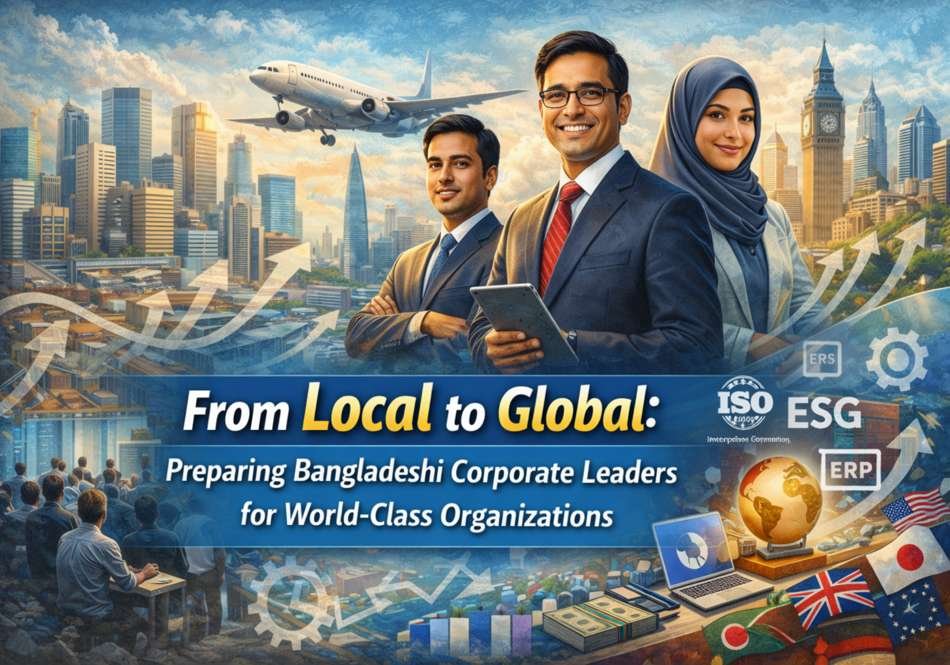
Bangladesh is no longer a small, developing economy trying to find its footing. It is a rising industrial nation with strong growth in garments, pharmaceuticals, construction, IT, energy, and manufacturing. Yet one major question remains:
Are Bangladeshi corporate leaders truly prepared to lead in world-class organizations?
Working in global corporations requires more than academic degrees or years of local experience. It demands global mindset, strategic thinking, governance knowledge, communication excellence, ethical strength, technological awareness, and cross-cultural competence.
If we want Bangladeshi corporate leaders to move from local boardrooms to international executive tables, we must understand what is necessary—and what must change.
- A Global Mindset: Thinking Beyond Borders
The first and most important requirement is mindset.
Many leaders operate within a local comfort zone. They understand local suppliers, local labor, local market behavior—but global organizations operate differently.
A global mindset includes:
- Understanding international markets
- Being aware of geopolitical and economic risks
- Thinking in terms of scalability
- Embracing diversity
- Being comfortable with international collaboration
Global leaders think long-term. They consider sustainability, ESG (Environmental, Social, Governance), digital transformation, and innovation as permanent responsibilities—not temporary projects.
To compete globally, Bangladeshi leaders must shift from:
“How do I manage this company locally?”
to
“How do I position this organization competitively in the global market?”
- Mastery of International Standards and Governance
World-class organizations operate under strict compliance frameworks.
Corporate leaders must understand:
- ISO 9001 (Quality Management)
- ISO 14001 (Environmental Management)
- ISO 45001 (Occupational Health & Safety)
- ESG principles
- Corporate governance structures
- Risk management frameworks
- Internal audit systems
- Regulatory compliance mechanisms
Global companies demand documented systems, measurable KPIs, and traceable processes. Leadership must be comfortable working within structured systems—not informal practices.
Without strong governance understanding, global trust cannot be built.
- Technical Competence with Strategic Vision
Local leadership often focuses heavily on operational execution. Global leadership demands strategic execution.
This means:
- Understanding financial statements deeply
- Interpreting balance sheets and cash flow strategically
- Managing cost optimization scientifically
- Using data analytics for decisions
- Planning risk mitigation
A world-class leader must move beyond experience-based decisions and adopt data-driven leadership.
They must ask:
- What does our ROI indicate?
- What is our productivity per employee?
- How does our supply chain risk compare globally?
- Are we innovation-driven or cost-driven?
Strategic thinking separates managers from global executives.
4️. Strong Communication and Professional Language
One major barrier for many developing-country executives is communication.
Global corporate environments require:
- Clear, confident English communication
- Professional email writing
- Presentation skills
- Board-level reporting
- Negotiation capabilities
- Cross-cultural diplomacy
Communication is not just about language—it is about clarity, persuasion, and executive presence.
Leaders must be able to:
- Present financial data convincingly
- Handle investor questions confidently
- Negotiate contracts professionally
- Resolve conflicts diplomatically
A strong idea poorly communicated loses influence. Global leadership requires both intelligence and articulation.
5️. Emotional Intelligence and Leadership Character
Technical knowledge alone does not build global leaders.
Emotional intelligence includes:
- Self-control under pressure
- Respect for diversity
- Cultural sensitivity
- Listening skills
- Conflict resolution
- Empathy toward team members
Global companies are multicultural. Leaders must manage teams from different nationalities, religions, and backgrounds.
Arrogance destroys global careers. Humility builds them.
Ethical integrity is equally critical. In international environments, transparency is non-negotiable. Leaders must reject corruption, favoritism, and unethical shortcuts.
Reputation travels globally. One ethical mistake can end an international career permanently.
6️. Digital Competence and Technology Awareness
Modern corporate leadership requires digital fluency.
Global leaders must understand:
- ERP systems
- Data dashboards
- Automation and AI impact
- Cybersecurity risks
- Digital transformation strategies
- Industry 4.0 principles
Technology is not only IT department responsibility. It is a strategic leadership concern.
Leaders who ignore digital transformation fall behind quickly. The future executive must combine traditional management with digital intelligence.
7️. Exposure to International Work Culture
Global readiness requires exposure.
Corporate leaders should seek:
- International training programs
- Global conferences
- Multinational internships
- Cross-border projects
- Overseas site visits
- Collaborative projects with foreign partners
Exposure changes perspective. It teaches:
- Professional punctuality
- Meeting discipline
- Documentation rigor
- Performance measurement systems
- Zero tolerance for inefficiency
Without exposure, leaders may remain competent locally but uncomfortable internationally.
8️. Financial and Economic Awareness
World-class executives understand macroeconomics.
They track:
- Global interest rate trends
- Inflation impact
- Currency fluctuations
- International trade policies
- Energy prices
- Supply chain disruptions
A corporate leader working globally must anticipate economic shocks.
Understanding international financial markets is essential for strategic planning.
9️. Strong Ethical Foundation
Trust is the currency of global leadership.
Global organizations prioritize:
- Transparency
- Accountability
- Anti-corruption compliance
- Fair labor practices
- Environmental responsibility
Bangladeshi corporate leaders must commit to ethical excellence.
Integrity is not a slogan—it is a competitive advantage.
International investors choose leaders they trust.
10. Performance-Based Culture, Not Relationship-Based Culture
Many developing economies struggle with favoritism and informal systems.
Global organizations operate on:
- Meritocracy
- KPI-based evaluation
- Clear reporting lines
- Structured promotions
- Measurable performance targets
Bangladeshi leaders must move toward:
- Data-based HR systems
- Transparent performance reviews
- Leadership succession planning
- Structured organizational hierarchy
Professionalism must replace informal influence.
1️1. Continuous Learning and Adaptability
The global corporate environment evolves constantly.
New regulations emerge. Technology changes. Markets shift.
A global leader:
- Reads regularly
- Learns new frameworks
- Adapts quickly
- Welcomes innovation
- Encourages experimentation
Static leaders become obsolete. Adaptive leaders remain valuable.
1️2. Building a Strong Personal Brand
Corporate leaders today represent not only companies but themselves.
Professional branding includes:
- Clean LinkedIn presence
- Thought leadership articles
- Speaking engagements
- Professional certifications
- International networking
Global recruiters often evaluate leaders online before interviews.
A strong professional identity increases international opportunities.
13. National Strategy for Global Leadership Development
To produce world-class leaders, systemic change is required.
Bangladesh must:
- Reform business education
- Integrate real industry training
- Encourage internships in multinational firms
- Promote corporate governance training
- Support professional certification programs
- Strengthen English communication at higher levels
Universities must align curriculum with global standards.
MBA degrees must include practical exposure—not just theoretical assignments.
1️4. Role of Corporate Mentorship
Experienced leaders must mentor the next generation.
Mentorship helps young professionals:
- Understand corporate politics ethically
- Develop strategic thinking
- Learn professional communication
- Build international perspective
Leadership pipelines must be developed intentionally.
1️5. Courage to Compete Globally
Finally, mindset again.
Bangladeshi corporate leaders must believe:
“We are capable of competing internationally.”
Confidence must be built on competence—not arrogance.
Global competition is intense. But with discipline, skill, ethics, and preparation, Bangladeshi executives can lead in multinational companies, regional headquarters, and global projects.
Conclusion: From Local Strength to Global Excellence
Preparing Bangladeshi corporate leaders for world-class organizations requires more than ambition. It requires structured preparation.
Necessary elements include:
- Global mindset
- Governance mastery
- Strategic financial understanding
- Communication excellence
- Emotional intelligence
- Ethical integrity
- Digital competence
- International exposure
- Performance-based culture
- Continuous learning
Bangladesh has talent. It has intelligence. It has ambition.
What it needs is alignment with global standards.
When Bangladeshi leaders combine local resilience with international discipline, they will not just work in global organizations—they will lead them.
The journey from local to global is not automatic. It is intentional.
And the future belongs to those who prepare for it.


