



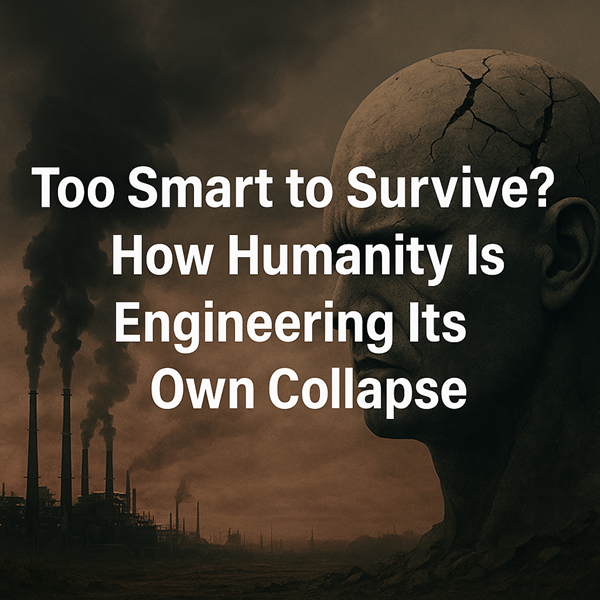
Human beings often celebrate themselves as the pinnacle of intelligence on Earth. We have decoded the genome, split the atom, walked on the Moon, and built machines that can think faster than us. No other species has reshaped the planet so completely—or so confidently. Yet beneath this triumph lies an unsettling paradox: the very intelligence that elevated humanity may now be pushing it toward collapse.
This is not a prophecy of doom, nor a rejection of progress. It is a sober examination of how human brilliance, when divorced from wisdom, restraint, and ethics, can become self-destructive. History suggests that civilizations rarely collapse because they are ignorant. They collapse because they are clever enough to create problems they cannot control.
Intelligence Without Wisdom
Intelligence is the ability to solve problems. Wisdom is knowing which problems should never be created.
Modern humanity excels at the first and struggles deeply with the second. We innovate rapidly, often without fully understanding long-term consequences. Technologies are deployed before ethical frameworks exist. Economic growth is pursued without ecological limits. Convenience is prioritized over sustainability.
The result is a world of astonishing capability paired with fragile systems—complex, interconnected, and dangerously dependent on continuous stability.
In earlier eras, mistakes were localized. A failed irrigation system collapsed one kingdom. Today, a single error—financial, technological, or environmental—can ripple across the globe in hours.
The Environmental Self-Sabotage
Perhaps the clearest example of intelligence turned against survival is environmental destruction.
Humanity understood the basics of ecology long ago: forests regulate climate, oceans absorb carbon, biodiversity stabilizes ecosystems. Yet armed with industrial power and scientific knowledge, we systematically dismantled these life-support systems.
- Forests cleared faster than they can regenerate
- Oceans overfished and polluted
- Atmosphere overloaded with greenhouse gases
- Freshwater sources depleted
Climate change is not a mystery. It is a known outcome of known actions, repeated despite decades of warnings. This is not ignorance—it is calculated neglect.
Ironically, many of the proposed solutions now rely on even more complex technologies, each carrying new risks. We attempt to engineer our way out of problems engineered in the first place.
Technology: Tool or Trap?
Technology is humanity’s greatest strength—and its most dangerous temptation.
From artificial intelligence to genetic engineering, we are entering domains once reserved for nature itself. These technologies promise efficiency, longevity, and control. But they also concentrate power, accelerate inequality, and reduce resilience.
Artificial Intelligence
AI can optimize systems, but it can also:
- Replace millions of jobs faster than societies can adapt
- Amplify misinformation at unprecedented scale
- Concentrate decision-making in opaque algorithms
The danger is not that machines will suddenly rebel. The danger is that humans will hand over critical decisions to systems they barely understand, then blame those systems when outcomes turn disastrous.
Digital Dependence
Modern societies are digitally fragile. Power grids, healthcare, finance, and food distribution rely on interconnected networks. A cyberattack, solar storm, or systemic failure could paralyze entire nations.
We have built efficiency at the cost of redundancy—and resilience.
Economic Growth as an Addiction
Economic intelligence has allowed humanity to extract extraordinary wealth from the planet. But the global economic model depends on endless growth in a finite world.
This contradiction is often ignored rather than resolved.
To sustain growth:
- Resources are extracted faster
- Waste accumulates faster
- Inequality widens
The system rewards short-term profit over long-term survival. Corporations that exploit ecosystems thrive. Those that prioritize sustainability struggle. Nations compete economically even when cooperation is essential.
In this sense, humanity resembles a brilliant engineer who designs a powerful engine—but forgets to include brakes.
War: Intelligence Turned Inward
War is one of the oldest human activities, but modern warfare represents a terrifying escalation of intelligence misused.
We now possess:
- Nuclear weapons capable of ending civilization
- Autonomous weapons that can decide who lives or dies
- Cyber weapons that can cripple societies without a single shot
The most disturbing fact is not that these weapons exist—but that they are maintained, modernized, and justified by rational arguments.
Human intelligence has become so effective at destruction that survival increasingly depends on perfect restraint, every day, by every nuclear-armed state. History offers little confidence in such perfection.
The Information Overload Paradox
Never before has humanity had access to so much information. And never before has truth been so fragile.
The digital age rewards:
- Speed over accuracy
- Emotion over evidence
- Division over understanding
Algorithms amplify outrage because it increases engagement. Lies travel faster than corrections. Conspiracy theories flourish in the same networks that host scientific knowledge.
The paradox is cruel: the more information we have, the harder it becomes to agree on reality.
A society unable to agree on facts cannot solve complex problems—no matter how intelligent it claims to be.
Social Fragmentation and Loss of Meaning
Intelligence builds cities, but it does not automatically build communities.
As societies become more technologically advanced, many people experience:
- Isolation despite constant connectivity
- Loss of purpose in automated economies
- Identity crises fueled by comparison culture
Mental health struggles rise even as material comfort increases. Traditional social structures weaken faster than new ones form. People search for meaning in consumption, ideology, or digital validation.
A civilization that excels at production but fails at belonging creates internal instability—one no amount of intelligence can easily fix.
The Collapse Pattern: Lessons from History
Past civilizations offer warnings.
The Roman Empire had advanced engineering, law, and administration—but collapsed under overexpansion, inequality, and resource strain. The Maya civilization possessed sophisticated astronomy and agriculture—yet environmental mismanagement played a key role in its decline.
Collapse rarely comes from a single catastrophe. It emerges from layers of intelligent decisions that make sense individually but prove fatal collectively.
Modern civilization mirrors this pattern on a global scale.
Are We Truly Too Smart to Survive?
The problem is not intelligence itself. It is unchecked intelligence without ethical alignment.
Survival requires:
- Long-term thinking over short-term gain
- Cooperation over competition
- Limits over endless expansion
Yet human psychology evolved for immediate survival, not planetary stewardship. Our intelligence outpaced our emotional and moral evolution.
We can design climate models—but struggle to change lifestyles.
We can predict disasters—but delay action until it is too late.
This gap between knowledge and behavior is the true danger.
A Narrow Window for Change
Despite the grim trajectory, collapse is not inevitable.
Human intelligence also enables:
- Self-reflection
- Moral reasoning
- Collective action
The same species that engineered the crisis can still engineer restraint—if it chooses to redefine success.
This requires:
- Redesigning economies around well-being, not just growth
- Treating environmental limits as non-negotiable
- Governing technology with ethics, not hype
- Valuing wisdom as much as innovation
These changes are difficult, slow, and politically uncomfortable—but they are possible.
Conclusion: Intelligence Needs Humility
The ultimate test of intelligence is not how much we can control—but how much we are willing to limit ourselves.
Humanity stands at a crossroads unique in history. Never before has a species had such power over its own fate. And never before has survival depended so heavily on self-restraint.
If we continue to equate intelligence with domination—over nature, over each other, over future generations—we may indeed be too smart to survive.
But if intelligence matures into wisdom, humility, and responsibility, humanity’s greatest invention may not be technology at all—but the choice to endure.
The question is no longer can we engineer our future.
It is whether we are wise enough to stop engineering our own collapse.


