



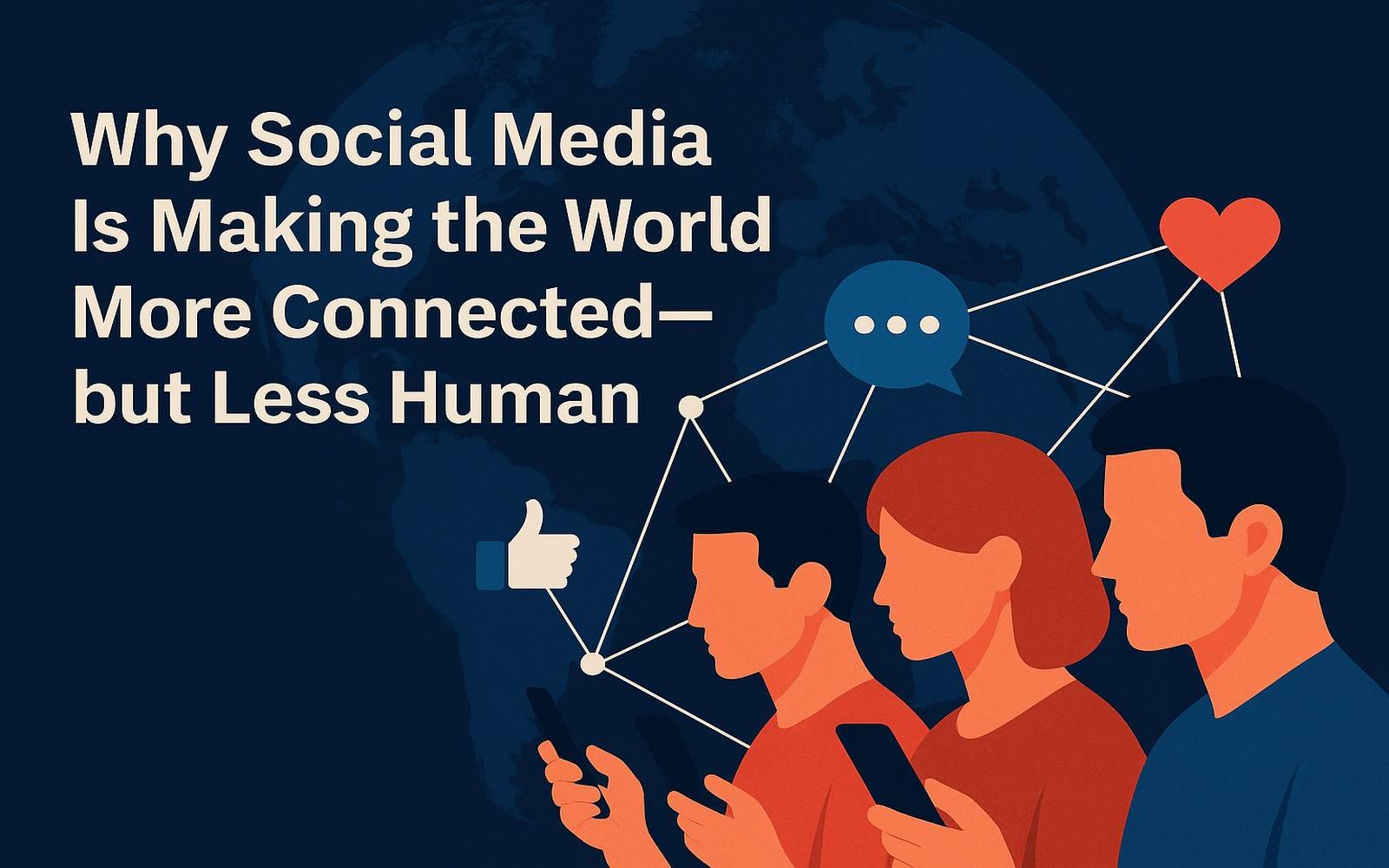
Never in human history have people been so connected—and so alone at the same time.
A teenager in Dhaka can watch a live video from New York. A worker in London can message a friend in Lagos instantly. News travels across continents in seconds. Social media has collapsed distance, erased borders, and created a digital village where billions of people coexist on the same platforms.
And yet, despite this unprecedented connectivity, something deeply human is slipping away.
Loneliness is rising. Empathy is declining. Conversations are becoming hostile. Attention spans are shrinking. Anxiety and depression are spreading, especially among young people. The paradox is painful: the tools designed to bring us together are quietly pulling us apart as human beings.
This article explores why social media, while connecting the world technically, is making us emotionally distant, psychologically fragile, and socially fragmented—and what that means for the future of humanity.
The Illusion of Connection
Social media gives the appearance of connection without the substance.
A “like” feels like approval. A comment feels like conversation. A follower count feels like popularity. But these interactions lack the depth, vulnerability, and emotional feedback that define real human relationships.
In face-to-face interaction:
- We read facial expressions
- We hear tone and hesitation
- We sense emotions beyond words
On social media, communication is flattened into text, emojis, and curated images. Misunderstandings are common. Empathy is optional. Accountability is minimal.
As a result, many people are surrounded by digital noise—but starved of genuine connection.
From Community to Audience
Historically, humans lived in small communities where identity was shaped by contribution, responsibility, and belonging. Social media has transformed this dynamic.
Today, we are no longer community members—we are performers.
Every post becomes a performance:
- Carefully selected photos
- Edited captions
- Highlighted achievements
- Hidden struggles
People no longer ask, “Who am I?”
They ask, “How will this be perceived?”
This shift turns relationships into transactions. Attention becomes currency. Validation replaces understanding. And slowly, human worth becomes measured in metrics—likes, shares, views, followers.
The Rise of Comparison Culture
Social media does not show reality—it shows curated reality.
People post:
- Their best moments, not their worst
- Their successes, not their failures
- Their beauty, not their pain
When users consume this nonstop stream, the mind compares real life to someone else’s highlight reel. The result is predictable:
- Feelings of inadequacy
- Chronic dissatisfaction
- Anxiety and low self-esteem
Even intelligent, confident individuals are not immune. The human brain is not designed to compare itself with hundreds or thousands of idealized lives every day.
Ironically, platforms that promise inspiration often deliver quiet despair.
Algorithm Over Humanity
Social media platforms are not neutral tools. They are businesses driven by engagement, profit, and data.
Algorithms are designed to:
- Keep users scrolling
- Trigger emotional reactions
- Amplify content that provokes outrage, fear, or desire
Calm, thoughtful discussion does not spread as fast as anger or controversy. As a result, the digital world becomes louder, harsher, and more polarized.
People are pushed into echo chambers where:
- Their beliefs are constantly reinforced
- Opposing views are ridiculed or dehumanized
Over time, disagreement turns into hostility. Dialogue turns into attack. Strangers become enemies.
Connection exists—but humanity fades.
The Death of Deep Conversation
Before social media, conversations were slower and deeper.
People listened more because interruptions were costly. Silence existed. Attention was focused. Now, conversation competes with notifications, messages, reels, and infinite scrolling.
Modern communication is often:
- Reactive, not reflective
- Short, not meaningful
- Fast, not thoughtful
People reply without listening. Argue without understanding. Judge without context.
When attention fragments, empathy suffers. When empathy disappears, society hardens.
Loneliness in the Age of Likes
One of the greatest ironies of social media is that it increases loneliness.
Research across countries shows rising loneliness, especially among young people, despite increased online interaction. Why?
Because human connection is not just about communication—it is about presence.
- Sitting together in silence
- Sharing unfiltered emotions
- Being seen without performing
Social media cannot replicate these experiences. Instead, it replaces them with constant stimulation that masks loneliness rather than curing it.
Many people feel pressure to appear happy online while struggling deeply offline. This emotional disconnect creates a silent epidemic of isolation.
Identity Fragmentation and Loss of Self
On social media, people often maintain multiple identities:
- Professional persona
- Social persona
- Anonymous persona
Over time, the boundary between authentic self and digital self blurs. People begin to internalize their online image, shaping behavior to protect it.
This leads to:
- Fear of saying the wrong thing
- Fear of being canceled or misunderstood
- Self-censorship
Authenticity becomes risky. Vulnerability becomes dangerous. People retreat behind masks—even from themselves.
A society afraid to be honest cannot remain emotionally healthy.
Reduced Empathy and Digital Cruelty
One of the most alarming effects of social media is the normalization of cruelty.
Behind screens:
- Insults feel consequence-free
- Dehumanization feels easier
- Suffering becomes content
People mock tragedies, attack strangers, and spread hate without witnessing the emotional impact. The absence of face-to-face feedback weakens empathy.
Over time, cruelty becomes entertainment. Pain becomes viral. And humanity becomes optional.
Short Attention, Shallow Thinking
Social media trains the brain for speed, not depth.
Endless scrolling conditions users to:
- Consume information quickly
- Abandon content if it doesn’t immediately engage
- Avoid complexity
This affects thinking itself. Long-form reading declines. Nuanced arguments feel exhausting. Simplistic slogans replace careful reasoning.
In a world facing complex challenges—climate change, inequality, technological ethics—shallow thinking is dangerous.
A connected world without deep thinking is vulnerable to manipulation.
Children Growing Up Digitally Deprived
Perhaps the most serious consequence is the impact on children.
Many children now experience:
- Reduced face-to-face socialization
- Early exposure to comparison and validation culture
- Shortened attention spans
They learn to communicate through screens before learning emotional regulation. They measure self-worth through digital feedback before developing internal confidence.
The long-term consequences are still unfolding—but early signs suggest rising anxiety, reduced resilience, and weakened social skills.
A generation raised digitally connected but emotionally underdeveloped faces a difficult future.
Is Social Media the Enemy?
Social media itself is not evil. It has connected families, amplified marginalized voices, enabled education, and mobilized social movements.
The problem lies in how it is designed, consumed, and prioritized.
Technology becomes harmful when:
- It replaces real relationships instead of supporting them
- It prioritizes profit over well-being
- It rewards extremes over balance
Blaming users alone is unfair. Platforms are engineered to exploit psychological vulnerabilities. Awareness without structural change is not enough.
Reclaiming Humanity in a Digital World
The solution is not to abandon technology—but to re-humanize it.
This requires:
- Digital literacy that includes emotional awareness
- Platform accountability for mental health impacts
- Conscious limits on screen time
- Revival of offline relationships and community spaces
On an individual level, it means:
- Choosing presence over performance
- Listening more than reacting
- Valuing depth over reach
Humanity survives not through connection alone—but through meaningful connection.
Conclusion: Connected, But at What Cost?
Social media has succeeded in connecting the world technologically. But it has failed—so far—in nurturing the human qualities that make connection worthwhile.
Without empathy, attention, authenticity, and wisdom, connection becomes noise.
The challenge of our time is not to become more connected—but to remain human while being connected.
If we do not consciously protect what makes us human, we may one day wake up in a world where everyone is online—yet no one truly understands one another.
The question is no longer whether social media connects us.
It is whether we are brave enough to reclaim our humanity within it.
Top of Form
Bottom of Form


