



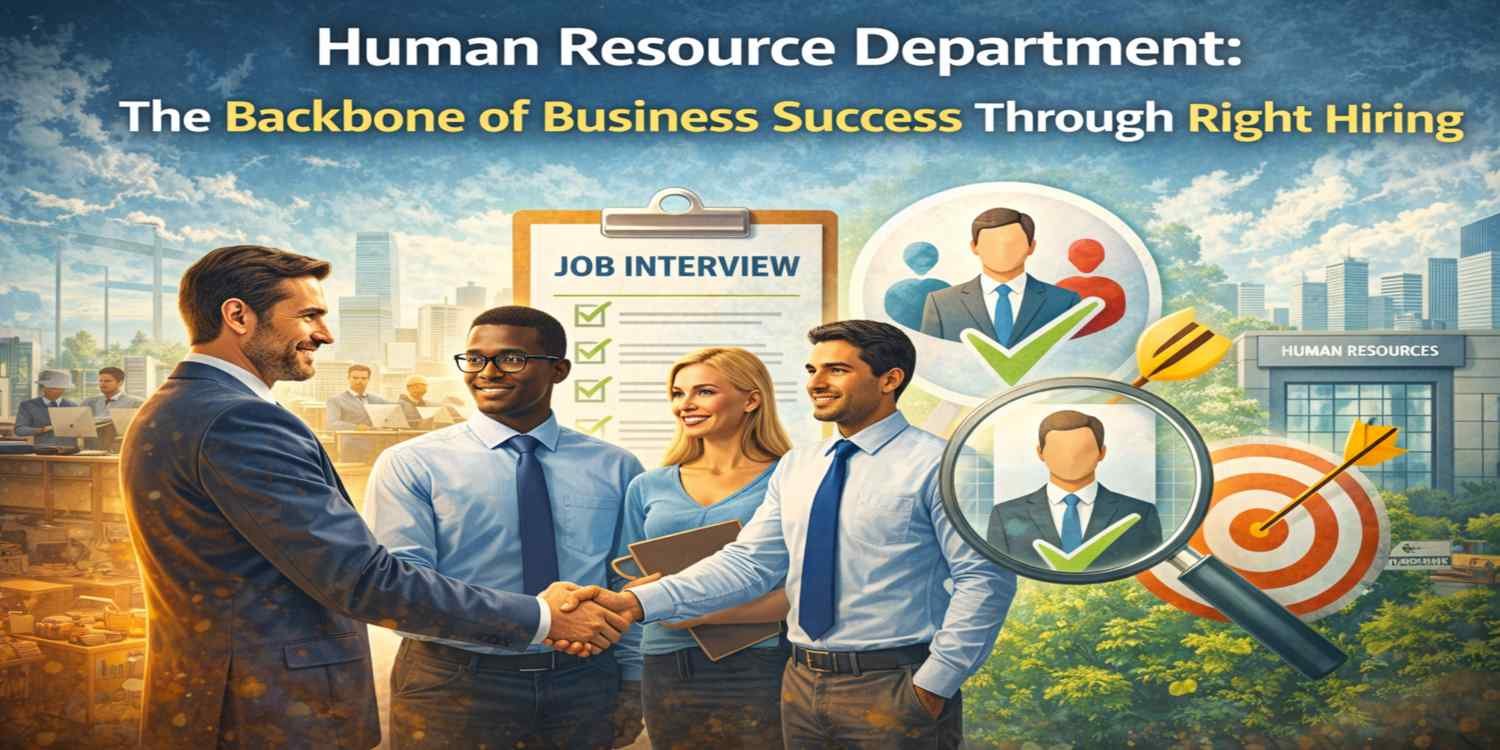
In today’s competitive and rapidly changing business environment, organizations invest heavily in technology, infrastructure, marketing, and systems to gain an edge. Yet, despite all these investments, many businesses fail to achieve sustainable success. The reason is often not poor strategy or lack of resources, but a more fundamental issue: hiring the wrong people. At the heart of this issue lies the Human Resource (HR) Department—the backbone of any organization.
The Human Resource Department is not merely an administrative function responsible for payroll, attendance, or employee records. It is a strategic department that shapes the future of the organization through one of the most critical decisions in business: hiring the right people for the right roles at the right time. When recruitment is done correctly, businesses grow, innovate, and sustain performance. When it is done poorly, even the strongest strategies collapse.
The Strategic Importance of the Human Resource Department
Modern organizations increasingly recognize that people are their most valuable asset. Machines, capital, and systems can be copied, but a skilled, motivated, and aligned workforce cannot be easily replicated. The HR department plays a central role in building and managing this human capital.
HR acts as a bridge between organizational goals and workforce capability. It ensures that the business has the right competencies, behaviors, and leadership to execute its strategy. Among all HR functions—training, performance management, compensation, employee relations—recruitment and selection stand at the foundation. If hiring decisions are wrong, every other HR activity becomes corrective rather than developmental.
Simply put, business success begins with right hiring.
Why Hiring the Right Candidate Is Critical to Business Success
Hiring the right candidate means selecting an individual who not only has the required technical skills but also aligns with the organization’s culture, values, and long-term objectives. A right hire contributes positively from day one, while a wrong hire drains time, money, and morale.
Wrong hiring decisions lead to:
- Low productivity
- High employee turnover
- Increased training and supervision costs
- Workplace conflicts
- Safety and quality issues
- Poor customer satisfaction
- Loss of organizational knowledge
Research consistently shows that the cost of a wrong hire can be one to three times the employee’s annual salary, considering recruitment costs, lost productivity, and replacement expenses. HR’s role in preventing these losses is critical to business sustainability.
HR as the Architect of Workforce Quality
The Human Resource Department acts as the architect of workforce quality. Through systematic workforce planning, job analysis, and competency mapping, HR ensures that every position contributes meaningfully to organizational performance.
Workforce Planning
HR identifies current and future manpower requirements based on business growth, expansion, or technological change. This prevents both overstaffing and understaffing, which can harm efficiency and profitability.
Job Analysis and Role Clarity
Clear job descriptions and role definitions help HR attract candidates who truly fit the position. Without clarity, recruitment becomes guesswork, leading to mismatched expectations and early attrition.
Competency-Based Hiring
Right hiring goes beyond academic qualifications. HR evaluates:
- Technical competence
- Problem-solving ability
- Communication skills
- Adaptability
- Teamwork
- Ethical behavior
This holistic approach ensures long-term performance, not just short-term task completion.
Recruitment as a Strategic HR Function
Recruitment is often mistakenly treated as a transactional process—posting vacancies, collecting CVs, and conducting interviews. In reality, recruitment is a strategic business process that determines organizational capability.
A strong HR department approaches recruitment strategically by:
- Aligning hiring with business objectives
- Using structured selection methods
- Eliminating bias and subjectivity
- Assessing both skill and cultural fit
- Planning succession and leadership pipelines
Strategic recruitment enables organizations to respond quickly to market changes and build resilient teams capable of handling future challenges.
Cultural Fit: The Hidden Factor in Successful Hiring
Technical skills can be taught, but attitude and values are difficult to change. One of HR’s most important responsibilities is ensuring cultural alignment during hiring.
Employees who align with organizational culture:
- Collaborate better
- Show higher engagement
- Accept accountability
- Adapt to change
- Stay longer with the organization
A highly skilled employee who disrupts culture can be more damaging than an average performer who strengthens teamwork. HR plays a vital role in assessing behavioral compatibility through structured interviews, behavioral assessments, and reference checks.
HR’s Role in Reducing Employee Turnover
High employee turnover is a silent killer of business performance. It affects productivity, customer relationships, and team stability. In most cases, turnover is not caused by salary alone, but by poor hiring decisions and mismatched expectations.
When HR hires the right candidates:
- Employees understand their roles clearly
- Performance expectations are realistic
- Job satisfaction increases
- Career growth paths align with individual goals
Right hiring significantly reduces voluntary turnover, saving organizations substantial recruitment and training costs.
Impact of Right Hiring on Productivity and Performance
Productivity is directly linked to employee capability and motivation. Right hires require less supervision, learn faster, and contribute innovative ideas.
A well-functioning HR department ensures that:
- Performance standards are defined during recruitment
- Employees possess required competencies
- Training needs are minimized
- Teams operate efficiently
This leads to higher output, better quality, and improved customer satisfaction—all essential for business success.
HR and Leadership Development Through Hiring
Business growth depends heavily on leadership quality. Many organizations fail because they do not build future leaders early enough. HR plays a strategic role in identifying leadership potential during recruitment.
By hiring candidates with:
- Decision-making ability
- Initiative and ownership
- Communication skills
- Ethical judgment
HR creates a pipeline of future supervisors, managers, and leaders. This reduces dependence on external hiring for leadership roles and ensures continuity in management philosophy and culture.
Right Hiring and Risk Reduction
Wrong hiring decisions increase operational risks, especially in industries such as manufacturing, construction, energy, and healthcare. Unqualified or careless employees can cause:
- Safety incidents
- Quality failures
- Environmental violations
- Legal disputes
HR reduces these risks by verifying qualifications, conducting background checks, assessing safety awareness, and ensuring regulatory compliance during recruitment. This risk-based approach protects both employees and the organization.
HR Hiring and Organizational Reputation
Employees represent the organization in front of customers, suppliers, regulators, and the public. Poorly selected employees can damage brand image and customer trust.
On the other hand, when HR hires competent and professional individuals:
- Customer relationships improve
- Corporate reputation strengthens
- Employer branding improves
- Talent attraction becomes easier
In this way, HR directly influences the organization’s external perception and market credibility.
Integration with ISO 9001 and Management Systems
Under ISO 9001:2015, organizations are required to ensure employee competence and awareness. The HR department plays a central role in fulfilling this requirement through structured recruitment and selection processes.
Right hiring supports:
- Clause 7.2 (Competence)
- Clause 7.3 (Awareness)
- Risk-based thinking
- Process effectiveness
Thus, HR is not only a people function but also a compliance and governance function that supports quality and operational excellence.
Challenges Faced by HR in Hiring the Right Candidates
Despite its importance, HR often faces challenges such as:
- Pressure for urgent hiring
- Limited talent availability
- Budget constraints
- Bias from line managers
- Inadequate job information
Overcoming these challenges requires strong management support, clear policies, structured recruitment processes, and data-driven decision-making.
How Organizations Can Strengthen HR Hiring Effectiveness
To maximize HR’s contribution to business success, organizations should:
- Treat HR as a strategic partner
- Involve HR in business planning
- Invest in HR training and tools
- Use structured interviews and assessments
- Measure hiring effectiveness through KPIs
When HR is empowered, hiring quality improves, and business performance follows.
Conclusion: HR Hiring Is a Business-Critical Decision
The Human Resource Department is the backbone of business success because it controls the entry point of human capital into the organization. Every employee hired shapes culture, performance, risk, and future leadership. Hiring the right candidate is not a routine activity—it is a strategic decision with long-term consequences.
Organizations that recognize the strategic value of HR and invest in right hiring build strong teams, reduce costs, improve productivity, and achieve sustainable growth. Those that ignore this reality pay the price through inefficiency, turnover, and lost opportunities.
In the end, businesses do not succeed because of plans alone—they succeed because of people. And the responsibility of bringing the right people into the organization lies with a strong, competent, and strategic Human Resource Department.
Right hiring is not just the key to business success—it is the foundation upon which success is built.


