



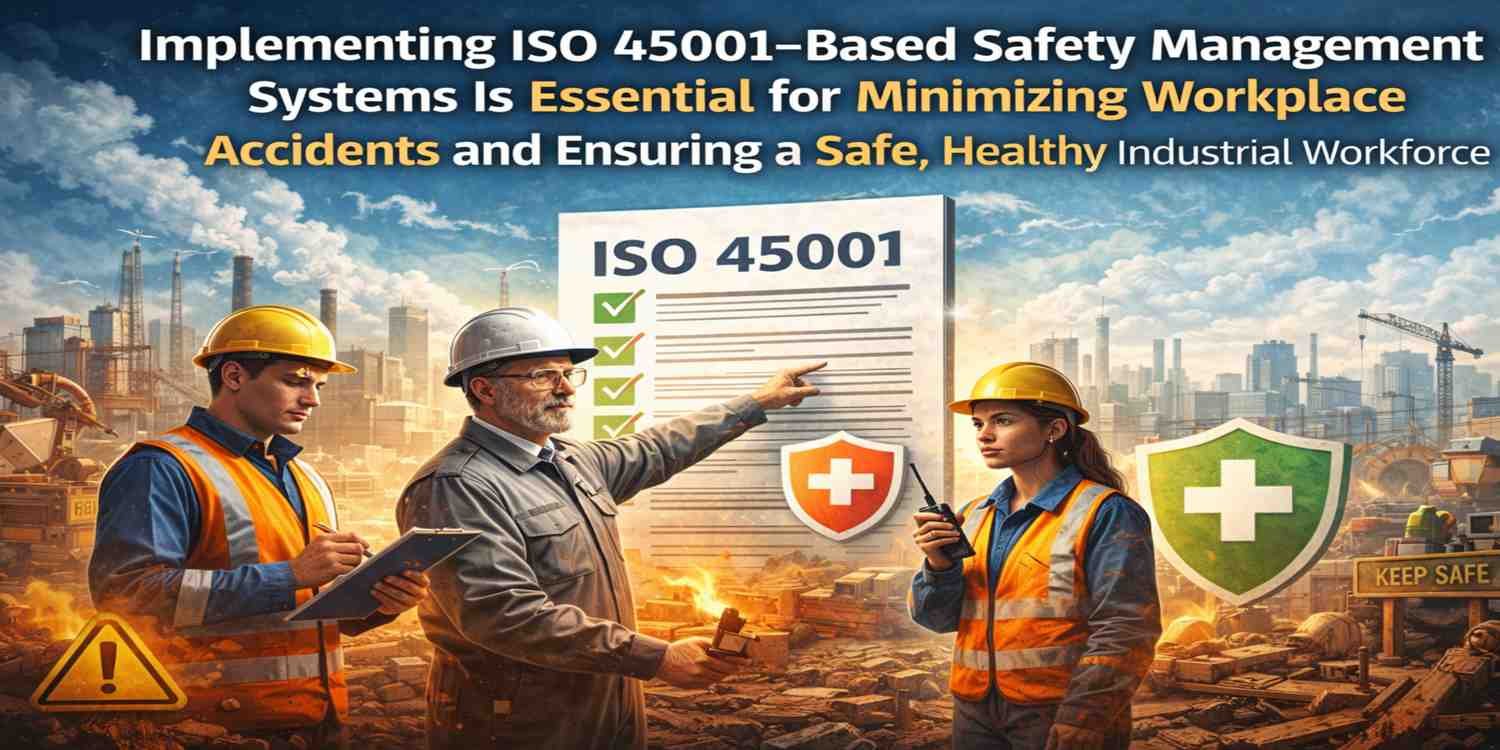
Workplace safety is no longer a secondary concern or a matter of compliance alone—it is a fundamental responsibility of every organization. Across industries worldwide, millions of workers are exposed daily to occupational hazards that can result in injuries, illnesses, fatalities, production losses, and long-term reputational damage. Despite technological advancements and automation, workplace accidents remain a significant challenge, largely due to inadequate safety management systems, weak leadership commitment, and reactive approaches to risk.
In this context, ISO 45001, the international standard for Occupational Health and Safety Management Systems (OHSMS), provides a structured, proactive, and systematic framework to control risks, prevent accidents, and protect workers. Implementing ISO 45001–based safety management systems is essential not only for minimizing workplace accidents but also for ensuring a safe, healthy, and productive industrial workforce.
Understanding ISO 45001: A Proactive Safety Standard
ISO 45001 was developed to replace OHSAS 18001 and represents a significant shift in how organizations manage occupational health and safety. Rather than focusing only on compliance and corrective actions after incidents occur, ISO 45001 emphasizes risk-based thinking, prevention, leadership involvement, and worker participation.
The standard applies to all types of organizations—manufacturing, construction, energy, chemical, textile, engineering, logistics, and service industries—regardless of size or complexity. Its core objective is to prevent work-related injuries and ill health by eliminating hazards and minimizing OH&S risks.
ISO 45001 follows the Plan–Do–Check–Act (PDCA) cycle, ensuring continuous improvement in safety performance rather than one-time compliance.
Why Workplace Accidents Continue to Occur
Despite safety regulations, accidents persist due to several recurring weaknesses in industrial environments:
- Lack of hazard identification and risk assessment
- Unsafe machinery and poor maintenance
- Inadequate training and supervision
- Weak safety culture and worker awareness
- Absence of emergency preparedness
- Management prioritizing production over safety
- Reactive response instead of preventive planning
These issues cannot be solved through isolated safety rules or PPE alone. They require a systematic safety management approach, which ISO 45001 is designed to provide.
How ISO 45001 Minimizes Workplace Accidents
1. Hazard Identification and Risk Assessment
At the heart of ISO 45001 is a structured process for identifying workplace hazards and assessing associated risks. This includes:
- Mechanical hazards (moving machinery, sharp tools)
- Electrical hazards
- Chemical exposure
- Fire and explosion risks
- Ergonomic risks
- Working at height
- Confined space hazards
- Noise, dust, and vibration
By systematically identifying hazards before accidents occur, organizations can implement control measures such as engineering controls, administrative controls, and PPE, following the hierarchy of controls. This proactive approach significantly reduces accident probability.
2. Leadership Commitment and Accountability
ISO 45001 places strong emphasis on top management leadership, making safety a strategic priority rather than an operational afterthought.
Top management is required to:
- Establish OH&S policy and objectives
- Allocate resources for safety
- Integrate safety into business processes
- Demonstrate visible commitment
- Ensure accountability at all levels
When leadership actively supports safety management, it creates a culture where safety is valued equally with productivity and quality—leading to fewer unsafe behaviors and reduced accidents.
3. Worker Participation and Consultation
One of the most powerful elements of ISO 45001 is the requirement for worker participation. Workers are often the first to recognize unsafe conditions, yet traditional safety systems frequently exclude them from decision-making.
ISO 45001 requires organizations to:
- Consult workers during risk assessments
- Encourage reporting of hazards and near misses
- Involve employees in safety committees
- Protect workers from retaliation
This involvement improves hazard detection, builds ownership of safety practices, and fosters a strong safety culture, directly reducing accident rates.
4. Competence, Training, and Awareness
Many workplace accidents occur due to lack of training or misunderstanding of safety procedures. ISO 45001 addresses this by requiring organizations to ensure that workers are competent to perform their tasks safely.
This includes:
- Job-specific safety training
- Equipment and machine operation training
- Emergency response training
- Induction and refresher training
- Awareness of OH&S policies and procedures
A trained workforce is more alert, confident, and capable of recognizing risks, significantly minimizing unsafe acts.
5. Operational Control and Safe Work Practices
ISO 45001 requires organizations to establish operational controls for activities associated with significant OH&S risks. This includes:
- Standard Operating Procedures (SOPs)
- Permit-to-work systems
- Lockout/tagout procedures
- Machine guarding
- Contractor safety controls
- Safe material handling procedures
These controls standardize safe behavior and reduce variability in work practices, ensuring consistency and reliability in safety performance.
6. Emergency Preparedness and Response
Accidents often escalate due to poor emergency preparedness. ISO 45001 requires organizations to identify potential emergency situations and establish response plans.
These may include:
- Fire and explosion
- Chemical spills
- Electrical accidents
- Structural collapse
- Natural disasters
- Medical emergencies
Regular drills, training, and evaluation of emergency response readiness ensure quick, effective action, minimizing injuries and damage when incidents occur.
7. Monitoring, Measurement, and Incident Investigation
ISO 45001 promotes continuous monitoring of safety performance through:
- Safety inspections
- Internal audits
- Incident and near-miss reporting
- OH&S performance indicators
- Root cause analysis
Instead of blaming individuals, the system focuses on identifying systemic causes of accidents and implementing corrective and preventive actions. Learning from near misses further reduces future risks.
Building a Safe and Healthy Industrial Workforce
Physical Health Protection
ISO 45001 helps organizations control occupational hazards that cause injuries, musculoskeletal disorders, hearing loss, respiratory diseases, and chemical exposure. Health surveillance and preventive controls protect workers’ long-term physical health.
Mental Health and Well-Being
Modern workplaces face increasing stress, fatigue, and psychological pressure. ISO 45001 recognizes psychosocial risks and encourages organizations to address workload, working hours, harassment, and workplace stress—ensuring a healthier, more engaged workforce.
Reduced Absenteeism and Turnover
A safe work environment leads to fewer injuries, reduced sick leave, higher morale, and improved employee retention. Workers are more loyal and productive when they feel protected and valued.
Business Benefits of ISO 45001 Implementation
Beyond safety, ISO 45001 delivers strong business advantages:
- Reduced accident-related costs and downtime
- Lower insurance premiums
- Improved productivity and efficiency
- Enhanced corporate reputation
- Compliance with legal and regulatory requirements
- Better stakeholder and customer confidence
- Stronger ESG and sustainability performance
Safety is not a cost—it is an investment with measurable returns.
Integration with Other ISO Management Systems
ISO 45001 is designed using the High-Level Structure (HLS), making it easy to integrate with:
- ISO 9001 (Quality Management)
- ISO 14001 (Environmental Management)
- ISO 50001 (Energy Management)
Integrated management systems improve overall operational control, reduce duplication, and strengthen organizational resilience.
Challenges and How to Overcome Them
Common challenges during ISO 45001 implementation include:
- Resistance to change
- Lack of safety awareness
- Limited resources
- Inadequate documentation
- Weak leadership involvement
These challenges can be overcome through:
- Strong management commitment
- Practical, site-specific risk assessments
- Continuous training and communication
- Worker engagement
- Step-by-step implementation approach
Conclusion: Safety Management Is a Moral and Strategic Imperative
Implementing ISO 45001–based safety management systems is not merely about achieving certification—it is about protecting human lives, preserving dignity, and building sustainable industrial operations. Every accident prevented represents a family spared from suffering, a worker protected from harm, and a business safeguarded from loss.
In an increasingly complex and competitive industrial world, organizations that prioritize occupational health and safety demonstrate true leadership. They understand that productivity, quality, and profitability cannot exist without safety.
ISO 45001 provides the roadmap to minimize workplace accidents, safeguard employee health, and create a resilient, responsible, and high-performing industrial workforce.


