



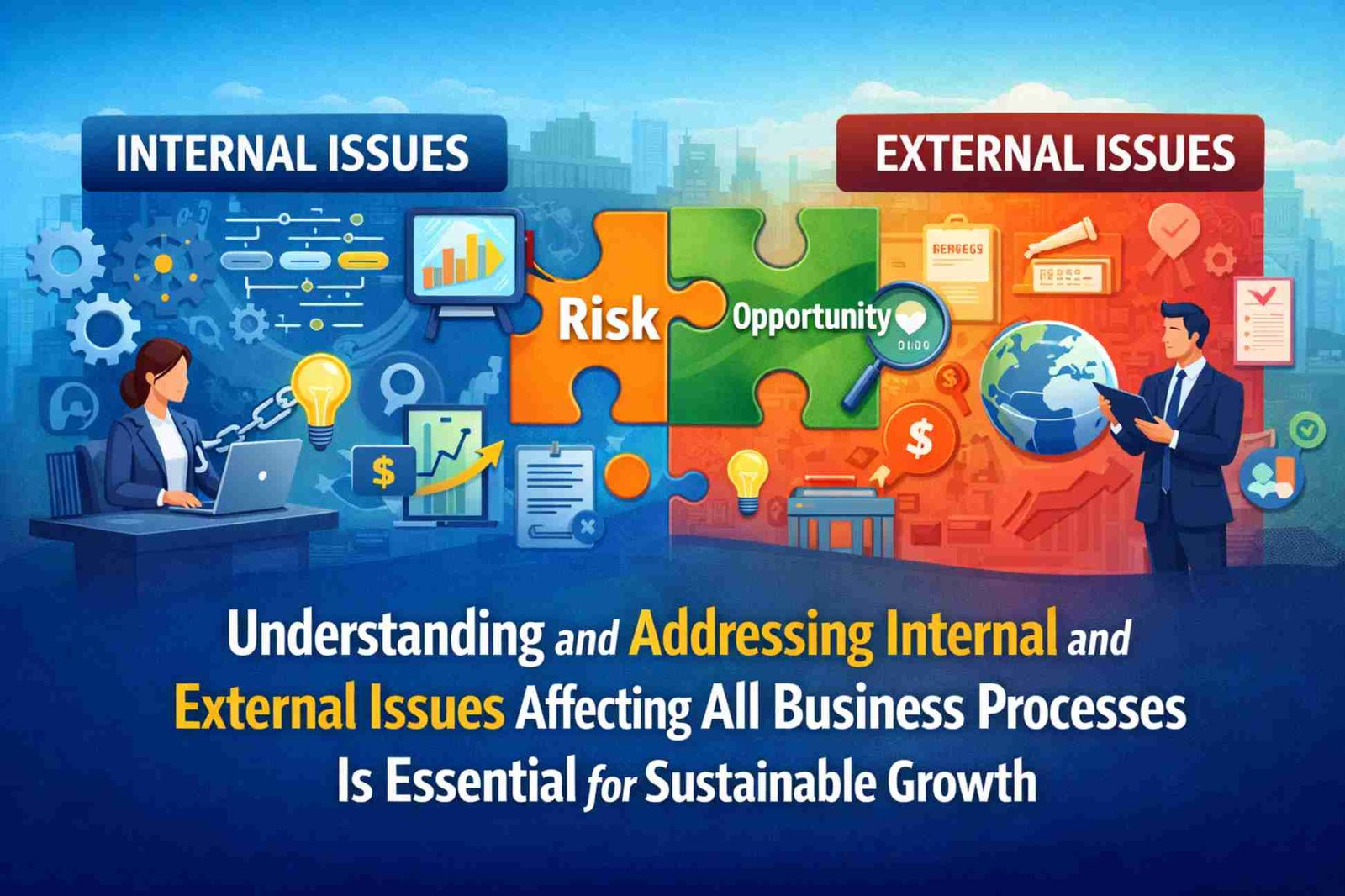
Sustainable business growth does not happen by chance. Organizations that survive, grow, and remain competitive over the long term are those that understand their operating environment and respond to it intelligently. Many businesses focus heavily on sales, production, or expansion while ignoring the deeper forces that shape performance. These forces—both internal and external issues—influence every business process, decision, and outcome.
Internal and external issues are the conditions, factors, and circumstances that affect how an organization operates, performs, and grows. Ignoring them leads to inefficiency, instability, compliance failures, and strategic misalignment. Understanding and addressing these issues systematically is not only a requirement of modern management standards such as ISO 9001 but also a fundamental necessity for sustainable growth.
This article explores why identifying, understanding, and managing internal and external issues across all business processes is essential for long-term success and how organizations can embed this practice into daily operations and strategic planning.
Understanding Internal and External Issues
What Are Internal Issues?
Internal issues originate from within the organization and are largely under management control. They relate to how the business is structured, managed, and operated. Common internal issues include:
- Organizational structure and governance
- Leadership effectiveness
- Employee competence and motivation
- Process efficiency and consistency
- Resource availability (financial, human, technological)
- Organizational culture and communication
- SOP effectiveness and documentation
- Data management and decision-making systems
Internal issues directly influence operational stability and performance. Weak internal systems create inefficiencies and limit growth potential, even in favorable market conditions.
What Are External Issues?
External issues arise from outside the organization and are often beyond direct control, though they can be anticipated and managed. These include:
- Market conditions and competition
- Customer expectations and behavior
- Legal and regulatory requirements
- Economic conditions
- Technological advancements
- Political and social factors
- Environmental and sustainability pressures
- Supplier reliability and supply chain risks
External issues shape opportunities and threats. Businesses that fail to adapt to external changes often lose relevance and competitiveness.
Why Internal and External Issues Affect All Business Processes
No business process operates in isolation. Procurement, production, sales, HR, finance, quality, and IT are interconnected. An issue in one area often triggers consequences across the entire organization.
For example:
- A shortage of skilled manpower (internal issue) affects production quality, delivery timelines, and customer satisfaction.
- Regulatory changes (external issue) impact procurement standards, documentation, training, and compliance costs.
- Market competition (external issue) influences pricing strategies, innovation, and cost control processes.
Understanding internal and external issues holistically allows organizations to align processes with reality rather than assumptions.
The Role of Internal and External Issues in Sustainable Growth
1. Strategic Alignment and Direction
Sustainable growth requires clarity of direction. Identifying internal and external issues helps organizations:
- Align objectives with real-world conditions
- Avoid unrealistic strategies
- Focus resources on high-impact areas
- Anticipate risks and opportunities
When strategy is disconnected from environmental realities, growth becomes fragile and short-lived.
2. Risk-Based Thinking and Prevention
Modern management emphasizes prevention over correction. Understanding internal and external issues enables organizations to adopt risk-based thinking, allowing them to:
- Identify potential failures before they occur
- Strengthen controls in vulnerable processes
- Reduce operational, financial, and reputational risks
- Improve resilience during crises
Risk-aware organizations grow steadily because they are prepared for uncertainty.
3. Process Stability and Consistency
Internal and external issues often cause process variation and instability. For example:
- Frequent staff turnover disrupts standardized workflows.
- Supplier instability affects production schedules.
- Regulatory ambiguity creates confusion in compliance processes.
By identifying these issues, organizations can redesign processes, update SOPs, and introduce controls that maintain consistency even during change.
4. Improved Decision-Making
Decisions based on incomplete understanding lead to costly mistakes. When internal and external issues are clearly identified and analyzed, decision-making becomes:
- Data-driven rather than reactive
- Balanced between short-term gains and long-term sustainability
- Aligned with organizational capabilities and market realities
Better decisions result in efficient growth and reduced failure rates.
Internal Issues and Their Impact on Business Processes
Leadership and Governance
Leadership quality shapes organizational culture, discipline, and accountability. Weak leadership results in:
- Poor communication
- Lack of direction
- Resistance to change
- Inconsistent enforcement of policies
Strong leadership, supported by clear understanding of internal issues, fosters trust, alignment, and continuous improvement.
Human Resources and Competence
Employees execute processes. Internal issues such as skill gaps, low motivation, or unclear roles directly affect:
- Productivity
- Quality
- Safety
- Customer satisfaction
Addressing these issues through training, SOPs, and performance management strengthens operational capability and supports sustainable growth.
Process Design and Documentation
Poorly defined processes lead to waste, rework, and inefficiency. Internal issues often include:
- Lack of standardized procedures
- Outdated documentation
- Unclear responsibilities
Addressing these issues ensures repeatability, scalability, and quality consistency.
Organizational Culture
Culture influences how employees behave when no one is watching. A culture that ignores discipline, accountability, or improvement undermines growth. Recognizing cultural issues allows leadership to reinforce values aligned with sustainability, ethics, and performance.
External Issues and Their Influence on Business Processes
Market and Customer Expectations
Customer needs evolve continuously. External issues such as changing preferences, price sensitivity, and service expectations affect:
- Product design
- Quality standards
- Delivery timelines
- After-sales service
Organizations that monitor these issues adapt faster and maintain customer loyalty.
Legal and Regulatory Environment
Compliance requirements affect nearly all business processes. Failure to understand regulatory changes can lead to:
- Legal penalties
- Loss of certification
- Business disruption
Proactive identification of regulatory issues allows organizations to integrate compliance into daily operations rather than treating it as an afterthought.
Economic and Political Factors
Economic fluctuations, inflation, and political instability impact:
- Cost structures
- Supply chain reliability
- Investment decisions
Organizations that monitor these external issues build flexibility into planning and budgeting processes.
Technology and Innovation
Technological change can either disrupt or empower a business. External issues related to technology influence:
- Process automation
- Data management
- Cybersecurity
- Competitive advantage
Understanding technological trends allows organizations to invest wisely and avoid obsolescence.
Integrating Internal and External Issues into Business Processes
Systematic Identification
Organizations should use structured tools such as:
- SWOT analysis
- PESTLE analysis
- Stakeholder analysis
- Risk registers
These tools help identify relevant issues affecting each process.
Linking Issues to Risks and Opportunities
Identified issues should be translated into:
- Risks that need mitigation
- Opportunities that can be leveraged
This ensures issues lead to action rather than remaining theoretical.
Aligning SOPs and Controls
Standard Operating Procedures should reflect internal and external realities. SOPs must be updated to:
- Address regulatory changes
- Improve process resilience
- Reduce dependency on individuals
This alignment supports stable growth.
Monitoring and Review
Internal and external issues are dynamic. Regular review ensures:
- Continued relevance of processes
- Timely response to changes
- Continuous improvement
Management reviews and internal audits play a key role in this process.
Role of ISO and Management Systems
International standards emphasize understanding organizational context. This requirement exists because sustainable growth depends on alignment between processes and the environment.
ISO-based systems help organizations:
- Systematically identify issues
- Integrate risk-based thinking
- Align objectives with context
- Improve consistency and performance
However, the value lies not in certification but in meaningful implementation.
Common Mistakes Organizations Make
Despite the importance of internal and external issues, many organizations fail due to:
- Treating issue identification as a one-time exercise
- Copying generic SWOT or PESTLE analyses
- Failing to link issues with real processes
- Ignoring employee and stakeholder input
- Not updating analyses regularly
Avoiding these mistakes ensures the process adds real value.
Long-Term Benefits of Addressing Internal and External Issues
Organizations that consistently understand and manage their internal and external issues experience:
- Stable and predictable growth
- Reduced operational and strategic risks
- Stronger customer trust
- Better employee engagement
- Improved compliance and reputation
- Enhanced resilience during crises
These benefits compound over time, creating sustainable competitive advantage.
Conclusion
Understanding and addressing internal and external issues affecting all business processes is not an academic exercise or a compliance requirement—it is a strategic necessity. Sustainable growth depends on how well an organization understands itself and its environment and how effectively it aligns processes with reality.
Businesses that systematically identify internal and external issues build stronger foundations, make better decisions, and adapt faster to change. They move from reactive management to proactive leadership, from short-term survival to long-term sustainability.
In an increasingly complex and uncertain world, sustainable growth belongs to organizations that see clearly, think strategically, and act systematically. Understanding internal and external issues is the first step toward that future.
–Md Khairul Alom


