


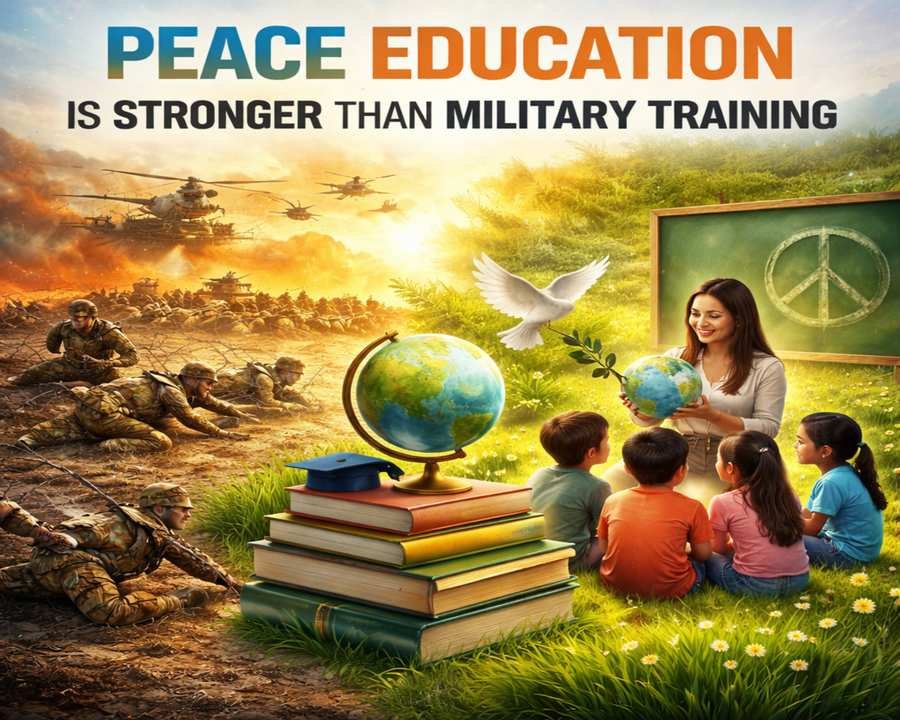
Nations have long believed that security is built through strength, and strength is measured by military power. Budgets grow for weapons, armies expand, and training focuses on combat readiness. From an early age, societies are taught to admire uniforms, discipline, and force. Yet despite centuries of military preparation, the world remains trapped in cycles of war, violence, and instability. This contradiction raises a fundamental question: if military training truly ensured peace, why does conflict persist?
The answer lies in a deeper truth—peace is not created by force alone, but by minds shaped to choose understanding over violence. Military training may defend borders, but peace education protects humanity. In the long run, peace education is not only stronger than military training; it is more effective, more sustainable, and more aligned with the survival of civilization itself.
Understanding the Purpose of Military Training
Military training is designed for a clear objective: to prepare individuals to fight, obey commands, and neutralize perceived threats. It emphasizes discipline, hierarchy, loyalty, and readiness to use force. In moments of immediate danger, such training can be necessary. A state has the right to protect its citizens from aggression.
However, military training addresses symptoms, not causes. It responds to conflict after it has already formed. It prepares for war but does not prevent it. Soldiers are trained to act once political, ideological, or economic failures have already escalated into violence.
Most importantly, military training assumes conflict as inevitable. Peace education, by contrast, challenges that assumption.
What Is Peace Education?
Peace education is not about teaching people to be passive or defenseless. It is about developing the intellectual and moral capacity to resolve conflicts without violence. It focuses on critical thinking, empathy, ethical reasoning, dialogue, cooperation, and respect for human dignity.
Peace education teaches individuals to:
- Understand root causes of conflict
- Question propaganda and hate narratives
- Resolve disputes through dialogue
- Respect diversity without fear
- Balance national identity with global responsibility
Unlike military training, which prepares for destruction, peace education prepares for coexistence.
Wars Begin in Minds—So Must Peace
History repeatedly shows that wars begin long before weapons are used. They start in minds—through fear, prejudice, misinformation, and dehumanization. Children are taught selective histories, citizens are fed enemy images, and societies slowly normalize hostility.
Military training enters the picture only after minds are already poisoned.
Peace education works at the source. It intervenes before fear becomes hatred, before difference becomes threat, and before disagreement becomes violence. A mind trained to think critically and ethically is far less likely to accept war as the first solution.
The Cost Comparison: Guns vs Classrooms
One fighter jet can cost as much as building hundreds of schools. One missile can equal the annual education budget of a poor region. Yet governments often justify massive military spending while calling education budgets “expenses.”
This imbalance has consequences. Societies that invest heavily in weapons but neglect education produce generations skilled in violence but poor in judgment. Peace education, on the other hand, delivers long-term returns:
- Reduced crime and extremism
- Stronger social cohesion
- Better governance
- Sustainable economic growth
Military power may deter an enemy temporarily. Educated minds prevent enemies from being created at all.
Peace Education Builds Stronger Citizens, Not Weaker Ones
A common argument against peace education is that it makes societies “soft” or “vulnerable.” This is a misunderstanding. Peace education does not remove strength—it redefines it.
True strength lies in:
- Self-control over aggression
- Wisdom over impulse
- Dialogue over domination
- Courage to compromise
History’s most resilient societies were not those that relied solely on force, but those that developed strong institutions, educated citizens, and ethical leadership. Peace education produces individuals who are confident, rational, and capable of defending values without resorting to blind violence.
Military Training Without Peace Education Is Dangerous
When military training is not balanced with peace education, it becomes a risk rather than a safeguard. Soldiers trained only to obey without ethical reflection can become tools of oppression. History offers painful examples where militaries were used against civilians, minorities, or political opponents.
Peace education introduces moral accountability. It teaches that orders must be evaluated against human values, international law, and conscience. A soldier educated in peace is less likely to commit atrocities and more likely to protect civilians.
Thus, peace education does not weaken defense forces—it humanizes them.
Breaking the Cycle of Revenge
Violence often reproduces itself. One act of aggression creates anger, which leads to retaliation, which fuels endless cycles of revenge. Military responses alone rarely end these cycles; they often deepen them.
Peace education teaches conflict resolution skills—listening, mediation, negotiation, and restorative justice. These skills help societies break free from historical grudges and inherited hatred.
Without peace education, children inherit conflicts they did not create. With peace education, they inherit the tools to end them.
Education Shapes Leadership—And Leadership Shapes Peace
Leaders emerge from education systems. If those systems reward dominance, nationalism without ethics, and zero-sum thinking, leaders will govern the same way. If education emphasizes empathy, evidence-based decision-making, and global responsibility, leadership quality improves.
Many modern conflicts are not failures of military capability but failures of leadership judgment. Peace education develops leaders who:
- Understand long-term consequences
- Avoid emotional decision-making
- Value diplomacy over escalation
- Recognize human cost beyond political gain
A single wise decision can prevent a war. That wisdom comes from education, not weapons.
Peace Education and Youth: The Decisive Factor
Young people are the most vulnerable to radicalization and the most powerful agents of peace. Extremist ideologies target youth precisely because young minds are still forming.
Peace education offers youth a sense of purpose without violence. It teaches them to question simplistic narratives, resist manipulation, and engage constructively with society.
A young person trained only in military ideology may learn how to fight. A young person trained in peace learns why fighting is often unnecessary.
Global Challenges Require Peaceful Minds
Modern threats—climate change, pandemics, economic inequality, cyber warfare—cannot be solved by armies alone. They require cooperation across borders, cultures, and political systems.
Military training is limited by national interest. Peace education encourages global thinking. It prepares citizens to see humanity as interconnected rather than divided into hostile camps.
In an interconnected world, peace education is not idealism—it is realism.
The False Glory of War
Societies often romanticize war, portraying it as heroic and honorable. The reality is different: war destroys families, traumatizes survivors, and diverts resources from human development.
Peace education demystifies war. It teaches history honestly—not as glory, but as tragedy. When people understand the true cost of violence, they become less willing to accept it casually.
This awareness is a powerful defense mechanism—stronger than any weapon system.
Peace Education Does Not Replace Defense—It Makes It Smarter
This is not an argument for abolishing all military training overnight. Defense structures may still be necessary in an imperfect world. However, defense without peace education is blind.
The strongest societies are those that balance security with wisdom. Military training should be the last line of protection, not the first response. Peace education ensures that force is used only when absolutely unavoidable.
In this balance, peace education plays the dominant role.
Conclusion: The Strongest Weapon Is the Educated Mind
Military training can protect a nation for a moment. Peace education can protect humanity for generations.
Weapons can win battles, but they cannot heal societies. Armies can guard borders, but they cannot remove fear from minds. Only education—ethical, critical, and compassionate—can do that.
If the goal is survival, dignity, and progress, then the choice is clear. Peace education is not weaker than military training—it is stronger, deeper, and more enduring.
A world that invests more in teaching children how to think than in training them how to fight is not naïve.
It is wise.
And wisdom, not force, has always been the true foundation of lasting peace.


