


In every era of human progress, one truth remains constant: societies advance not merely through resources or technology, but through people. Roads, factories, machines, and software may shape the physical structure of economies, but it is skilled manpower that brings them to life. Without trained hands and informed minds, even the most advanced systems remain underutilized. The journey from unskilled to unstoppable is not a matter of chance—it is the result of deliberate, structured, and continuous training. Manpower skill development is the invisible force that transforms individuals into assets, organizations into competitors, and nations into global players.
Understanding the Meaning of “Unskilled”
An unskilled worker is often misunderstood. It does not mean a lack of intelligence, effort, or potential. Rather, it refers to the absence of formal training, practical exposure, or standardized competencies required to perform specific tasks efficiently and safely. Across developing and even developed economies, millions of people possess raw talent and willingness to work but lack access to structured learning.
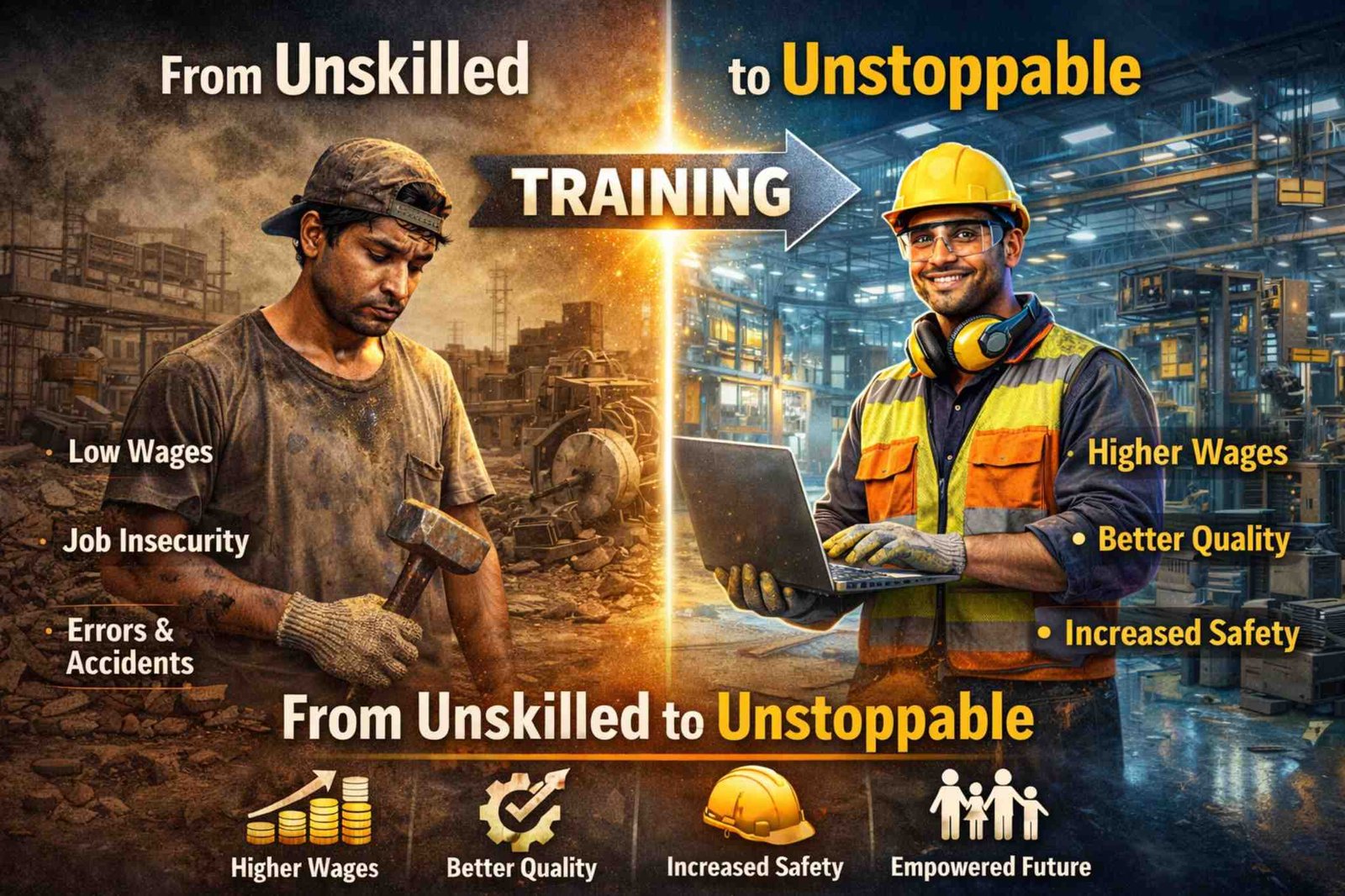
Unskilled manpower commonly faces low wages, job insecurity, workplace accidents, poor productivity, and limited career growth. From a macro perspective, a workforce dominated by unskilled labor restricts industrial efficiency, increases wastage, and limits innovation. This condition creates a cycle of low income, low productivity, and low national competitiveness.
Breaking this cycle requires one critical intervention: training.
Training as the Turning Point
Training is not merely an educational activity; it is a transformation process. It converts effort into efficiency, labor into expertise, and employment into empowerment. When individuals receive proper training, they do more than learn tasks—they understand processes, quality standards, safety practices, and problem-solving methods.
The transformation begins with clarity. Training provides workers with a clear understanding of what to do, how to do it, and why it must be done in a certain way. This clarity alone dramatically reduces errors, rework, and inefficiency.
More importantly, training instills confidence. A trained worker performs tasks with assurance, communicates better with supervisors, and adapts more quickly to change. Confidence is the foundation of initiative, and initiative is the foundation of growth.
Productivity: The First Visible Impact
One of the earliest and most measurable outcomes of manpower training is increased productivity. Skilled workers complete tasks faster, with fewer mistakes, and with consistent quality. They understand tools, machines, and systems well enough to optimize their use rather than struggle with them.
In manufacturing, trained operators reduce machine downtime, minimize material wastage, and maintain quality consistency. In service sectors, trained staff improve customer satisfaction, reduce complaints, and increase retention. In construction, trained workers ensure structural accuracy, safety compliance, and timely project completion.
Productivity gains from training benefit everyone:
- Workers earn more through better performance and job security
- Organizations reduce costs and increase profitability
- Customers receive better products and services
- Economies experience higher output and competitiveness
This multiplier effect is why training is often described as an investment rather than an expense.
Quality Improvement and Error Reduction
Unskilled manpower often relies on trial and error, which leads to defects, rejections, and customer dissatisfaction. Training replaces guesswork with knowledge. Workers learn standard operating procedures, quality checkpoints, and industry best practices.
When employees understand quality requirements, they stop seeing quality as management’s responsibility and start owning it themselves. This cultural shift—from inspection to prevention—is only possible through systematic training.
Quality-driven organizations consistently outperform their competitors, not because they work harder, but because their people work smarter.
Safety: Protecting Lives and Livelihoods
Workplace accidents are one of the most overlooked costs of unskilled labor. Lack of training leads to unsafe practices, misuse of equipment, and ignorance of hazards. Beyond human suffering, accidents cause production stoppages, legal liabilities, and reputational damage.
Training transforms safety from a rule-based obligation into a habit-based culture. Workers learn to identify risks, use protective equipment correctly, and respond effectively to emergencies. A trained workforce does not just follow safety rules—it understands their importance.
A safe worker is a productive worker. A safe workplace is a sustainable workplace.
Adaptability in a Changing World
Technology is evolving faster than ever. Automation, digital tools, artificial intelligence, and smart systems are reshaping industries. In this environment, untrained manpower becomes obsolete quickly, while trained manpower becomes adaptable.
Training builds learning capacity. Once workers learn how to learn, they can upgrade skills continuously. This adaptability ensures long-term employability and organizational resilience.
Companies that invest in regular upskilling can adopt new technologies smoothly, while those that neglect training struggle with resistance, errors, and inefficiency.
Empowerment Beyond the Workplace
The impact of training extends far beyond job performance. Skilled individuals experience higher self-esteem, social mobility, and economic independence. Training empowers people to make informed decisions, negotiate better wages, and pursue entrepreneurship.
For many, skill development is a pathway out of poverty. A trained worker can support a family, educate children, and contribute positively to the community. At scale, this empowerment strengthens social stability and reduces inequality.
In this sense, manpower training is not just an economic tool—it is a social investment.
Organizational Transformation Through Training
Organizations with structured training systems consistently outperform those without them. Training aligns employees with company goals, standardizes processes, and builds leadership pipelines.
Trained employees:
- Understand organizational vision and values
- Communicate more effectively across departments
- Solve problems proactively instead of escalating them
- Show higher loyalty and engagement
This reduces employee turnover, recruitment costs, and operational disruptions. Training also creates future supervisors, managers, and leaders from within, ensuring continuity and cultural consistency.
An organization’s strength is not its infrastructure—it is the competence of its people.
National Growth and Global Competitiveness
At a national level, skill development determines a country’s economic trajectory. Nations with skilled manpower attract foreign investment, develop export-oriented industries, and compete effectively in global markets.
Countries that prioritize training move from labor-intensive to knowledge-intensive economies. They export value, not just volume. They innovate instead of imitate.
In contrast, countries that neglect manpower development remain dependent on low-wage labor, vulnerable to automation, and trapped in economic stagnation.
History repeatedly proves that human capital is the most reliable resource a nation can build.
Challenges in Skill Development
Despite its importance, manpower training faces several challenges:
- Limited access to quality training facilities
- Mismatch between training content and industry needs
- Lack of qualified trainers
- Resistance to change among workers and management
- Short-term cost-focused decision-making
Overcoming these challenges requires collaboration between governments, industries, educational institutions, and training providers. Training must be practical, industry-relevant, and continuously updated.
The Way Forward: Making Manpower Unstoppable
To transform unskilled manpower into an unstoppable force, training must be:
- Continuous – not one-time events
- Practical – focused on real workplace needs
- Inclusive – accessible to all segments of society
- Aligned – connected with industry demands
- Measured – evaluated for effectiveness and impact
Organizations should embed training into their strategic planning, not treat it as an optional activity. Governments should support skill development through policy, funding, and infrastructure. Individuals should view learning as a lifelong responsibility.
Conclusion: Training as the Great Equalizer
From unskilled to unstoppable is not a slogan—it is a proven pathway. Training transforms manpower by unlocking potential, enhancing productivity, ensuring safety, and enabling growth. It empowers individuals, strengthens organizations, and builds resilient nations.
In a world where technology changes rapidly and competition is global, the true differentiator is not who works harder, but who is better trained. Machines can be bought. Resources can be depleted. But skilled people can adapt, innovate, and lead.
Training does not merely change what people do.
It changes who they become.
And when people grow, everything grows with them.


