



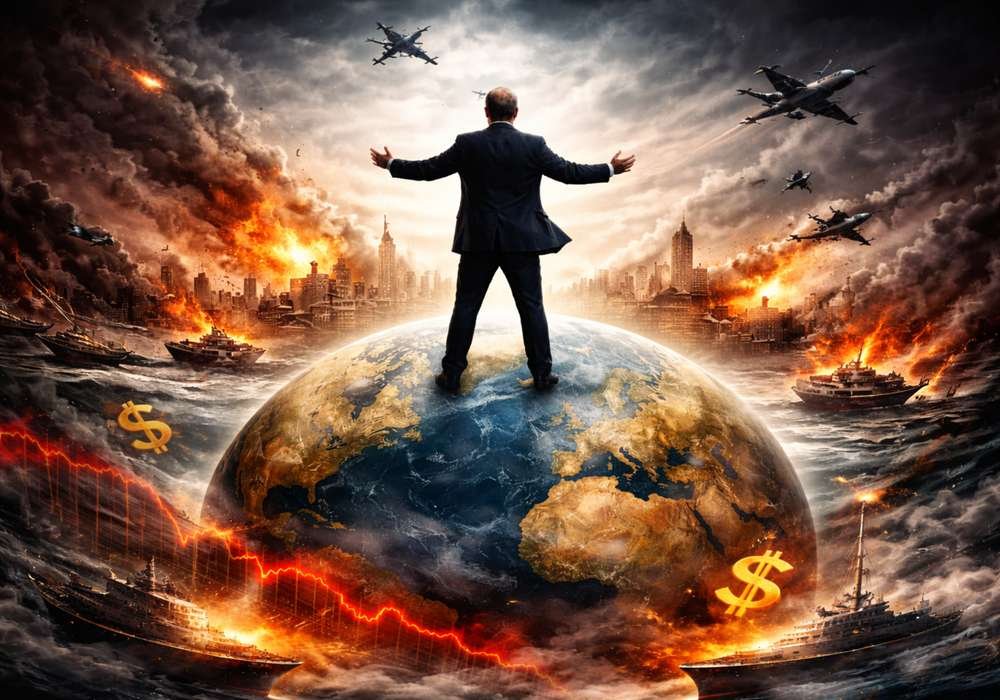
In an interconnected world, leadership in powerful nations no longer affects only domestic populations. Decisions made in the capitals of superpowers ripple across continents, shaking economies, destabilizing regions, altering climate outcomes, and in extreme cases, threatening human survival itself. When leadership is thoughtful, ethical, and informed, global stability becomes possible. But when leadership is impulsive, ignorant, ego-driven, or detached from reality, chaos follows.
Bad leadership in superpowers is not a local failure—it is a global hazard.
Power Multiplies Consequences
Power is not dangerous by itself. What makes power dangerous is poor judgment. Superpowers command vast military capabilities, control major financial systems, influence global trade, shape international institutions, and dominate narratives through media and diplomacy. A single miscalculation by a powerful leader can:
- Collapse financial markets
- Trigger regional or global conflicts
- Disrupt energy and food supply chains
- Undermine international law
- Accelerate climate and humanitarian crises
When a small country makes a mistake, it suffers internally. When a superpower does, the world pays the price.
What Defines Bad Leadership?
Bad leadership is not simply about lack of intelligence or formal education. History shows that destructive leaders often possess confidence, charisma, and authority—but lack wisdom, humility, and accountability. Bad leadership in superpowers typically exhibits several traits:
- Impulsive decision-making without consultation
- Ego-driven politics prioritizing image over impact
- Disregard for expert advice
- Simplistic thinking about complex global systems
- Short-term political gain over long-term stability
- Hostility toward institutions and norms
Such leadership mistakes confidence for competence and strength for recklessness.
Global Economics: When Bad Decisions Crash the World
Modern economies are tightly interconnected. Trade wars, sanctions, currency policies, and interest rate decisions by powerful countries shape global inflation, employment, and growth.
A poorly planned trade restriction can:
- Collapse export-dependent economies
- Increase global prices for food and energy
- Trigger retaliatory measures that spiral into economic conflict
When leaders use economic power as a weapon without understanding global interdependence, ordinary people across the world—especially in poorer nations—suffer first.
Bad leadership transforms economic tools into instruments of instability.
War and Military Escalation: From Local Tension to Global Crisis
Superpowers often position themselves as guardians of global security. Yet history shows that wars rarely begin with careful planning; they begin with misjudgment, miscommunication, and arrogance.
Poor leadership can:
- Escalate regional disputes into proxy wars
- Normalize military threats as political tools
- Undermine diplomatic solutions
- Increase the risk of accidental conflict
In a nuclear-armed world, even a moment of poor judgment can carry irreversible consequences. When leaders treat war as rhetoric or spectacle, humanity stands closer to catastrophe.
Climate Chaos: Leadership Failure Against a Global Threat
Climate change is not a future problem—it is a present emergency. Superpowers are among the largest contributors to emissions and resource consumption. Their leadership choices determine whether global climate cooperation advances or collapses.
Bad leadership in this area includes:
- Denial of scientific consensus
- Withdrawal from international agreements
- Prioritizing short-term industrial gains
- Weak environmental regulations
When powerful nations fail to lead, smaller nations lose incentives to act. The result is rising sea levels, extreme weather, food insecurity, and mass displacement—chaos not confined by borders.
Undermining Global Institutions and Rules
The modern world relies on international rules, agreements, and institutions to manage conflict and cooperation. Bad leadership weakens these systems by:
- Ignoring international law
- Undermining multilateral organizations
- Promoting unilateral actions
- Treating diplomacy as weakness
When powerful nations break rules openly, others follow. The erosion of global norms leads to a world governed by force rather than cooperation—a return to instability rather than progress.
Information Disorder and Cultural Damage
Superpowers shape global narratives. When leaders spread misinformation, attack science, dismiss journalism, or manipulate facts, truth itself becomes a casualty.
This creates:
- Distrust in democratic systems
- Polarization across societies
- Erosion of public reasoning
- A global culture of confusion and hostility
In the digital age, irresponsible leadership spreads chaos not only through policies, but through words amplified worldwide within seconds.
Why Do Bad Leaders Rise in Powerful Nations?
Bad leadership does not appear in isolation. It emerges from systemic weaknesses:
- Populism that rewards simple answers
- Media environments driven by outrage
- Voter frustration and economic inequality
- Weak political institutions
- Culture that glorifies strength over wisdom
Powerful nations are not immune to these forces. In fact, their global dominance sometimes creates the illusion that consequences can be ignored.
They cannot.
The World Pays the Price
When leadership fails in superpowers:
- Refugee crises expand
- Developing nations face instability
- Global inequality deepens
- Trust between nations collapses
- Future generations inherit irreversible damage
The most tragic aspect is that those least responsible—children, the poor, and vulnerable populations—suffer the most.
What the World Needs Instead
Global stability requires a different kind of leadership, especially in powerful nations:
- Humility over arrogance
- Wisdom over impulsiveness
- Consultation over isolation
- Long-term thinking over short-term popularity
- Responsibility over dominance
True strength is not the ability to act without consequence, but the discipline to act with restraint.
Conclusion: Power Without Wisdom Is Global Danger
The world today is too connected, too fragile, and too complex for careless leadership at the top of powerful nations. Bad leadership in superpowers does not merely fail its own people—it destabilizes humanity.
History repeatedly teaches one lesson:
When intelligence, ethics, and responsibility are absent from power, chaos fills the vacuum.
The question the world must continuously ask is not which nation is strongest—but who is wise enough to lead it.
Pixel 4a Review
The Google Pixel 4A currently tops our rank of the greatest Samsung phones available, beating even the pricier iPhone Ultra Max Mega.
So unsurprisingly this is an absolutely fantastic phone. The design isn't massively changed from the previous generation, but most other elements have been upgraded. This is what we call a big boost.
-
Display8.5
-
Performance9
-
Features7
-
Usability8
-
Battery Life10


