



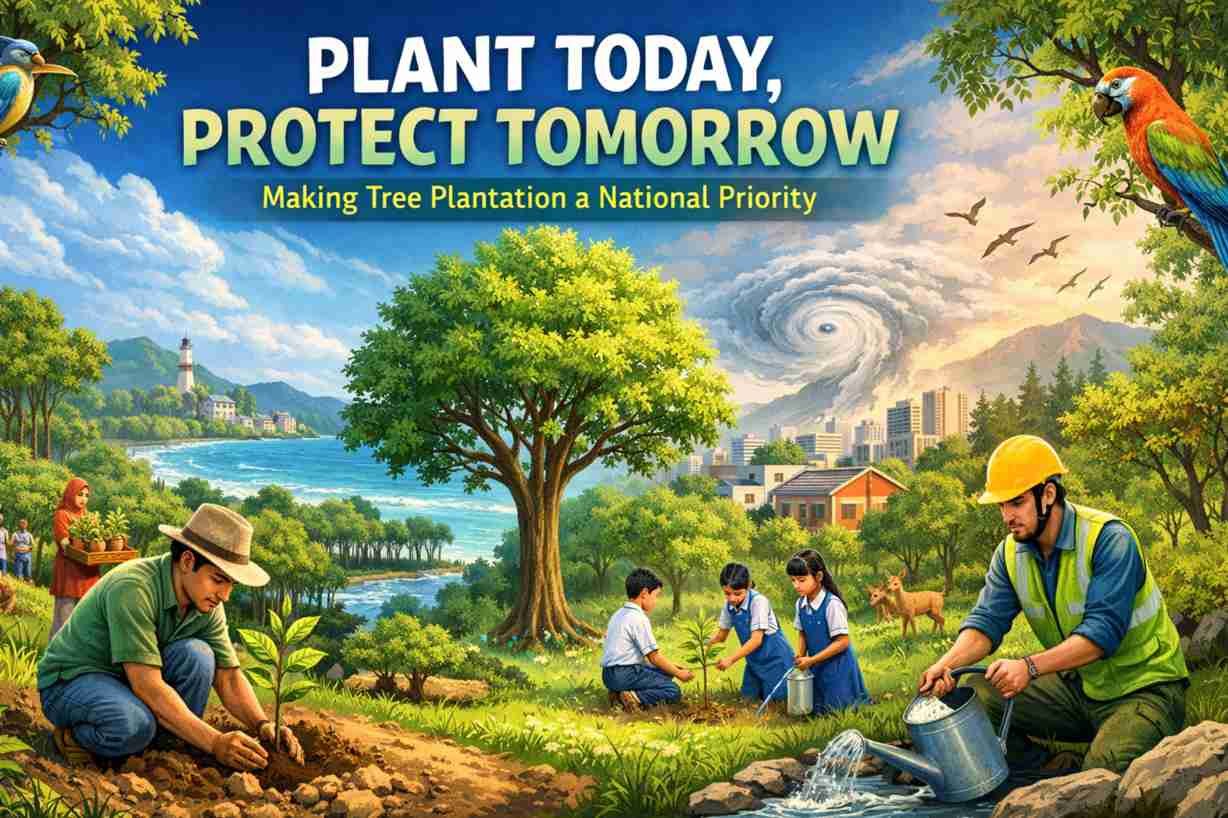
A nation’s future is not built only with roads, bridges, and factories. It is also built with shade, clean air, safe water, fertile soil, and a stable climate—things that trees quietly provide every single day. That is why “Plant Today, Protect Tomorrow” is more than a slogan. It is a realistic development strategy. If tree plantation becomes a true national priority—planned, protected, and maintained—countries like Bangladesh can reduce climate risks, strengthen public health, improve agriculture, and create green jobs at scale.
Tree plantation is often treated like a seasonal activity: a few events during the rainy season, some photo sessions, and then silence. But planting trees is only the first step. A national priority means treating trees like national infrastructure—just like embankments, drainage, bridges, and power grids. Trees protect lives and money. They reduce disaster damage, lower healthcare costs, and improve productivity. So, the real question is not, “Can we afford to plant trees?” The question is, “Can we afford not to?”
Why Trees Must Become a National Priority
In many developing nations, environmental protection is seen as a “luxury.” But for climate-vulnerable countries, it is a survival need. Trees are nature’s most cost-effective technology. They cool the air, store carbon, prevent erosion, recharge groundwater, protect riverbanks, and reduce the pressure on cities by improving rural livelihoods.
1) Climate resilience and disaster risk reduction
Bangladesh faces cyclones, storm surges, floods, drought-like heat, riverbank erosion, and salinity intrusion. Trees, especially in coastal belts and along embankments, act as living shields. A well-managed green belt can slow wind speed, reduce wave energy, and protect settlements. Inland, trees stabilize slopes, protect canals and wetlands, and reduce surface runoff that causes flash flooding. Tree plantation is not just about “beauty”—it is a disaster risk management tool.
2) Public health and livable cities
Urban areas are heating up. Concrete absorbs heat, traffic creates pollution, and reduced open space makes cities harsh for children and elderly people. Trees filter dust, absorb harmful gases, and provide shade that lowers temperatures. Even a small increase in urban greenery can reduce heat stress and improve mental well-being. Making tree plantation a priority means treating parks, roadside trees, school gardens, and city forests as essential public health infrastructure.
3) Water security and soil protection
Trees help water enter the ground slowly instead of rushing away. Their roots hold soil together, reducing erosion and siltation of canals and rivers. When soil stays where it belongs, farmland remains fertile and waterways remain navigable. This is especially important for a riverine country where siltation and narrowing of channels create serious economic and environmental problems. Tree plantation—combined with canal restoration, wetland protection, and dredging—forms a complete water resilience strategy.
4) Food security and stronger agriculture
Agroforestry—growing trees with crops—can increase farm income and protect fields from wind and extreme heat. Fruit trees provide nutrition, timber trees provide long-term savings, and shade trees protect livestock. Tree plantation can be designed to support farmers directly: windbreaks along fields, orchards near homesteads, and community woodlots that reduce illegal cutting in natural forests.
5) Green jobs and local economies
A nationwide plantation drive creates employment in nurseries, seed collection, planting, fencing, watering, monitoring, pruning, and value-added industries (fruit processing, bamboo products, furniture, medicinal plants). If managed properly, this can become a long-term green economy—especially for youth and rural communities.
The Difference Between “Planting Trees” and “Building a Forest Future”
Many plantation programs fail because they focus on numbers: “We planted one million saplings.” But success is not measured at planting day. Success is measured after 1 year, 3 years, and 5 years—by survival rate, biodiversity, and community ownership.
A national priority requires three shifts:
Shift 1: From events to systems
Plantation must be planned like a national program, with targets, budgets, monitoring, and accountability—not random campaigns.
Shift 2: From saplings to survival
A plantation program should publicly report survival rates. If 60% trees die, that is not success. Survival needs fencing, watering, protection from grazing, and local caretakers.
Shift 3: From single-species planting to biodiversity
Monoculture plantations may grow fast, but they can harm ecosystems, reduce wildlife habitat, and become vulnerable to disease. Native and mixed species planting is healthier, more resilient, and more beneficial.
Where the Nation Should Plant First
To make tree plantation a national priority, the country needs a clear map of priority zones. The goal is not to plant everywhere randomly. The goal is to plant strategically where trees deliver maximum protection.
1) Coastal green belts and cyclone-prone areas
Strengthen mangroves and coastal plantations where they can reduce wind and storm surge impacts. This includes protecting existing mangrove ecosystems and restoring degraded coastal lands.
2) Riverbanks, canals, and wetlands
Plant deep-rooted native species along riverbanks to reduce erosion, stabilize soil, and protect waterways from encroachment. Restore canal networks and plant along both sides to protect the channel and improve water retention.
3) Roadsides, railways, and embankments
Linear plantations provide shade, reduce dust, and lower heat. But they must be planned with safe species selection so roots do not damage structures and branches do not become hazards during storms.
4) Cities: schools, hospitals, parks, rooftops, and empty plots
Urban tree programs should prioritize neighborhoods with low green coverage and high heat exposure. Every school can have a “student forest,” every hospital can have a healing garden, and every city can protect remaining open land as green reserves.
5) Degraded forests and hill tracts
Reforestation must focus on ecosystem restoration, not commercial plantations only. Mixed native species, protected regeneration, and community co-management are key to long-term success.
How to Make Tree Plantation a True National Priority
A national priority needs policy, funding, governance, education, and social participation. Here are practical steps that can transform plantation from a seasonal campaign into a national movement with measurable outcomes.
1) Set a clear national target with survival accountability
Instead of announcing “X million saplings,” set targets like:
- 80% survival rate after 3 years
- biodiversity score requirements (minimum number of native species per site)
- maintenance budget per tree for the first 2–3 years
Every ministry, city corporation, and district administration can have assigned targets and public dashboards.
2) Create a “Tree Protection Law” with strict enforcement
Planting without protection is wasted money. Laws should prevent:
- illegal tree cutting,
- destruction of roadside plantations,
- encroachment on parks, wetlands, and forest lands.
But enforcement must be fair and community-friendly: provide legal access to alternative fuel, promote efficient cookstoves, and support community woodlots to reduce pressure on natural forests.
3) Build a national nursery and seed system
Good plantations depend on good seedlings. The country needs:
- certified nurseries,
- seed banks for native species,
- training for nursery owners,
- quality control to prevent weak or invasive species.
A single weak seedling equals years of lost work. Quality must be non-negotiable.
4) Make schools and madrasas the heart of the movement
If children grow up planting and caring for trees, the nation changes forever. A school-based program can include:
- a “one student, two trees” initiative,
- tree care clubs,
- practical lessons on biodiversity and climate,
- yearly monitoring by students.
This transforms tree plantation into a culture, not a project.
5) Engage local communities with incentives and ownership
People protect what they own. Community forestry and local co-management can be strengthened by:
- giving communities rights to benefits (fruit, pruning wood, bamboo),
- paying caretakers for survival performance,
- involving local groups in monitoring and reporting.
If villagers, students, and local leaders become guardians, trees survive.
6) Use technology for monitoring and transparency
A simple national system can track plantation sites by:
- GPS location,
- species list,
- planting date,
- photos every 6 months,
- survival rate reporting.
This reduces corruption, improves learning, and builds public trust. Even youth volunteers can contribute using mobile tools.
7) Link plantation with national development projects
Every new road, bridge, industrial zone, housing project, and river protection project should include:
- mandatory green buffers,
- compensation plantation for removed trees,
- long-term maintenance plans.
Development should not erase nature. Development should rebuild nature better.
Choosing the Right Trees: Native, Useful, and Safe
Not every tree belongs everywhere. Species selection should consider:
- native biodiversity value,
- root strength for erosion control,
- drought and salinity tolerance (especially coastal areas),
- fruit and livelihood benefits (where appropriate),
- urban safety (branch strength, non-invasive roots).
Mixed planting is usually best: timber + fruit + native habitat trees. This balances economy and ecology.
The Role of Media, Business, and Religious Institutions
Media can keep the national focus alive by publishing survival reports, highlighting best practices, and exposing illegal cutting or land grabbing.
Businesses can support plantation through genuine CSR programs:
- funding nurseries,
- sponsoring roadside green belts,
- supporting urban parks,
- ensuring industrial sites maintain green buffers.
Religious institutions can contribute by planting and protecting trees around mosques, temples, and community spaces, and by encouraging environmental responsibility as a moral duty.
Common Mistakes That Must Stop
To make plantation a national priority, we must stop repeating the same errors:
- Planting without watering or fencing
- Choosing fast-growing monoculture only
- Planting in the wrong season
- Planting without community involvement
- Ignoring survival data
- Cutting old trees to “replace” with new saplings
A mature tree is worth far more than a newly planted sapling. Protecting existing trees is as important as planting new ones.
A National Mission: Plant Today, Protect Tomorrow
Tree plantation should not be treated as a “nice activity.” It should be treated as national defense—defense against heat, floods, storms, pollution, erosion, and climate instability. The best time to plant a tree was years ago. The second-best time is now. But we must plant wisely, protect seriously, and maintain patiently.
If the nation commits to a long-term tree plantation mission—backed by law, budgets, education, community ownership, and transparent monitoring—then the results will be visible in every part of life: cooler cities, safer coasts, healthier children, richer farms, stronger rivers, and a more stable future.
Plant today, protect tomorrow. Not as a slogan for a banner—but as a national promise, practiced every season, every year, for generations.


