



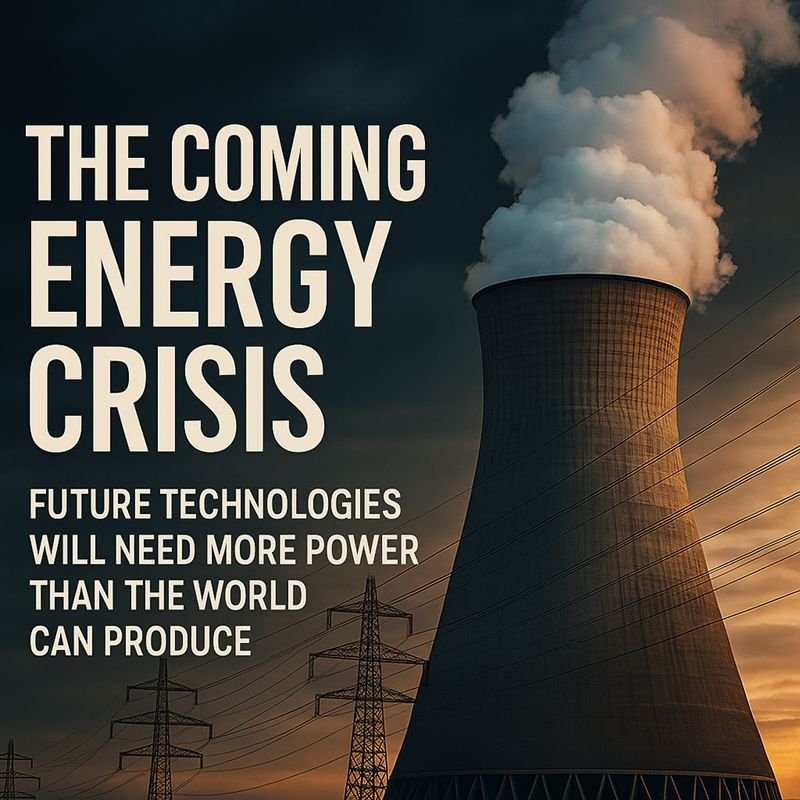
Human civilization is standing at a critical crossroads. Never in history have we experienced a technological revolution as rapid and all-encompassing as the one unfolding today. Artificial intelligence, electric transportation, robotics, automation, data centers, crypto mining, and smart infrastructure are transforming the world at a speed that even experts struggle to keep up with. These innovations promise economic growth, convenience, and unimaginable progress. But behind this progress lies a shadow—a growing energy crisis that humanity is almost unprepared to confront.
Future technologies demand enormous amounts of electricity, cooling water, rare minerals, and stable grids. As global energy needs surge, the world may face a phenomenon that experts already warn about: technology will advance faster than our ability to power it.
This article explores the coming energy crisis, why future technologies will need more power than the world can produce, and what humanity must do to prevent a catastrophic imbalance.
1. Technology’s Energy Appetite Has Exploded
Every year, humanity invents more powerful tools—but every innovation comes with a hidden cost: energy consumption.
Today’s cutting-edge technologies require far more energy than anything built in the past century:
AI and Machine Learning
Training a single advanced AI model consumes as much electricity as a small town uses in months. Running that model for millions of users then multiplies the energy footprint further.
Data Centers
Data centers are the backbone of the digital world—storing videos, messages, apps, websites, financial systems, and every AI service.
But they consume shocking amounts of power:
- Google’s data centers use more electricity than entire countries.
- Meta’s AI infrastructure now consumes over 9 terawatt-hours annually.
- By 2030, data centers may consume 10% of global electricity.
Electric Vehicles (EVs)
While EVs reduce fuel consumption, they increase dependence on electricity. A world filled with EVs requires massive grid upgrades and new power plants.
Cryptocurrency Mining
Bitcoin mining alone consumes more electricity than Sweden. Other cryptocurrencies add further pressure.
Robotics and Automation
Factories of the future will be fully automated—machines, robots, and sensors running 24/7.
Automation increases productivity but requires continuous power without interruption.
Smart Homes & Smart Cities
From smart lighting to IoT devices, billions of microdevices constantly draw small but cumulative amounts of power.
Humanity’s digital lifestyle has become an energy-hungry beast—and its appetite grows every second.
2. Why the Future Will Require MUCH More Energy
The future is not slowing down. Our energy needs are expanding because:
A. AI Will Become 1000 Times Stronger
With models becoming more complex, AI training requirements multiply monthly. Future AI systems—superintelligence, large-world models, real-time agents—will need massive parallel computation, which demands gigantic electrical power.
B. Everything Is Moving to the Cloud
Businesses, governments, and individuals rely on cloud and remote servers for everything.
Even simple tasks—opening a photo, sending a message, watching a video—activate a chain of servers around the world.
More digital dependency = more electricity needed.
C. Billions of New Devices Are Coming Online
The rise of the Internet of Things (IoT) means:
- Smart fridges
- Smart watches
- Smart vehicles
- Smart industries
- Smart agriculture
- Smart healthcare
Each “smart” upgrade increases energy use.
D. Electric Vehicles Will Replace Petrol Cars
If all cars become electric, global electricity needs will surge by 40–60%. Today’s grids are not ready.
E. Space Technology and Satellite Internet
Starlink, Amazon Kuiper, and future space-based networks require constant energy to maintain communication with thousands of satellites.
F. Water Cooling Requirements Are Exploding
Modern AI data centers need millions of liters of water daily for cooling servers.
This creates a water-energy-technology triangle where each depends on the other.
The world is heading toward a future where energy demand will double or possibly triple by 2050.
3. The World’s Energy Supply Cannot Keep Up
Even with advanced technologies, energy production is struggling to expand at the required pace.
A. Fossil Fuels Are Declining
Oil, coal, and natural gas are finite.
Countries are under pressure to reduce carbon emissions.
At the same time, global demand continues rising—creating a dangerous imbalance.
B. Renewable Energy Has Limitations
Solar and wind energy are incredible, but:
- They depend on weather
- They require massive land area
- Storage batteries are expensive
- They cannot provide stable base load energy
Renewables alone cannot power future AI and industrial systems.
C. Nuclear Power Is the Strongest Option—but Also the Most Difficult
Nuclear energy is powerful and clean.
But it suffers from:
- High construction cost
- Long approval cycles
- Safety concerns
- Radioactive waste
- Political resistance
Although nuclear energy could solve much of the coming crisis, most countries move too slowly to adopt it.
D. Emerging Economies Are Growing Fast
Countries like Bangladesh, India, Vietnam, Indonesia, and African nations are industrializing rapidly.
This increases:
- factory energy demand
- industrial machinery usage
- air conditioning usage
- technology consumption
The global energy requirement is rising faster than supply.
4. The Cooling Crisis: Technology Needs Water Too
It is not only electricity—modern technology needs huge amounts of water for cooling.
Data centers cannot run without water.
AI servers heat up dramatically and require constant cooling.
Examples:
- A single AI data center can use up to 5 million gallons of water per day.
- Water shortages in major cities will force data centers to reduce operations.
- Some regions already face conflicts over water between agriculture, households, and AI companies.
This creates a double crisis: electricity shortage AND water shortage.
5. If This Continues: What Will Happen by 2035–2050?
Experts warn that without major reforms, the world may face:
1. Electricity Blackouts
As grids crack under pressure, countries will experience more frequent outages—affecting industries, hospitals, and digital services.
2. Slowing Technological Growth
Companies will not be able to train large AI models due to power limitations.
3. Rising Energy Costs
Electricity prices could double or triple, affecting everyone—from factories to ordinary households.
4. Shutdown of High-Power Industries
Crypto mining, heavy robotics, and steel plants may face forced restrictions.
5. Digital Inequality Between Rich and Poor Nations
Countries with strong energy infrastructure will dominate the future. Others may fall behind by decades.
6. Geopolitical Tension
Energy-rich nations will gain massive power.
Energy-poor nations will face economic collapse.
6. How Humanity Can Avoid the Coming Energy Crisis
Although the crisis is real, solutions exist—if implemented in time.
A. Build Next-Generation Nuclear Power Plants
Small Modular Reactors (SMRs) and advanced nuclear technologies offer safe, powerful, long-term electricity solutions.
These must be adopted urgently.
B. Invest in High-Efficiency Engines and Machinery
Factories must replace:
- old motors
- outdated compressors
- energy-wasting pumps
- inefficient chillers
with VFD-based, inverter-based, IE3/IE4 motors, and modern equipment.
C. Build Greener, Smarter Data Centers
Companies must use:
- liquid cooling
- geothermal cooling
- AI-based energy optimization
- renewable-backed server farms
to reduce power waste.
D. Develop Better Battery Storage
Energy from renewables must be stored efficiently.
Advanced batteries, hydrogen storage, and compressed air systems can help stabilize future grids.
E. Build Energy-Efficient Cities
Urban planning must include:
- smart grids
- high-efficiency buildings
- optimized transportation
- strict energy codes
without these measures, no city will support future technology demands.
F. Promote Natural Gas As the Transitional Fuel
Natural gas is cleaner, stable, and widely available.
It can serve as a bridge until renewable and nuclear technologies mature.
G. Educate Industries and Citizens
Companies must adopt global standards like:
- ISO 50001 (Energy Management System)
- ISO 14001 (Environmental Management)
- ISO 9001 (Quality)
Stronger energy management will reduce waste and increase savings.
7. Why This Crisis Matters for Developing Countries
Nations like Bangladesh, India, Pakistan, Nepal, Sri Lanka, Vietnam, and much of Africa face additional challenges:
- older infrastructure
- limited electricity generation
- dependence on fuel imports
- rising population
- industrial expansion
If they fail to modernize, they risk falling 50 years behind in the digital era.
Countries that ignore the energy crisis will be unable to support industries like:
- AI development
- semiconductor manufacturing
- electric vehicle production
- automation
- large-scale digital services
This will widen the global economic gap dramatically.
8. The Hard Truth: Humans Want Unlimited Technology—but the Planet Has Limits
We want:
- unlimited AI
- unlimited data
- unlimited internet
- smart cars
- smart devices
- robots
- automation
- EVs
But the planet cannot generate unlimited electricity.
Technology is speeding forward while energy infrastructure walks slowly behind.
If this gap continues to widen, we will reach a breaking point.
Conclusion: The Future Belongs to the Nations That Understand Energy
The coming energy crisis is not just a technical problem—it is a civilization problem.
Human advancement, economic stability, digital transformation, industrial growth, and national security all depend on energy.
If the world fails to expand and modernize energy production, future technologies will slow, economies will collapse, and conflicts may arise over access to electricity and water.
But if countries act now—investing in nuclear, natural gas, efficient machines, smart grids, and renewable innovations—the world can enjoy a future filled with progress, powered sustainably.
The message is clear:
Technology is rising. Energy must rise with it.
Otherwise, the future will be a world of promises we cannot afford to power.


