



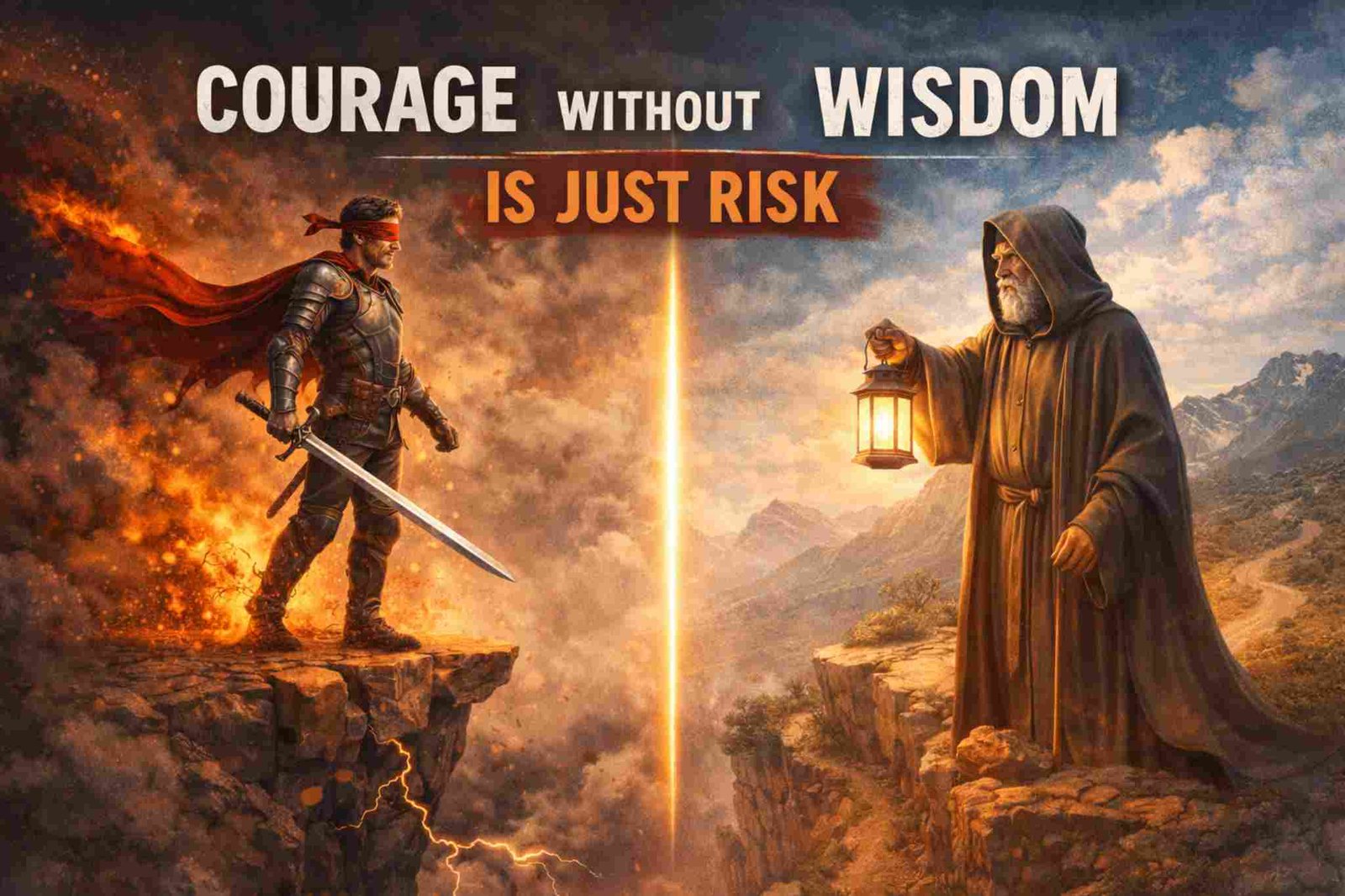
Courage is one of the most admired human qualities. From childhood stories to national histories, brave individuals are celebrated as heroes—those who stepped forward when others hesitated, who acted when fear ruled the moment. Courage gives us movement, momentum, and the strength to face danger. But courage, when detached from wisdom, becomes something far less noble. It becomes recklessness. It becomes blind risk. It becomes destruction disguised as bravery.
The truth is uncomfortable but essential: courage without wisdom is not virtue—it is danger.
In a world increasingly shaped by fast decisions, emotional reactions, and public displays of boldness, we often confuse loud action with meaningful bravery. Wisdom, patience, and foresight are dismissed as weakness, while impulsive courage is praised. Yet history, leadership failures, personal tragedies, and global conflicts repeatedly prove the same lesson—unwise courage destroys more than fear ever could.
This article explores why courage alone is insufficient, how wisdom transforms bravery into strength, and why societies, leaders, and individuals must learn to value intelligent restraint as much as bold action.
Understanding Courage: Action in the Face of Fear
At its core, courage is the ability to act despite fear. It is not the absence of fear but the decision to move forward anyway. Courage allows soldiers to defend nations, doctors to enter epidemic zones, whistleblowers to expose corruption, and ordinary people to stand up for what is right.
Without courage, progress stalls. Fear keeps injustice intact. Silence protects wrongdoing. In this sense, courage is essential. A world without courage would be stagnant and submissive.
But courage alone does not define good action—only action.
When courage is not guided by understanding, knowledge, ethics, and foresight, it loses its moral value. It becomes impulsive force rather than purposeful strength.
Wisdom: The Missing Half of Bravery
Wisdom is not intelligence alone. It is the ability to apply knowledge with judgment, experience, ethics, and long-term thinking. Wisdom asks questions courage often ignores:
- What are the consequences of this action?
- Who might be harmed?
- Is this the right time?
- Is there a better way?
- Am I acting out of ego, anger, or responsibility?
Wisdom slows courage just enough to prevent disaster.
True bravery is not rushing into danger blindly—it is choosing the right danger, for the right reason, at the right time. That choice requires wisdom.
Without wisdom, courage becomes noise. With wisdom, courage becomes leadership.
Courage Without Wisdom: A History of Failure
History is full of courageous individuals and movements that failed because wisdom was absent.
Many wars were started by leaders who believed boldness equaled strength. They charged forward with confidence, ignoring economic realities, human cost, and diplomatic alternatives. The result was not glory but devastation—millions of lives lost, nations broken, and generations traumatized.
Revolutions driven by anger rather than planning often replaced one tyranny with another. The courage to overthrow was present; the wisdom to build was missing.
On a personal level, people make reckless choices in the name of bravery—quitting careers without preparation, confronting powerful forces without strategy, taking dangerous risks to prove fearlessness. When consequences arrive, courage alone offers no protection.
These failures are not due to a lack of bravery. They are failures of wisdom.
Leadership: Why Boldness Is Not Enough
Leadership is one of the most dangerous places for unwise courage.
A courageous but unwise leader makes dramatic decisions to appear strong. They reject advice, dismiss experts, and confuse stubbornness with confidence. Such leaders often say, “We must act now,” without asking whether action is correct.
Wise leaders understand something critical: not every action is courageous, and not every pause is cowardice.
Sometimes, the bravest decision is restraint.
Sometimes, the strongest move is patience.
Sometimes, walking away saves more lives than charging forward.
Great leaders balance courage with wisdom. They know when to speak and when to listen, when to fight and when to negotiate, when to move and when to wait.
History remembers them not for loud actions, but for lasting results.
The Courage of Silence and Self-Control
Modern culture often glorifies visible bravery—public confrontations, viral outrage, dramatic gestures. Quiet courage is overlooked.
But it takes immense wisdom to remain silent when provoked, to walk away from unnecessary conflict, to delay gratification, to admit uncertainty, or to change one’s mind.
Self-control is one of the highest forms of courage, yet it rarely receives applause.
A wise person understands that not every battle deserves engagement. Courage without wisdom fights every war; wisdom chooses which wars matter.
Intelligence Alone Is Not Enough Either
It is important to clarify: wisdom does not mean intelligence without action. Intelligence without courage leads to hesitation, fear of failure, and wasted potential. Smart people may see the problem clearly but do nothing.
That is why courage still matters.
But courage must be built on wisdom, not separated from it.
The ideal human quality is not bravery alone or intelligence alone, but wise courage—the union of understanding and action.
Courage, Ego, and the Illusion of Strength
One of the most dangerous enemies of wisdom is ego.
Ego-driven courage seeks validation, dominance, and recognition. It wants to prove strength rather than serve purpose. This kind of courage is loud, defensive, and impatient.
Wise courage is quiet, secure, and focused on outcomes—not applause.
Many reckless decisions are justified as “being bold” when they are actually attempts to protect pride. Wisdom demands humility—the willingness to admit limits, listen to others, and accept complexity.
True courage is not afraid of wisdom. Only ego is.
Modern Society and the Crisis of Unwise Courage
Today’s world moves faster than ever. Social media rewards instant reactions. Politics rewards aggressive posturing. Business culture often praises “move fast and break things” without asking what is being broken—or who.
In such an environment, wisdom struggles to survive.
Yet the problems we face—climate change, global conflict, economic inequality, technological ethics—are not problems that can be solved by reckless courage. They require thoughtful, coordinated, informed bravery.
The future belongs not to the loudest risk-takers, but to those who combine courage with deep understanding.
Teaching the Next Generation: A New Definition of Bravery
If we teach children that bravery means never being afraid, never backing down, and always charging forward, we raise a generation skilled in risk but poor in judgment.
We must teach a better definition:
- Bravery includes thinking.
- Bravery includes restraint.
- Bravery includes learning before acting.
- Bravery includes admitting mistakes.
A wise child who learns to assess danger, seek advice, and choose thoughtful action is far braver than one who runs headfirst into harm.
Conclusion: Wisdom Is What Makes Courage Worthy
Courage is powerful—but power without direction is destruction.
Wisdom gives courage its moral compass. It transforms risk into responsibility, action into leadership, and bravery into lasting impact.
The world does not need more reckless heroes. It needs wise ones.
Because in the end, courage without wisdom is just risk—and wisdom without courage is just thought. Only together do they create progress, justice, and true strength.


