



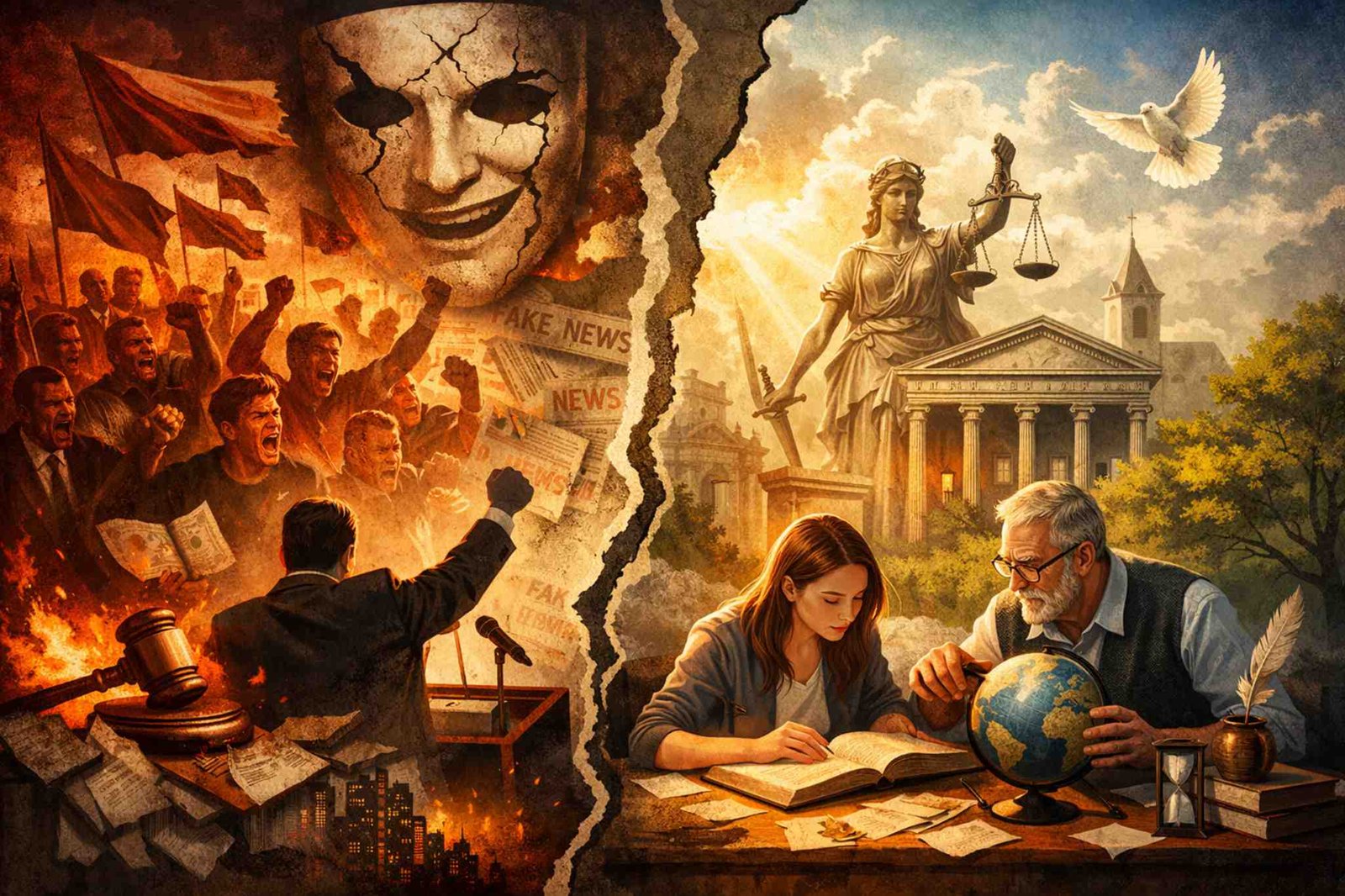
Nations rarely lose their morality and honesty in a single dramatic moment. The decline is gradual, subtle, and often disguised as passion, patriotism, or political loyalty. One of the earliest and most dangerous signs of this decay appears when politics begins to teach people whom to hate before it teaches them how to think. In such societies, emotions replace ethics, loyalty replaces truth, and noise replaces reasoning. What follows is not just political polarization, but a deep moral erosion that affects every layer of national life.
At its core, morality is the collective agreement on what is right and wrong, fair and unfair, acceptable and unacceptable. Honesty is the discipline of truth—truth in words, actions, and intentions. Both morality and honesty depend on thinking: the ability to reflect, to judge evidence, to recognize complexity, and to empathize with others. When politics undermines thinking, it undermines the very foundations on which morality and honesty stand.
Politics is meant to be a tool for organizing differences within a society. Diverse opinions, competing interests, and conflicting visions are natural in any nation. Healthy politics channels these differences into dialogue, debate, and decision-making. It requires citizens to listen, evaluate arguments, and sometimes accept uncomfortable truths. However, when politics shifts from persuasion to provocation, from reasoning to rage, it stops being a public service and becomes a weapon.
Teaching people to hate is far easier than teaching them to think. Thinking demands patience, education, humility, and effort. Hatred demands none of these. Hatred offers instant clarity: a villain, a narrative, and a sense of belonging. It simplifies complex realities into emotionally satisfying explanations. Political actors who rely on hatred know this well. When ideas are weak, emotions are amplified. When solutions are absent, enemies are invented.
The first casualty of this approach is honesty. In a hatred-driven political environment, truth becomes secondary to usefulness. Facts are accepted or rejected not based on accuracy, but on whether they support one’s side. Lies are justified if they harm opponents. Silence becomes a survival strategy for those who fear social or political retaliation. Over time, dishonesty is normalized. People no longer ask, “Is this true?” but “Is this helpful to us?”
This selective relationship with truth corrodes public life. Media outlets become partisan amplifiers rather than sources of information. Social discourse becomes flooded with half-truths, exaggerations, and deliberate misinformation. Citizens, trained to react emotionally rather than think critically, share narratives that confirm their hatred without verification. In such an environment, honesty is no longer rewarded; it is punished as betrayal.
Morality soon follows honesty into decline. When hatred defines political identity, ethical standards become conditional. The same act is judged differently depending on who commits it. Corruption is condemned in opponents and excused in allies. Abuse of power is justified if it serves the “right” cause. Violence is rationalized when directed at the “wrong” people. This moral double standard destroys the idea of justice as a shared principle and replaces it with tribal loyalty.
Once morality becomes tribal, society fragments. Citizens stop seeing each other as individuals with rights and dignity and begin seeing each other as symbols of political camps. Dehumanization becomes common language. Insults replace arguments. Fear replaces understanding. In such a climate, empathy is considered weakness, and cruelty is mistaken for strength. A nation cannot remain morally healthy when its people are taught to hate their neighbors before understanding their humanity.
Institutions, which depend on shared moral and ethical norms, also suffer. Courts lose legitimacy when judgments are evaluated through partisan lenses. Civil servants are pressured to serve parties rather than laws. Law enforcement becomes selective. Accountability weakens. When institutions are no longer trusted to be fair, people stop respecting them. This creates a dangerous cycle: moral decay weakens institutions, and weakened institutions accelerate moral decay.
Education, which should be the strongest defense against such decline, often becomes a battleground. When politics prioritizes hatred, education is reshaped to serve narratives rather than truth. History is rewritten, critical thinking is discouraged, and questioning is framed as disloyalty. Young people are taught slogans instead of skills, identities instead of inquiry. A generation raised in such an environment may be politically loud but ethically shallow, confident in opinion but fragile in judgment.
The economic consequences of moral and intellectual decline are significant. Honesty is essential for markets, contracts, and cooperation. When dishonesty spreads, trust collapses. Businesses struggle in environments where rules are inconsistently applied and corruption is tolerated. Innovation suffers when free inquiry is suppressed. Skilled individuals leave in search of societies that value truth and integrity. Economic decline then feeds further resentment, which politics again converts into hatred, deepening the cycle.
Social relationships deteriorate as well. Families, friendships, and communities fracture under political hostility. Conversations become confrontations. Differences become personal attacks. People self-censor to avoid conflict. The shared social space that holds a nation together shrinks. When trust between citizens disappears, cooperation becomes impossible. Even simple collective actions—disaster response, public health measures, community development—become politicized and contested.
On the international stage, nations that lose moral clarity and intellectual discipline become unpredictable. Leaders who depend on hatred for domestic support often adopt aggressive postures abroad. Diplomacy is dismissed as weakness. Compromise is framed as surrender. National honor becomes entangled with personal ego and political survival. Such behavior increases the risk of conflict, not because war is necessary, but because restraint becomes politically dangerous.
Perhaps the most tragic aspect of hatred-first politics is how it exploits real pain. Economic inequality, social change, and cultural anxiety are genuine challenges. Instead of addressing these issues with honesty and thoughtful policy, divisive politics redirects frustration toward scapegoats. People are encouraged to blame rather than understand, to resent rather than resolve. This may provide emotional relief, but it leaves underlying problems untouched, ensuring that anger returns stronger each time.
It is important to distinguish between disagreement and hatred. Disagreement is healthy and unavoidable. Hatred is destructive and learned. Societies grow through debate, not through uniformity. Morality does not require consensus; it requires respect. Honesty does not require agreement; it requires sincerity. A thinking society can argue fiercely and still remain ethical. A hatred-driven society cannot.
Recovering morality and honesty requires a conscious shift in political culture. Leaders must resist the temptation of easy mobilization through fear and anger. They must choose explanation over exaggeration, responsibility over applause. This is difficult, especially in environments where outrage is rewarded. But leadership is defined precisely by the willingness to choose what is right over what is popular.
Citizens also bear responsibility. Democracy is not a spectator sport. Thinking must be practiced. Narratives must be questioned. Sources must be examined. Emotional reactions must be paused. Refusing to hate on command is an act of civic courage. It requires individuals to accept discomfort, uncertainty, and complexity—qualities essential for moral maturity.
Media and education systems play decisive roles in this process. Journalism must prioritize accuracy, context, and accountability over speed and sensationalism. Education must emphasize critical thinking, ethical reasoning, and empathy. Teaching people how to think does not make them weak; it makes them resilient. A society capable of thinking is harder to manipulate and less likely to surrender its morality.
Ultimately, the strength of a nation is not measured solely by its economy, military, or technological advancement. It is measured by the character of its people and the integrity of its public life. When politics teaches people to hate before they learn to think, it poisons that character and undermines that integrity. Morality fades because hatred justifies cruelty. Honesty disappears because truth becomes inconvenient.
A nation begins to lose its morality and honesty not when its people disagree, but when they are trained to stop thinking. It loses itself when anger replaces conscience, when loyalty replaces truth, and when hatred replaces humanity. The survival of any society depends on a simple but demanding choice: to educate minds before inflaming emotions, to cultivate thought before exploiting fear. History shows that nations which fail to make this choice may survive in name, but they are already lost in spirit.


