



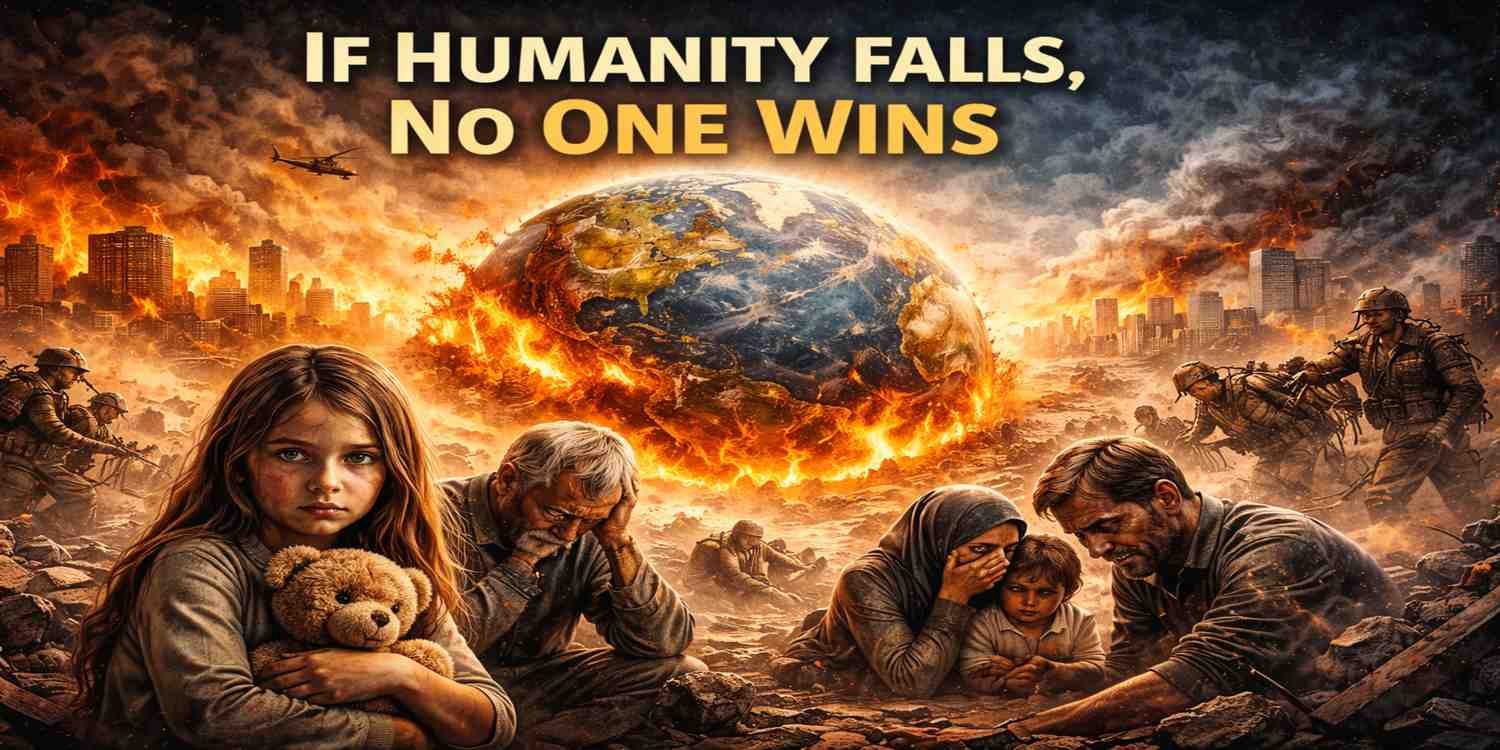
Humanity has reached a point in history where progress and collapse exist side by side. Never before have we possessed such advanced technology, global connectivity, and scientific knowledge. And yet, never before have we been so divided, distrustful, and destructive toward one another. Wars rage, inequality deepens, ecosystems collapse, and hatred is normalized across societies. In this fragile moment, one truth stands above all others:
If humanity falls, no one wins.
There will be no victors standing on the ruins of civilization. No ideology, nation, corporation, or individual can claim success in a world stripped of dignity, compassion, and life itself. Humanity is not a luxury of peace—it is the foundation of survival.
The Dangerous Illusion of Winning
Throughout history, people have believed in victory through domination. Empires conquered lands. Armies claimed triumph. Political systems celebrated power. Economic elites amassed wealth and influence. Each believed they had “won.”
But history tells a harsher story.
Empires collapsed under their own cruelty. Victories turned into prolonged suffering. Power shifted hands, but trauma remained. The supposed winners inherited instability, resentment, and decay. Even those at the top lived in fear—guarded, isolated, and constantly threatened.
The idea of winning while humanity loses is a dangerous illusion. A society may dominate others temporarily, but it cannot escape the consequences of moral collapse. When humanity erodes, the system that enabled victory collapses with it.
Humanity Is the Invisible Infrastructure of Civilization
We often talk about infrastructure in terms of roads, bridges, energy, and technology. But the most critical infrastructure of any civilization is invisible: trust, empathy, ethics, and shared responsibility.
These human values hold societies together. They allow cooperation, innovation, and peaceful coexistence. When they weaken, no amount of wealth or military power can compensate.
A city can be rebuilt after a disaster.
An economy can recover after a recession.
But a society that loses its humanity struggles to recover at all.
When cruelty becomes normal and indifference replaces compassion, civilization begins to rot from the inside.
The Cost of Dehumanization
Dehumanization is the first step toward collapse. When people are reduced to labels—enemy, outsider, inferior, threat—it becomes easy to justify violence against them. Suffering becomes abstract. Death becomes statistics.
History’s darkest chapters began with dehumanization. Genocides, slavery, ethnic cleansing, and systemic oppression all started when humanity was denied to some in order to empower others.
Dehumanization never stops with one group. Once humanity is negotiable, everyone becomes vulnerable. The logic that justifies cruelty today will justify it tomorrow against someone else.
A world that accepts dehumanization is a world preparing its own destruction.
Violence Does Not End Conflict—It Multiplies It
Violence is often defended as necessary, decisive, or unavoidable. Yet violence has never eliminated conflict; it has only postponed it while making it worse.
Every act of violence creates trauma. Trauma breeds fear. Fear fuels anger. Anger demands revenge. The cycle continues, growing more complex and more brutal with each generation.
Children raised in violence inherit wounds they did not choose. They grow up normalizing aggression, mistrust, and survival instincts over cooperation. Long after conflicts officially end, their psychological consequences persist.
There is no clean victory in violence—only longer chains of suffering.
When Humanity Falls, Progress Becomes Meaningless
Technological advancement is often celebrated as proof of progress. But technology without humanity is not progress—it is power without purpose.
We can build smarter machines, faster weapons, and more efficient systems. But if those systems deepen inequality, suppress freedom, or enable mass destruction, they represent failure disguised as innovation.
Artificial intelligence, surveillance, automation, and digital manipulation raise profound ethical questions. Without humanity guiding these tools, they risk becoming mechanisms of control rather than liberation.
Progress measured only by capability, not conscience, is a dead end.
The Environmental Reckoning
Humanity’s fall is inseparable from environmental collapse. The planet reflects our moral priorities. A world that exploits people also exploits nature.
Wars poison land and water. Industries sacrifice ecosystems for profit. Climate change accelerates as cooperation fails. While nations argue, the planet burns, floods, and dries.
Nature does not negotiate. It does not forgive delay. Environmental collapse will not discriminate between winners and losers. It will affect everyone—especially the most vulnerable.
If humanity cannot unite to protect the planet, the planet will remind us how small our power truly is.
Economic Inequality and the Fractured Future
Extreme inequality is not just an economic issue—it is a humanitarian crisis. When wealth and opportunity concentrate in the hands of a few, social stability erodes.
People who feel abandoned by systems lose faith in society itself. Trust disappears. Polarization intensifies. Desperation grows. In such conditions, extremism thrives.
A society divided by inequality cannot sustain peace. Eventually, the cost of exclusion outweighs the benefits of hoarding power. History shows that no economic system survives when humanity is treated as expendable.
If the future belongs only to a few, it will collapse for everyone.
Children: The Silent Victims of Humanity’s Fall
Perhaps the clearest sign of humanity’s decline is how it treats its children.
Millions grow up in war zones, poverty, broken homes, and hostile environments. They witness violence before learning kindness. They experience fear before safety. Their childhoods are stolen by conflicts they did not create.
These children are not just victims of today—they are the future of tomorrow. When they grow up traumatized, uneducated, or disillusioned, society inherits instability.
A future that sacrifices its children has already lost.
The Political Weaponization of Hatred
Hatred has become a political tool. Fear mobilizes faster than hope. Division distracts from accountability. Blame replaces solutions.
When leaders exploit hatred to gain or maintain power, they poison the social fabric. Citizens turn against each other instead of addressing systemic failures. Dialogue disappears. Democracy weakens.
This strategy may win elections, but it destroys nations. A system built on hostility cannot sustain unity, trust, or legitimacy.
If politics kills humanity, governance becomes domination, not leadership.
Humanity as a Survival Strategy
Humanity is often framed as moral idealism, but it is also a practical survival strategy.
Empathy reduces conflict. Cooperation solves complex problems. Justice builds stability. Inclusion unlocks human potential.
From public health to climate action, from education to innovation, humanity enables solutions that power alone cannot achieve. Societies that invest in human dignity are more resilient, creative, and adaptable.
Humanity is not weakness—it is intelligence applied to survival.
Choosing Humanity in Everyday Life
The fate of humanity is not decided only by governments or global institutions. It is shaped daily by individual choices.
Every time someone chooses dialogue over hatred, fairness over bias, truth over propaganda, humanity is strengthened.
Every act of compassion pushes back against collapse. Every refusal to dehumanize another person preserves the possibility of a shared future.
Humanity survives not through grand speeches alone, but through consistent ethical choices.
Education: The Last Line of Defense
Education determines whether future generations repeat past failures or transcend them.
An education system focused only on competition, profit, and technical skills produces capable individuals without moral grounding. Teaching ethics, empathy, and critical thinking is not optional—it is essential.
Students must learn not only how the world works, but how their actions affect others. Education must prepare them to be responsible global citizens, not just successful individuals.
Without humane education, power will always outpace wisdom.
If Humanity Falls, Power Becomes Pointless
What is power worth in a world of collapse?
What is wealth worth on a dying planet?
What is victory worth when society is broken?
If humanity falls, no one escapes the consequences. The powerful will not be protected from chaos. Borders will not stop climate disasters. Money will not buy moral legitimacy.
The collapse of humanity is the collapse of meaning itself.
Conclusion: The Choice Before Us
Humanity is not guaranteed. It must be chosen—again and again—especially in difficult times.
The world stands at a crossroads. One path continues toward division, domination, and destruction. The other demands courage, cooperation, and compassion.
If humanity falls, there will be no winners—only survivors in a diminished world.
But if humanity endures, the future remains possible.
Not perfect.
Not easy.
But worth living.
The greatest victory humanity can achieve is not defeating one another—but refusing to fall.
Because in the end, if humanity falls, no one wins.
Samsung Demo Phone
The Samsung Demo Phone currently tops our rank of the greatest Samsung phones available, beating even the pricier iPhone Ultra Max Mega.
So unsurprisingly this is an absolutely fantastic phone. The design isn't massively changed from the previous generation, but most other elements have been upgraded. This is what we call a big boost.
-
Display
-
Performance
-
Features
-
Usability
-
Battery Life


