


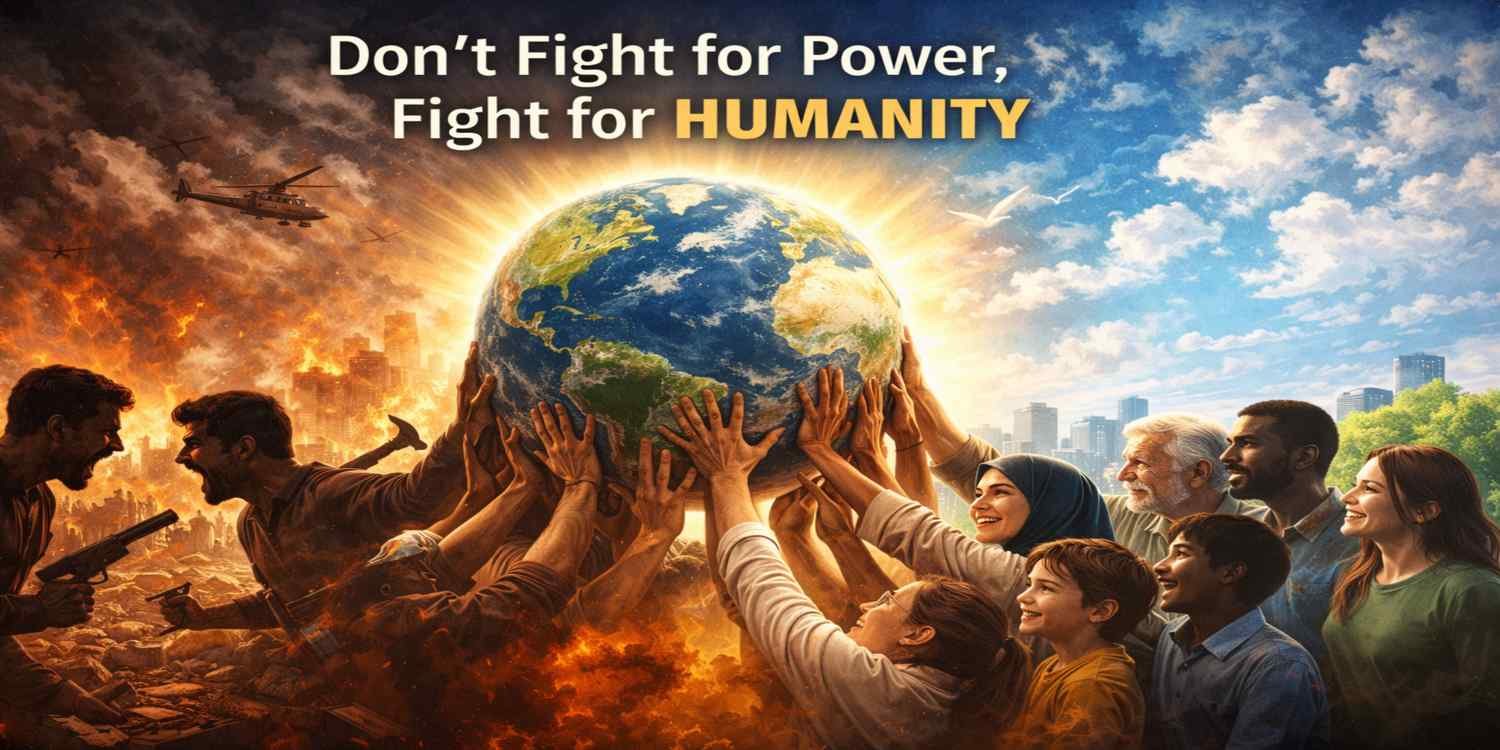
Throughout history, humanity has been driven by one recurring obsession: power. Power over land, power over people, power over resources, power over narratives. Empires rose in its name, wars were justified by it, and countless lives were sacrificed to preserve it. Yet, despite centuries of struggle, one truth remains painfully clear—fighting for power has never secured humanity’s future. Instead, it has fractured societies, normalized injustice, and pushed the world toward repeated cycles of destruction.
Today, as the world faces existential threats—climate change, inequality, war, technological misuse, and moral decay—the need is no longer for more power struggles. The need is for a fundamental shift in priorities. Don’t fight for power. Fight for humanity.
Power Has Always Promised Security—And Delivered Suffering
Power often disguises itself as protection. Leaders claim power is necessary for stability, prosperity, or national interest. Groups seek dominance to preserve identity or ideology. Individuals chase authority believing it will bring respect and safety.
Yet history shows a different outcome. Power concentrates privilege, silences dissent, and dehumanizes opposition. Those without power are treated as expendable, while those with power become detached from consequences.
Wars for power leave cities in ruins and generations traumatized. Economic power hoarded by a few creates poverty for millions. Political power misused corrodes trust and weakens institutions. In every form, unchecked power erodes humanity rather than preserving it.
The Illusion That Power Equals Strength
Power is often mistaken for strength. Loud voices overpower quiet truths. Force is seen as effectiveness. Control is mistaken for leadership.
But true strength has never been about domination. The strongest societies are not those that intimidate others, but those that protect their people. The strongest leaders are not those who crush opposition, but those who uplift dignity and inclusion.
History remembers tyrants for their destruction, not their greatness. It remembers peacemakers, reformers, and humanitarians for their courage to prioritize people over power.
Power without humanity is fragile.
Humanity with purpose is resilient.
When Power Becomes More Important Than People
The most dangerous moment for any society is when power becomes more valuable than human life. When systems prioritize profit over welfare, ideology over compassion, or authority over justice, humanity becomes collateral damage.
We see this when:
- civilians suffer while leaders argue over territory
- workers are exploited in the name of economic growth
- minorities are oppressed to maintain political control
- truth is sacrificed to preserve influence
In such systems, suffering is normalized, and empathy is labeled as weakness. The future is negotiated in boardrooms and battlefields, far removed from the people who will live—or die—with the consequences.
A future built on power alone is a future built on sacrifice—usually of the powerless.
Humanity Is Not Weakness—It Is the Foundation of Survival
Humanity is often dismissed as idealism, but in reality, it is practical and necessary. Compassion reduces conflict. Justice builds trust. Inclusion strengthens societies. Cooperation accelerates progress.
Every major human advancement—medicine, science, education, human rights—was achieved not through domination, but through shared purpose. Humanity fuels innovation because people thrive when they feel valued and protected.
When people are treated with dignity, they contribute.
When they are treated as tools, they resist or break.
Humanity is not soft. It is strategic.
The Cost of Power Politics in a Fragile World
In a world already strained by environmental collapse and social inequality, power politics is reckless. Climate change does not care who controls borders. Pandemics do not respect ideology. Economic crises spread regardless of political alliances.
Yet global responses remain competitive instead of cooperative. Nations race instead of collaborate. Leaders posture instead of solve.
This obsession with power wastes precious time and resources. It delays solutions and deepens damage. Humanity cannot afford this distraction anymore.
The future demands collaboration, not competition for dominance.
Fighting for Humanity Means Redefining Leadership
Leadership rooted in humanity looks fundamentally different from leadership driven by power.
Human-centered leaders:
- protect the vulnerable
- listen before they command
- value long-term well-being over short-term control
- see people as citizens, not pawns
Such leadership requires courage, because it resists ego and popularity. It demands accountability instead of blind loyalty. It prioritizes ethics over expedience.
The world does not lack strong leaders.
It lacks humane ones.
The Role of Ordinary People in Choosing Humanity
Fighting for humanity is not limited to governments or global institutions. It begins with individuals.
Everyday choices shape the future:
- choosing dialogue over hatred
- fairness over favoritism
- truth over propaganda
- cooperation over conflict
When individuals normalize empathy, societies follow. When communities reject dehumanization, power structures are forced to adapt.
Humanity is not built only in laws—it is built in behavior.
Education: The Battlefield Between Power and Humanity
Education determines whether future generations fight for domination or dignity.
An education system obsessed only with competition, rankings, and profit produces skilled individuals without conscience. Teaching science without ethics, economics without empathy, and technology without responsibility creates powerful tools in morally empty hands.
Education must cultivate:
- critical thinking
- compassion
- global responsibility
- respect for human dignity
A future generation trained to value humanity will naturally resist destructive power struggles.
Technology Must Serve Humanity, Not Control It
Technology amplifies intention. In the hands of power-hungry systems, it becomes a tool of surveillance, manipulation, and warfare. In the hands of humane societies, it becomes a force for healing, education, and connection.
Artificial intelligence, data systems, and automation demand ethical guidance. Without humanity at the core, technological power will widen inequality and erode freedom.
The question is not whether technology will grow powerful—it already has.
The question is whether humanity will guide it.
Fighting for Humanity in a Divided World
Choosing humanity does not mean ignoring injustice. It does not mean accepting oppression or remaining silent in the face of cruelty. Fighting for humanity often requires resistance—but resistance rooted in dignity, not hatred.
History’s most transformative movements fought injustice without losing their humanity. They challenged power without becoming what they opposed.
Justice pursued without humanity becomes revenge.
Humanity pursued without justice becomes weakness.
The future requires both—balanced, intentional, and unwavering.
The Moral Reckoning of Our Time
Every generation faces a defining moral choice. Ours is deciding whether power or humanity will shape the future.
Will we continue to measure success by dominance, wealth, and control?
Or will we redefine progress as well-being, sustainability, and shared dignity?
This choice will determine whether future generations inherit a livable planet, stable societies, and meaningful freedom—or a fractured world ruled by fear.
The cost of choosing power over humanity is already visible. The question is whether we will learn from it.
Conclusion: A Different Kind of Fight
The world does not need more wars, louder leaders, or stronger weapons. It needs a different kind of fight.
A fight for:
- human dignity over domination
- cooperation over conquest
- justice over control
- compassion over cruelty
Power can seize territory, silence voices, and command obedience—but it cannot create trust, peace, or meaning. Only humanity can do that.
So don’t fight for power.
Fight for humanity.
Because power decides who rules today.
Humanity decides whether there is a tomorrow.
–By Engr. Md Khairul Alom


