



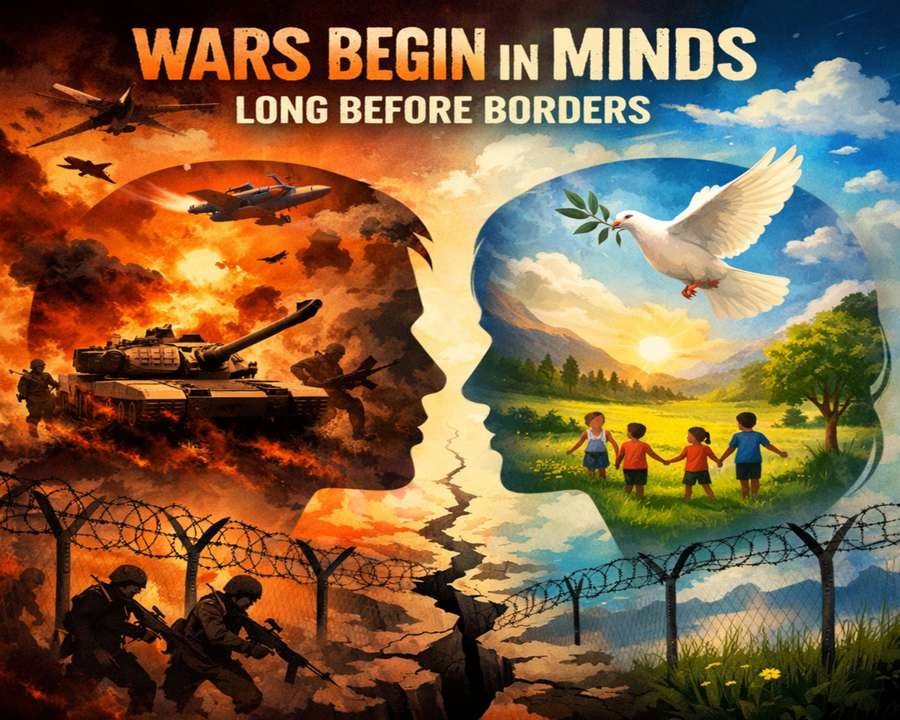
Wars are often explained through maps. Historians draw arrows across borders, mark frontlines, and circle disputed territories. Politicians speak of sovereignty, security, and national interest. News channels show tanks crossing boundaries and soldiers guarding checkpoints. Yet these visible moments of conflict hide a deeper and more dangerous truth: wars do not begin at borders—they begin in minds.
Long before the first bullet is fired or the first missile is launched, wars are quietly prepared inside human thinking. They grow in beliefs, fears, prejudices, ambitions, and narratives that divide “us” from “them.” Borders merely become the final stage where conflicts, already born in thought, turn into violence. To understand war—and to prevent it—we must look beyond geography and examine the psychology, culture, and ideas that make war possible.
The Illusion That Borders Create Enemies
Borders are lines drawn by humans, not by nature. Rivers flow across them, winds ignore them, and cultures often overlap on both sides. Yet borders are treated as sacred lines that define who belongs and who does not. Over time, these lines gain emotional weight. They become symbols of pride, fear, and identity.
But borders themselves do not create enemies. The idea that people on the other side are threats does. This idea is planted and nurtured through selective history, political messaging, and social conditioning. Children are taught who their “heroes” are and who their “historic enemies” were, often without learning the full truth. As generations pass, memory becomes myth, and myth becomes justification for future hostility.
When people are taught to see neighbors as rivals rather than fellow humans, borders stop being administrative lines and turn into psychological walls. At that point, conflict is no longer a possibility—it is only a matter of time.
Fear: The Most Powerful Weapon
Fear is one of the strongest forces behind war. Leaders rarely admit this openly. Instead, they speak of defense, security, or pre-emptive action. But beneath these words lies fear—fear of losing power, fear of being attacked, fear of economic decline, fear of cultural change.
Fear simplifies the world. It reduces complex human societies into stereotypes. “They want to destroy us.” “They hate our way of life.” “If we don’t strike first, we will be wiped out.” Such thinking leaves no room for dialogue or nuance. Once fear dominates the public mind, peaceful alternatives appear weak or dangerous.
Modern wars are often sold as necessities rather than choices. Citizens are told that war is unfortunate but unavoidable. In reality, fear has already won the mental battle, making violence seem like the only rational option.
Narratives That Normalize Violence
Wars require stories to survive. These stories are repeated through speeches, textbooks, media, and social platforms. They divide the world into good and evil, heroes and villains. One side is portrayed as civilized and righteous, the other as barbaric, backward, or inhuman.
Such narratives are powerful because they reduce moral discomfort. Killing becomes easier when the enemy is no longer seen as human. Civilian deaths are described as “collateral damage.” Destruction is framed as “liberation.” Language is carefully chosen to dull empathy and sharpen anger.
Once violence is normalized in language, it becomes acceptable in action. The mind adjusts before the body acts. By the time war begins physically, it has already been justified mentally thousands of times.
Identity Politics and the “Us vs Them” Trap
Human beings naturally seek belonging. Identity gives people meaning, pride, and security. However, when identity is built on exclusion—religion against religion, race against race, nation against nation—it becomes a tool of division.
Many conflicts begin when leaders manipulate identity for political gain. They exaggerate differences and downplay shared humanity. Economic problems are blamed on minorities or neighboring states. Cultural anxieties are turned into hostility. People are told that their identity is under threat and must be defended at all costs.
This “us vs them” mindset is dangerous because it turns compromise into betrayal. Peace becomes weakness. Dialogue becomes surrender. Once identity is weaponized, borders are no longer lines of coexistence—they become battle lines of ideology.
Historical Grievances That Refuse to Die
History plays a complex role in war. Remembering past injustices is important, but selectively remembering them can be destructive. Many wars are fueled by unresolved historical grievances—colonial wounds, partition trauma, lost territories, or past humiliations.
These memories are often passed down emotionally rather than factually. Each generation inherits anger without experiencing the original events. Over time, history is simplified into a story of victimhood and revenge. The past becomes a permanent excuse for present violence.
When societies are trapped in historical resentment, they struggle to imagine a shared future. Peace requires memory with wisdom, not memory with vengeance.
Media, Technology, and Accelerated Hostility
In the digital age, wars begin even faster in minds. Social media spreads outrage instantly. Misinformation travels faster than truth. Algorithms reward anger because it generates engagement. A single incident, real or fabricated, can inflame millions within hours.
Images are shown without context. Headlines are designed to provoke emotion, not understanding. People consume information that confirms their existing beliefs, creating echo chambers of hostility. In such an environment, reasoned discussion becomes rare, and emotional reaction becomes dominant.
Technology has made it easier not only to fight wars, but to prepare minds for war at unprecedented speed.
The Role of Leadership: Calm Minds or Inflamed Ones
Leadership plays a decisive role in whether conflicts escalate or dissolve. Responsible leaders calm fears, acknowledge complexity, and keep communication open. Irresponsible leaders inflame emotions, simplify reality, and exploit anger.
History shows that many wars could have been avoided if leaders had chosen patience over pride. However, pride is seductive. Appearing strong often matters more than being wise. Admitting mistakes is seen as weakness. Negotiation is mocked as appeasement.
When leaders choose ego over empathy, entire nations pay the price. Borders may define states, but leaders shape the mental climate that decides peace or war.
Militarization of Thought
Long before weapons are produced, societies militarize thinking. Children play war games. Movies glorify violence. Strength is equated with domination. Military spending is celebrated as patriotism, while investment in education and diplomacy is questioned.
This cultural conditioning makes war feel normal, even inevitable. Peace is treated as temporary, war as permanent. When conflict finally erupts, it feels familiar rather than shocking.
A world that constantly prepares for war should not be surprised when war arrives.
Peace Also Begins in Minds
If wars begin in minds, so must peace. Peace is not just a treaty signed by governments; it is a mindset cultivated in societies. It begins with critical thinking, empathy, and the courage to question simplified narratives.
Peace requires seeing humanity beyond identity. It demands media that informs rather than inflames, education that teaches complexity rather than hatred, and leadership that values long-term stability over short-term popularity.
Dialogue is not weakness. Compromise is not surrender. Understanding an opponent does not mean agreeing with them—it means recognizing their humanity.
Educating for Peace, Not Just Success
Education systems play a crucial role in shaping future conflicts or cooperation. When education focuses only on competition, dominance, and national glory, it plants seeds of conflict. When it teaches ethics, history with context, and global responsibility, it builds foundations for peace.
Students should learn not only what happened in wars, but why they happened—and how they could have been avoided. They should be taught to analyze information, question propaganda, and respect differences.
A mind trained to think deeply is less likely to accept violence blindly.
Choosing the Harder Path
War often appears easier than peace. It offers clear enemies, simple answers, and emotional release. Peace is harder. It requires patience, humility, and long-term thinking. It demands restraint when anger feels justified.
But the cost of war is always greater than the effort of peace. Lives lost cannot be replaced. Trauma crosses generations. Development is reversed in years of destruction.
Borders can be redrawn, but broken minds and wounded societies take decades to heal.
Conclusion: Change the Mind, Change the World
Wars do not suddenly erupt at borders. They are carefully prepared in minds—through fear, pride, misinformation, and dehumanization. Borders only reveal what thinking has already decided.
If humanity truly seeks lasting peace, it must shift its focus from controlling territories to transforming thought. From glorifying strength to valuing wisdom. From feeding fear to cultivating understanding.
The battlefield of the future is not just land or air—it is the human mind.
And the most powerful weapon for peace is not force, but conscious, ethical, and compassionate thinking.


