


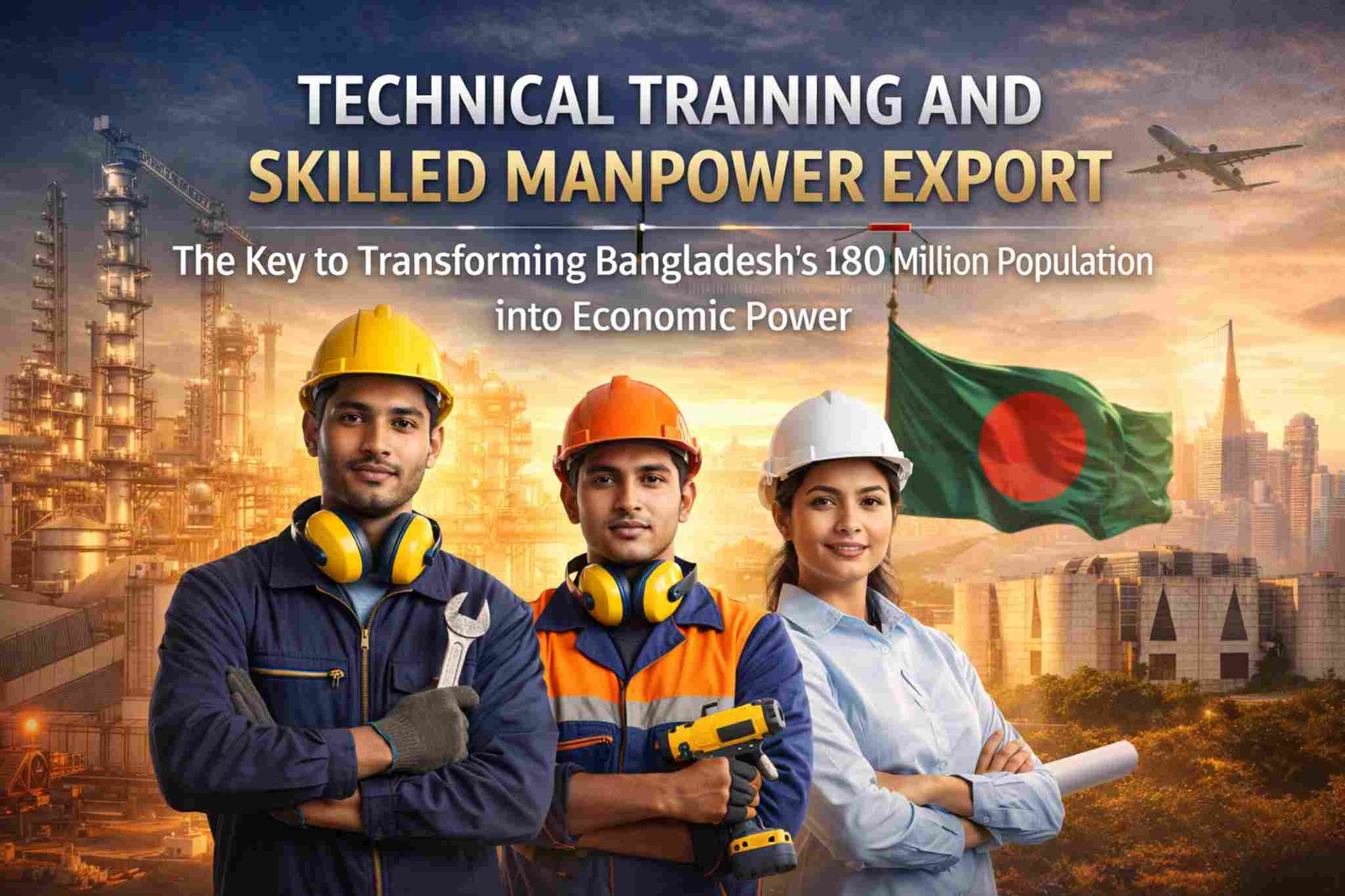
Bangladesh is home to more than 180 million people. This vast population can either be viewed as a burden or as the country’s greatest economic asset. The difference between these two perspectives lies in one critical factor: skill development.
In the 21st century, natural resources alone no longer determine a nation’s strength. Human capital does. Countries that invest in technical training, vocational education, and professional skill development consistently outperform those that rely on unskilled labor. Bangladesh stands at a crucial turning point. With proper technical training and strategic skilled manpower export, the country can transform its population into a powerful engine of sustainable economic growth.
The future of Bangladesh’s economy depends not only on manufacturing or remittance, but on the quality of its workforce.
The Demographic Opportunity
Bangladesh possesses one of the largest working-age populations in the world. This demographic structure presents what economists call a “demographic dividend.” However, a demographic dividend is not automatic. It must be earned through education, training, and employment generation.
Without skill development:
- Unemployment rises
- Underemployment increases
- Productivity remains low
- Social instability grows
With proper technical training:
- Productivity improves
- Wages increase
- Foreign employment opportunities expand
- Domestic industries strengthen
The same population can either strain the economy or power it forward.
Why Technical Training Is Essential
Traditional academic education alone cannot absorb the entire workforce. University degrees without technical competence often lead to educated unemployment.
Technical training focuses on practical skills such as:
- Electrical and mechanical engineering
- Construction and infrastructure work
- Industrial machine operation
- IT and software development
- Welding, plumbing, and fabrication
- Renewable energy systems
- Healthcare technical support
Countries like Germany, South Korea, and Singapore built their economic foundations through strong vocational and technical training systems.
Bangladesh must modernize and expand its Technical and Vocational Education and Training (TVET) framework to align with global industry standards.
Technical education reduces skill mismatch — one of the major causes of unemployment.
Skilled Manpower Export: Moving Beyond Low-Wage Labor
Bangladesh is already one of the world’s largest exporters of manpower. Remittance plays a crucial role in strengthening foreign currency reserves. However, a significant portion of migrant workers are low-skilled laborers.
Low-skilled migration leads to:
- Lower wages
- Poor working conditions
- Limited career growth
- Vulnerability to exploitation
If Bangladesh focuses on exporting skilled manpower instead of unskilled labor, the impact would multiply.
Skilled professionals such as:
- Engineers
- IT specialists
- Technicians
- Nurses
- Construction supervisors
- Industrial maintenance experts
earn significantly higher wages globally.
Higher skill equals higher remittance per worker.
Instead of sending large numbers of low-wage workers, Bangladesh can send fewer but highly skilled professionals earning multiple times more income.
Boosting Foreign Currency Reserves
Remittance is one of the strongest pillars of Bangladesh’s economy. Skilled manpower export can dramatically increase remittance inflow.
Consider the economic impact:
- A low-skilled worker may earn $300–$500 per month.
- A skilled technician or IT professional may earn $2,000–$5,000 per month.
The difference is transformational.
If even 10–15% of migrant workers are upgraded to skilled professionals, remittance income could significantly increase without increasing migration volume.
This strengthens:
- Foreign exchange reserves
- National currency stability
- Economic resilience during global crises
Skill development is not just social policy; it is monetary strategy.
Strengthening Domestic Industry
Technical training does not only support foreign employment. It also strengthens domestic industries.
Bangladesh’s manufacturing sectors — garments, textiles, pharmaceuticals, shipbuilding, construction, energy — require technically skilled manpower.
When industries lack skilled workers:
- Production defects increase
- Machinery downtime rises
- Safety incidents occur
- Quality control weakens
Skilled workers improve:
- Productivity
- Efficiency
- Safety standards
- Product quality
This enhances export competitiveness.
An industrial economy cannot run on unskilled labor alone.
Reducing Youth Unemployment
Youth unemployment is a growing concern in Bangladesh. Many young people complete education but struggle to find jobs aligned with their qualifications.
Skill-based training bridges the gap between education and employment.
Instead of theoretical learning only, practical training ensures:
- Immediate employability
- Entrepreneurial capacity
- Self-employment opportunities
- Industrial readiness
Technical institutes can partner with industries to design curriculum based on real market demand.
Employment-driven training reduces frustration and social instability.
The Role of Government Policy
To transform population into economic power, government intervention is essential.
Policy priorities should include:
- Expanding technical institutes across rural and urban areas
- Modernizing training equipment and infrastructure
- Partnering with global certification bodies
- Encouraging private sector participation
- Offering incentives for skill-based industries
- Strengthening overseas employment agreements
National skill development must become a strategic priority, not a secondary option.
A coordinated effort between education ministries, labor ministries, and industry associations is necessary.
Industry-Academia Collaboration
One of the major challenges in many developing countries is the disconnect between training institutions and industry needs.
Bangladesh must:
- Develop apprenticeship programs
- Encourage internship-based certification
- Involve industry experts in curriculum design
- Establish skill standardization frameworks
Industry collaboration ensures that training produces employable graduates.
Education without employability weakens economic growth.
Promoting Entrepreneurship Through Technical Skill
Technical training also encourages entrepreneurship.
Skilled individuals can start:
- Maintenance service businesses
- Construction firms
- IT startups
- Manufacturing workshops
- Renewable energy installation companies
This creates domestic employment and reduces dependence on government jobs.
Entrepreneurship transforms job seekers into job creators.
Women’s Participation in Skilled Workforce
Skill development must include women.
Technical training for women in:
- IT
- Healthcare
- Design and manufacturing
- Renewable energy
- Small-scale production
can significantly boost household income and national productivity.
Empowering women through technical competence accelerates economic progress.
Inclusive growth strengthens national stability.
Learning from Global Success Stories
Countries that transformed their economies through skill development include:
- South Korea (industrial training revolution)
- Germany (dual vocational training model)
- Singapore (skill-based economic planning)
- Malaysia (technical workforce modernization)
These countries invested heavily in workforce quality.
Bangladesh can adapt similar models suited to local conditions.
Digital Skills for the Future Economy
The future global economy will be technology-driven.
Bangladesh must invest in:
- Coding and software development
- AI and data analytics
- Cybersecurity
- Automation maintenance
- Robotics operation
Digital skill export can generate high-value foreign income without physical migration.
Remote work is a global opportunity.
Bangladesh’s youth, if properly trained, can serve international markets from within the country.
Infrastructure and Funding
Skill transformation requires financial investment.
Budget allocation for:
- Modern training centers
- Equipment upgrade
- Instructor development
- International accreditation
must be prioritized.
Investment in human capital yields long-term economic returns.
The cost of not investing is far greater.
Social Impact of Skill Development
Beyond economic gain, technical training contributes to:
- Poverty reduction
- Crime reduction
- Social stability
- Increased self-confidence
- National pride
A skilled workforce builds a confident nation.
Economic empowerment reduces dependence on aid and external borrowing.
From Population Pressure to Economic Power
Bangladesh’s 180 million people represent enormous potential energy.
If untrained, this energy becomes economic pressure.
If skilled, it becomes national strength.
The key transformation lies in:
- Policy commitment
- Institutional reform
- Industry cooperation
- Quality training
- Global workforce integration
Skill development is not an expense — it is investment.
Skilled manpower export is not migration alone — it is strategic economic expansion.
Conclusion: A National Call to Action
Bangladesh stands at a historic crossroads.
The country can continue exporting low-wage labor, or it can become a global supplier of skilled professionals.
The difference depends on how seriously technical training is prioritized today.
Technical training and skilled manpower export offer:
- Higher remittance
- Stronger domestic industries
- Lower unemployment
- Greater foreign currency stability
- Long-term economic resilience
Transforming 180 million people into economic power is not impossible.
It requires vision, policy reform, institutional strengthening, and commitment to human capital development.
A skilled Bangladesh will not only grow economically — it will lead confidently on the global stage.
The time to invest in skill is now.


