



In a fast-moving world driven by deadlines, screens, and endless distractions, many people believe that life is divided into two separate parts: work time and rest time. Work is seen as productive, while free time is often wasted on scrolling, gossip, or idle entertainment. Yet history, wisdom, and lived experience all point to a deeper truth: the quality of our free time determines the quality of our future.
Those who use their free hours to learn, to guide their children, and to build strong family values are quietly investing in the most reliable form of security—a peaceful future. Money can be lost, health can decline, and fame can fade, but a well-educated mind and well-raised children continue to protect and support us long after our working years end.
This article explores why studying in free time, teaching children with care, and consciously building their future is not only a moral duty but also the wisest long-term investment for personal peace and societal stability.
1. Free Time Is Not Empty Time—It Is Opportunity
Many people complain that they have “no time” to study, read, or think deeply. In reality, most people have time—but they lose it unconsciously. Hours disappear into social media, meaningless conversations, television, or passive entertainment that adds little value to life.
Free time is not meant to be wasted; it is meant to be used wisely. Even 30–60 minutes a day spent reading, learning a new skill, or reflecting on life can slowly but powerfully transform a person.
Learning in free time does not require classrooms or certificates. It can include:
- Reading books or quality articles
- Learning about finance, health, parenting, or ethics
- Improving communication and emotional intelligence
- Studying religion, philosophy, or history
- Learning modern skills such as technology, language, or management
A person who studies regularly becomes more thoughtful, patient, and confident. Such a person makes better decisions, handles problems calmly, and becomes a role model at home. This inner growth becomes the foundation of a peaceful future.
2. Knowledge Builds Stability, Not Just Success
People often study only to get jobs or promotions. While financial improvement is important, the true power of knowledge lies beyond income. Knowledge helps us understand people, control emotions, raise children wisely, and adapt to change.
A knowledgeable person:
- Reacts less emotionally and more rationally
- Solves problems instead of creating conflicts
- Understands long-term consequences
- Learns from mistakes instead of repeating them
Such qualities directly affect family life. Homes guided by understanding rather than anger are peaceful homes. Parents who grow mentally can guide their children through confusion, pressure, and temptation.
Thus, studying in free time is not selfish—it is preparation for responsibility.
3. Teaching Children Is the Greatest Responsibility
Children do not learn mainly from schools; they learn from what they see at home. Parents are the first teachers, whether they realize it or not. A child observes how parents speak, react, manage stress, respect others, and use time.
Teaching children does not mean forcing books into their hands or pressuring them for grades. Teaching with care means:
- Listening to them patiently
- Encouraging curiosity and questions
- Teaching honesty, discipline, and empathy
- Helping them think, not just memorize
- Guiding them gently, not controlling them harshly
A parent who studies in free time gains the wisdom needed to teach effectively. Without knowledge, parents often rely on anger, fear, or outdated methods. With learning, they use explanation, example, and encouragement.
Children raised with care grow into adults who are confident, responsible, and emotionally stable—qualities that later protect their parents’ peace.
4. A Child’s Future Is Built at Home, Not Outside
Many parents worry about their children’s future but focus only on external factors—schools, tutors, certificates, or connections. While these matter, the real foundation of a child’s future is built at home.
At home, children learn:
- How to treat others
- How to handle failure
- How to manage time
- How to respect elders
- How to deal with pressure and temptation
When parents invest time after office hours to talk, teach, and guide, children develop clarity and confidence. They grow up knowing right from wrong and understanding the value of effort and patience.
Such children are less likely to fall into destructive habits and more likely to support their parents emotionally and practically in later life.
5. Peaceful Old Age Is Earned, Not Given
Many people dream of a peaceful future but do little to earn it. They focus on earning money while neglecting learning and parenting. Later, they feel lonely, misunderstood, or dependent on others.
A peaceful future does not come automatically with age. It is built slowly through:
- Lifelong learning
- Strong family bonds
- Wise parenting
- Mutual respect between generations
Parents who teach their children with care often enjoy:
- Respect instead of neglect
- Support instead of loneliness
- Understanding instead of conflict
Children who grow up guided by knowledge and values do not abandon their parents; they become their strength.
6. The Cycle of Learning and Teaching
There is a beautiful cycle in life: those who keep learning can keep teaching, and those who keep teaching continue learning.
When parents study:
- They improve themselves
- They inspire their children
- They stay mentally active
When children see their parents reading, thinking, and improving, they naturally value education. This creates a culture of learning at home—one that benefits generations.
Such families do not fear the future; they are prepared for it.
7. Social Impact: Strong Families Build Strong Societies
This principle goes beyond individual families. Societies are built from homes. When parents waste free time, children grow without guidance. When parents learn and teach, societies gain thoughtful citizens.
Many social problems—crime, corruption, intolerance—begin with lack of guidance at home. Teaching children with care is not just personal responsibility; it is social service.
A society with educated parents and well-guided children is more peaceful, productive, and resilient.
8. Practical Ways to Apply This Principle
To turn this philosophy into action:
- Set aside daily learning time, even if short
- Read while children observe you
- Discuss ideas, not just rules
- Encourage questions at home
- Spend quality time instead of expensive gifts
- Teach values through behavior, not lectures
Consistency matters more than intensity. Small daily efforts produce lifelong results.
Conclusion: Peace Is Built, Not Bought
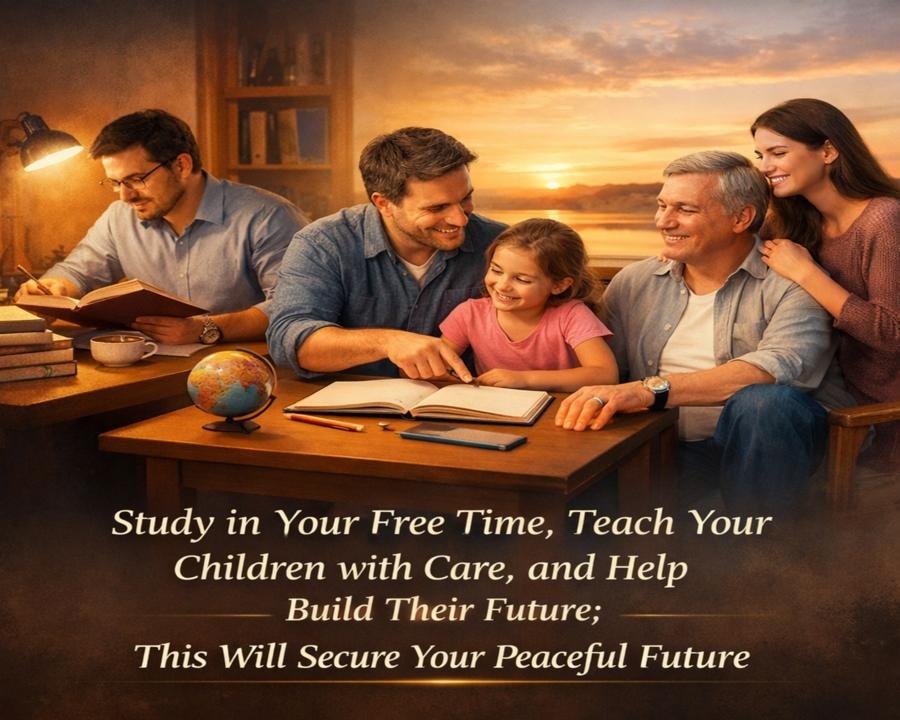
Study in your free time, teach your children with care, and help build their future; this will secure your peaceful future—this is not just a sentence, but a life strategy.
In a world full of uncertainty, the safest investment is not wealth or property, but knowledge and family values. Those who grow mentally and raise their children wisely enjoy respect, support, and peace in later years.
Free time is not a break from responsibility; it is an opportunity to fulfill the most important one. When we choose learning over wasting time and guidance over neglect, we do not just build better children—we build a peaceful future for ourselves.


