



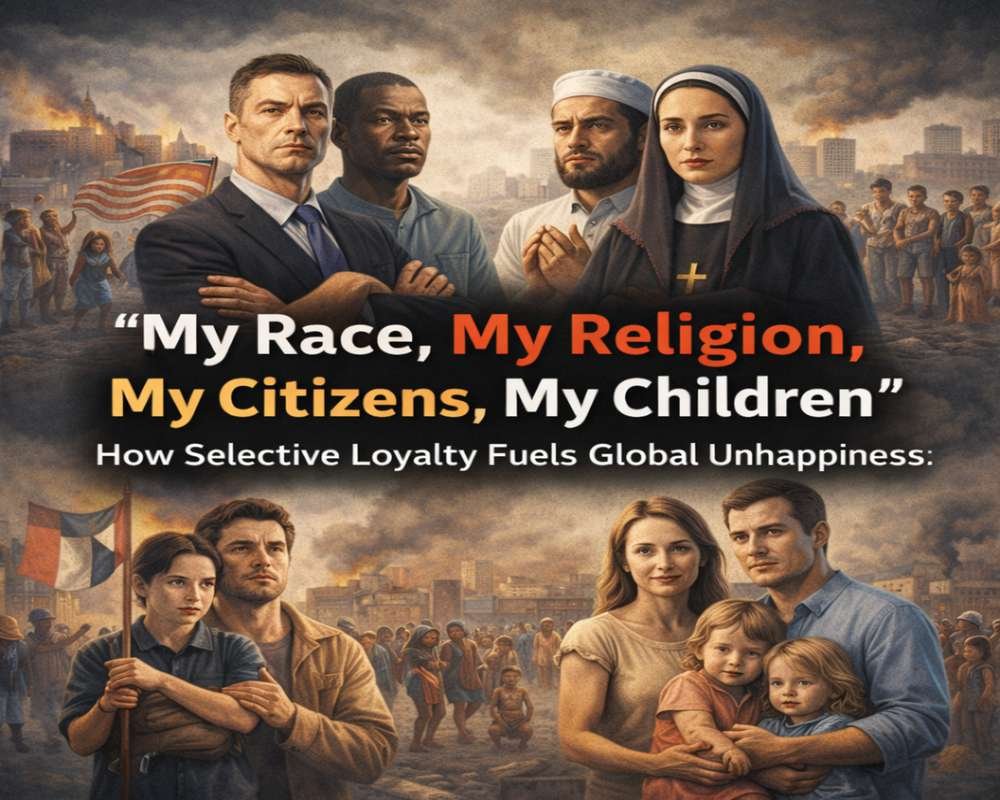
Human beings are naturally inclined to protect what is closest to them. Parents prioritize their children. Communities care for their own members. Nations seek the welfare of their citizens. Faith groups support their followers. At a personal level, this instinct is understandable and often necessary for survival. Yet when this instinct hardens into a worldview—my race above others, my religion over all, my citizens first, my children at any cost—it quietly becomes one of the strongest drivers of global unhappiness.
The modern world is not suffering from a lack of resources, intelligence, or technology. It is suffering from selective loyalty—a mindset that limits empathy, justice, and responsibility to a narrow circle of identity. This way of thinking does not merely create division; it systematically produces inequality, conflict, resentment, and long-term instability.
Selective Loyalty: From Natural Care to Moral Blindness
Loving one’s own people is not the problem. The problem begins when love turns exclusive—when concern for “us” is paired with indifference or hostility toward “them.” Selective loyalty transforms moral values into tribal tools. Fairness becomes conditional. Justice becomes negotiable. Human dignity becomes relative.
When people believe that their race deserves more respect, their religion more rights, their citizens more life, and their children more future than others, they may feel righteous—but the outcome is rarely peace or happiness. Instead, the world becomes a competition of identities, each fighting for dominance rather than coexistence.
This mindset quietly reshapes institutions, policies, and social norms in ways that harm everyone, including those it claims to protect.
Race: When Identity Becomes Hierarchy
Race is one of the most enduring justifications for selective loyalty. Although science has clearly shown that race has no meaningful biological basis for superiority, societies continue to treat racial identity as destiny.
When race becomes a measure of worth, opportunity is distributed unevenly. Healthcare quality, education access, employment prospects, and legal protection often follow racial lines. Those excluded experience chronic stress, insecurity, and injustice—conditions that directly reduce well-being and life expectancy.
But racial favoritism does not only harm the marginalized. It damages the moral fabric of the favored group as well. Societies built on racial hierarchy become anxious, defensive, and fearful of change. Creativity declines. Trust erodes. Conflict becomes normalized. In the long run, no race thrives in a world structured by resentment.
Religion: From Moral Compass to Social Divider
Religion, at its ethical core, aims to elevate human behavior—promoting compassion, honesty, restraint, and responsibility. Nearly all major religions emphasize care for the vulnerable and justice for all. Yet selective loyalty distorts faith into a boundary marker: my religion’s people matter more than others.
This distortion turns belief into exclusion. Suffering is judged by identity rather than need. Aid becomes conditional. Violence is rationalized. Moral accountability weakens when actions are justified as serving “our” faith.
Ironically, this approach undermines the very spiritual peace religion promises. Communities locked in religious exclusivity live with constant tension, fear, and grievance. True faith is meant to calm the human heart; selective faith keeps it restless and hostile.
Citizenship: National Priority or Global Neglect
Every government has a duty to protect its citizens. However, when citizenship becomes a moral ceiling—when leaders and people believe only our citizens matter—global unhappiness accelerates.
In a connected world, no nation exists in isolation. Economic shocks, pandemics, climate change, wars, and migration do not respect borders. Ignoring suffering elsewhere eventually creates instability at home. Refugee crises, supply chain disruptions, security threats, and environmental damage all stem from neglect beyond borders.
History repeatedly shows that aggressive nationalism brings short-term pride but long-term insecurity. Nations that focus solely on “our people first” often become less safe, not more. Global cooperation is not charity; it is strategic self-preservation.
Children: Future Protection or Ethical Collapse
Perhaps the most emotionally powerful form of selective loyalty is the argument of children. “I must secure everything for my children” sounds virtuous. Yet when this belief ignores the futures of other children, it creates a morally unstable world.
A future where some children are over-protected while others are denied education, healthcare, or safety is not sustainable. The neglected children of today become the marginalized adults of tomorrow—carrying anger, trauma, and lost potential. This instability eventually reaches everyone, including the privileged.
Raising children with wealth, security, and opportunity while teaching them indifference toward others does not prepare them for a peaceful world. It prepares them for a fragile one.
The Psychological Cost of Selective Loyalty
Selective loyalty does not only create external conflict; it creates internal unrest. Societies built on exclusion live in constant comparison and fear. People worry about losing dominance. They distrust outsiders. They justify unethical behavior to protect group advantage.
This psychological environment fuels anxiety, stress, and social tension—key drivers of unhappiness. Even those who “win” under selective systems often feel insecure, pressured to defend their status rather than enjoy it.
Happiness requires safety, trust, and meaning. Selective loyalty undermines all three.
Inequality as a Product of Selective Loyalty
Global inequality is not accidental. It is the direct result of systems designed around selective care. Resources flow toward favored identities. Institutions protect some while neglecting others. Laws are applied unevenly.
Such inequality fuels crime, conflict, health crises, and political instability. The cost is paid not only by the poor, but by society as a whole—through insecurity, violence, and lost human potential.
A world divided by selective loyalty becomes a world constantly managing crises instead of building well-being.
Why This Mindset Persists
Selective loyalty persists because it feels safe and familiar. It simplifies complex problems into “us versus them.” It offers emotional comfort by placing responsibility within a small circle.
But comfort is not the same as truth. In a globalized world, narrow loyalty is no longer protective—it is dangerous. Problems today are shared, interconnected, and systemic. They require cooperation, not isolation.
From Selective Loyalty to Shared Responsibility
The solution is not to abandon identity, culture, faith, or family. The solution is to expand moral concern beyond them.
A healthy worldview recognizes:
- Love for one’s own does not require neglect of others
- National interest is strengthened by global stability
- Faith is deeper when it affirms universal dignity
- Children are safest in a world where all children matter
Shared responsibility does not weaken identity; it grounds it in ethics.
What a Broader Loyalty Looks Like
A broader loyalty means designing systems that prioritize competence over identity, need over affiliation, and justice over favoritism. It means investing in global health, education, and cooperation—not as charity, but as shared survival.
It means teaching children that success is not measured by how much they have compared to others, but by the kind of world they help create.
It means recognizing that humanity is not a competitor—it is a community.
Conclusion: The Real Source of Global Unhappiness
The world is unhappy not because people love their race, religion, nation, or children—but because they stop caring beyond them.
Selective loyalty narrows empathy, distorts morality, and destabilizes societies. It creates a world where happiness is fragile, security is temporary, and peace is always at risk.
A sustainable future demands a shift in thinking:
Different identities, shared humanity. Personal care, global responsibility.
Only when loyalty expands beyond “my own” can the world move from division toward durable happiness.


