



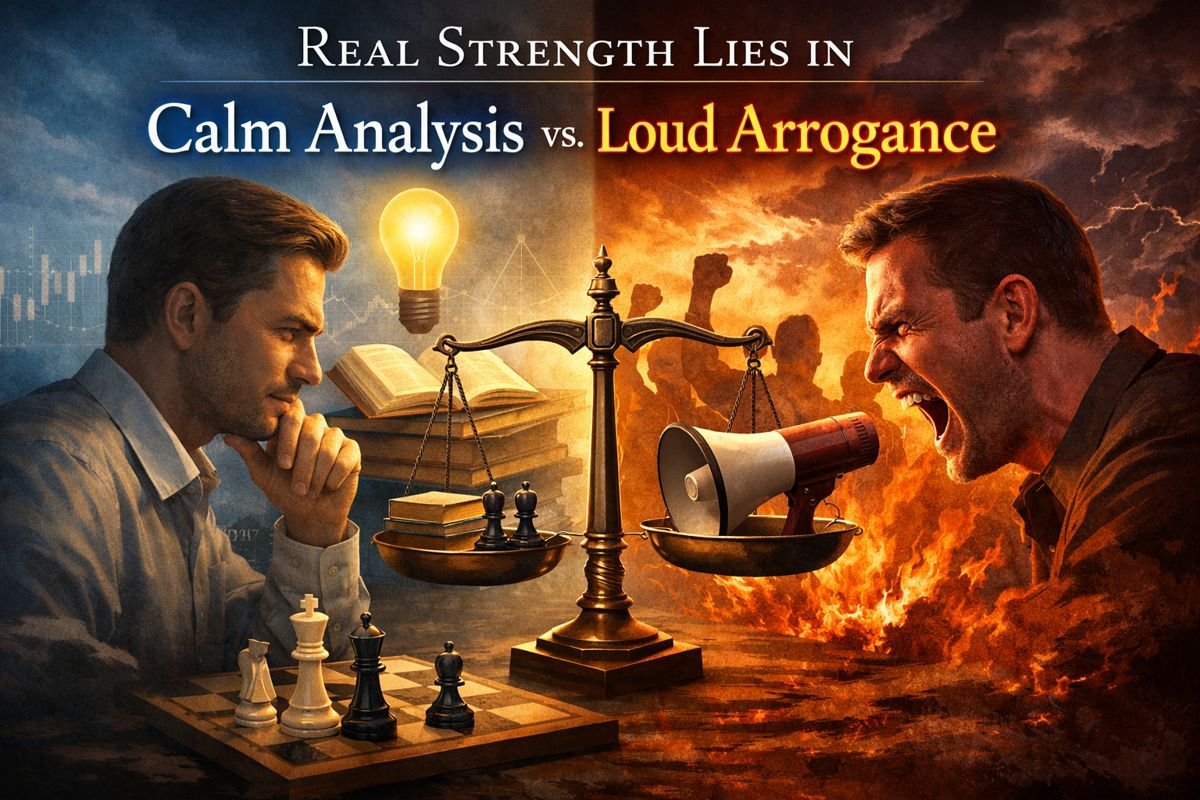
In a world growing louder by the day, calmness has begun to look like weakness. Shouting dominates discussions, outrage drives engagement, and confidence is often confused with volume. Social media rewards the loudest voices, not the wisest ones. Television debates favor interruption over insight. Even everyday conversations are increasingly shaped by who can speak faster, harsher, and more forcefully. Yet history, psychology, and lived human experience tell a very different story: real strength does not announce itself loudly; it reveals itself quietly through calm analysis.
True strength has never been about noise. It has been about clarity. It has been about the ability to pause, think, evaluate, and respond with intention rather than impulse. Loud arrogance may attract attention, but calm analysis commands respect—and more importantly, it produces results.
The Age of Noise and the Illusion of Strength
We live in an era where attention has become currency. Platforms are designed to amplify extremes because extremes generate clicks. Anger spreads faster than understanding. Simplistic slogans outperform nuanced arguments. As a result, arrogance often masquerades as strength.
A loud person appears confident. A shouting leader seems decisive. An aggressive opinion feels powerful. But this perception is largely an illusion. Noise creates the appearance of authority without the substance to support it.
Arrogance thrives where insecurity exists. When people lack depth, they compensate with volume. When ideas are weak, they are defended aggressively. Loudness becomes a shield to hide uncertainty. Calm analysis, on the other hand, requires courage—the courage to admit complexity, to accept doubt, and to sit with unanswered questions.
Why Calm Minds Are the Strongest Minds
Calmness is not passivity. It is control.
A calm mind is able to:
- Separate emotion from evidence
- Listen without immediately reacting
- Evaluate multiple perspectives
- Delay judgment until understanding is complete
These abilities are not signs of weakness. They are signs of mastery—over one’s emotions, impulses, and biases.
In high-stakes environments—surgery rooms, cockpits, courtrooms, emergency response centers—calm analysis is not optional; it is essential. No one wants a shouting pilot, an arrogant surgeon, or an emotionally reactive judge. We instinctively trust those who remain composed under pressure because composure signals competence.
True strength shows itself when emotions run high but reason remains steady.
Loud Arrogance: A Symptom, Not a Solution
Arrogance is often mistaken for confidence, but the two are fundamentally different. Confidence is quiet; arrogance is noisy. Confidence listens; arrogance interrupts. Confidence is curious; arrogance is defensive.
Loud arrogance shuts down learning. When someone believes they already know everything, analysis becomes unnecessary. Questions feel like threats. Criticism feels like attack. As a result, growth stops.
History is full of examples where arrogance led to collapse:
- Empires that dismissed warnings
- Leaders who ignored advisors
- Companies that laughed at innovation until it replaced them
In contrast, those who survived and evolved did so by listening, analyzing, and adapting.
Calm Analysis and the Power of Listening
Calm analysis begins with listening—real listening, not waiting for one’s turn to speak.
Listening allows us to:
- Understand opposing views
- Detect weaknesses in our own arguments
- Gather information beyond our assumptions
Arrogance speaks to dominate. Analysis listens to understand.
Some of the most powerful thinkers in history were known more for their questions than their declarations. They did not rush to conclusions. They examined ideas slowly, carefully, and often silently.
Silence, in this sense, is not emptiness. It is a workspace for thought.
Education: Where Strength Is Often Misunderstood
Modern education systems frequently reward quick answers over deep thinking. Students are encouraged to speak, present, and perform, but not always to reflect, read deeply, or write critically. Loud participation is praised, while quiet understanding is overlooked.
Yet true education is not about who speaks the most—it is about who thinks the best.
Reading builds perspective. Writing sharpens clarity. Analysis trains the mind to move beyond memorization into understanding. An education system that values calm analysis produces thinkers, innovators, and leaders—not just speakers.
Shouting answers may win debates. Thoughtful reasoning builds knowledge.
Leadership Without Noise
The strongest leaders are rarely the loudest ones. They are the ones who:
- Speak less but say more
- Make decisions after careful evaluation
- Remain composed in crisis
- Admit mistakes and adjust
Quiet leadership does not seek attention. It earns trust.
When leaders rely on arrogance and loud rhetoric, organizations suffer. Fear replaces dialogue. Innovation dies. Mistakes go uncorrected. But when leaders encourage analysis, disagreement, and reflection, teams grow stronger.
Calm leadership creates environments where ideas compete, not egos.
Social Media: Rewarding Arrogance, Punishing Thought
Social media has dramatically shifted how strength is perceived. Algorithms favor outrage, exaggeration, and certainty. Calm analysis struggles to survive in platforms built for speed rather than depth.
A thoughtful post receives fewer reactions than a provocative one. A nuanced argument is drowned out by a confident lie. Over time, this environment trains people to perform arrogance rather than practice thinking.
But popularity is not proof of truth. Virality is not validation. And volume is not value.
The responsibility lies with individuals to resist this pull—to choose reflection over reaction, depth over display.
Emotional Strength vs. Emotional Noise
Emotional strength does not mean suppressing feelings. It means understanding them.
Calm analysis allows emotions to inform decisions without controlling them. Arrogance lets emotions explode unchecked. One builds wisdom; the other builds conflict.
In personal relationships, this difference is crucial. Arguments escalate when voices rise and listening disappears. Conflicts resolve when one side pauses, reflects, and responds thoughtfully.
Strength in relationships is not about winning arguments—it is about preserving understanding.
The Long-Term Advantage of Calm Analysis
Loud arrogance may win short-term battles. Calm analysis wins long-term outcomes.
Analysis:
- Reduces errors
- Improves decision quality
- Builds credibility over time
- Encourages continuous learning
Arrogance:
- Increases blind spots
- Damages trust
- Prevents growth
- Collapses under complexity
The world is becoming more complex, not less. Problems are interconnected. Simple answers are rarely correct. In such a world, calm analysis is not just preferable—it is necessary.
Choosing Strength in a Noisy World
Choosing calm analysis today is an act of quiet rebellion. It means:
- Thinking before speaking
- Questioning before concluding
- Learning before judging
It means resisting the urge to appear strong and focusing instead on being effective.
Real strength does not need to shout. It does not need to dominate conversations or crush opposition. It stands firm in logic, grounded in evidence, and open to revision.
Conclusion: Redefining Strength
Strength must be redefined—not as loudness, dominance, or arrogance, but as clarity, restraint, and thoughtfulness.
A calm mind can navigate chaos. An analytical mind can solve problems. A humble mind can grow.
In a world addicted to noise, the ability to think deeply is a rare and powerful skill. And in that quiet space—between impulse and response—real strength is found.
Real strength lies in calm analysis, not loud arrogance.


