



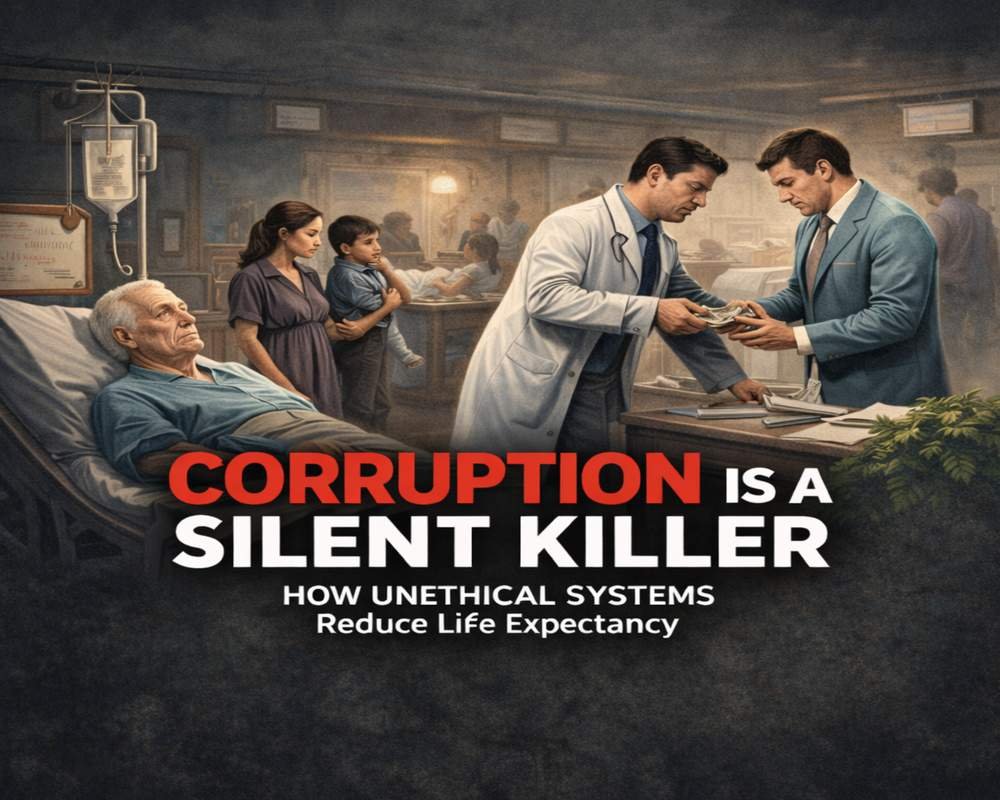
Life expectancy is often discussed in terms of healthcare access, nutrition, sanitation, and medical technology. Governments invest billions in hospitals, vaccines, and infrastructure to help citizens live longer, healthier lives. Yet one of the most powerful forces shortening human life rarely appears on medical charts or death certificates. Corruption—quiet, normalized, and deeply rooted in systems—is a silent killer. It does not strike suddenly like a virus or accident, but slowly erodes health, safety, trust, and dignity, ultimately reducing life expectancy across entire societies.
Corruption is not just a moral failure or an economic inefficiency; it is a public health crisis. When unethical behavior becomes institutionalized, it creates stress, inequality, unsafe environments, and weak services that shorten lives long before old age.
Understanding Corruption Beyond Bribes
Corruption is often narrowly defined as bribery—money exchanged under the table. In reality, it is far broader and more damaging. Corruption includes:
- Abuse of power for personal gain
- Fake degrees and certificates in critical professions
- Nepotism and favoritism over merit
- Embezzlement of public funds
- Manipulation of laws, tenders, and audits
- Lying, data falsification, and concealment of risks
These practices poison systems that people rely on every day—healthcare, education, transportation, food safety, law enforcement, and governance. When these systems fail, lives are shortened not dramatically, but systematically.
Corruption and Healthcare: When the System Meant to Heal Causes Harm
Healthcare corruption directly reduces life expectancy. When funds meant for hospitals are siphoned off, the result is predictable: under-equipped facilities, untrained staff, expired medicines, and overcrowded wards.
Fake medical degrees and certificates are among the deadliest forms of corruption. An unqualified doctor or technician may not intend to kill, but lack of competence can lead to misdiagnosis, surgical errors, wrong medication, and preventable deaths. Each mistake may be invisible statistically, but together they shave years off national life expectancy.
Corruption also affects access. Bribes determine who receives treatment first, who gets ICU beds, or who obtains life-saving medicine. The poor wait, suffer, and often die earlier—not because diseases are incurable, but because ethics are absent.
Unsafe Infrastructure: Corruption That Collapses Lives
Bridges collapsing, buildings catching fire, roads causing fatal accidents—these tragedies are rarely “accidents.” They are often the final stage of corruption.
When contractors use substandard materials, when safety inspections are falsified, or when officials accept bribes to approve unsafe designs, infrastructure becomes a death trap. Each unsafe building or road increases daily risk, especially for ordinary people who have no choice but to use them.
Life expectancy falls not because people suddenly become unhealthy, but because the environment itself becomes hostile to survival.
Food, Water, and Environmental Corruption
Clean water and safe food are fundamental to long life. Corruption in food inspection agencies, water treatment plants, and environmental regulation leads to contamination, toxic exposure, and chronic illness.
Industries may dump waste illegally. Inspectors may look away. Certificates may be issued without testing. Over time, people develop cancers, respiratory diseases, kidney failure, and developmental disorders. These are slow deaths—rarely traced back to corruption, yet deeply rooted in it.
Environmental corruption often affects the poorest communities most, creating health inequality and lowering average life expectancy for entire populations.
Education Corruption and Long-Term Health Damage
Education shapes life expectancy more than many realize. Educated individuals make better health decisions, earn more, live in safer conditions, and experience less stress.
When education systems are corrupted—through fake degrees, cheating, bribery, and unqualified teachers—the damage lasts generations. Graduates lack real skills. Professionals enter sensitive roles without competence. Engineers, pharmacists, teachers, and administrators who should protect society instead weaken it.
A society built on fake credentials becomes fragile. Poor decisions multiply. Systems malfunction. The result is not only economic decline, but shorter, more stressful lives.
Psychological Stress: The Hidden Health Burden of Corruption
One of the most overlooked impacts of corruption is chronic stress. Living in an unethical system means:
- Constant fear of unfair treatment
- Uncertainty about justice and safety
- Pressure to lie or pay bribes to survive
- Frustration from blocked opportunities
- Loss of trust in institutions and people
Chronic stress is scientifically linked to heart disease, hypertension, diabetes, weakened immunity, depression, and early death. When corruption becomes normal, stress becomes permanent.
Even those who benefit from corruption suffer. Living a lie, hiding fraud, or fearing exposure creates anxiety that silently damages mental and physical health.
Inequality: When Corruption Decides Who Lives Longer
Corruption amplifies inequality. Resources meant for many are captured by a few. The rich access private healthcare, safe housing, clean food, and legal protection. The poor face polluted environments, unsafe transport, underfunded hospitals, and injustice.
Life expectancy gaps widen. In the same city, one group may live 10–15 years longer than another—not due to genetics, but due to systemic corruption.
Societies with high inequality also experience more violence, crime, and social instability, further reducing average life expectancy.
Weak Institutions Mean Weak Protection of Life
Strong institutions protect life through regulation, law enforcement, and accountability. Corruption weakens these institutions from within.
- Unsafe products remain on the market
- Criminals escape punishment
- Workplace safety rules are ignored
- Emergency responses are delayed
- Public warnings are suppressed
When institutions fail, individuals are left exposed. Life becomes riskier at every step—from commuting to work to buying medicine.
Corruption vs. Trust: Why Trust Is Essential for Long Life
Trust is a powerful health factor. People in high-trust societies cooperate, follow public health advice, support one another, and resolve conflicts peacefully.
Corruption destroys trust. Citizens stop believing in rules, data, leaders, and even professionals. During crises—pandemics, disasters, economic shocks—this lack of trust becomes deadly. People ignore warnings, avoid hospitals, or rely on misinformation.
Lower trust equals higher mortality.
Ethical Societies Live Longer
Global comparisons consistently show that societies with lower corruption tend to have higher life expectancy. This is not coincidence. Ethical systems ensure:
- Merit-based professional competence
- Fair access to healthcare and education
- Safer infrastructure and environments
- Lower stress and higher social cohesion
- Stronger prevention and early intervention
Ethics, therefore, is not a luxury—it is life-saving infrastructure.
Breaking the Cycle: Ethics as Preventive Medicine
If corruption shortens life, then integrity extends it. Fighting corruption is one of the most effective long-term health strategies a society can adopt.
Key actions include:
- Zero tolerance for fake degrees and certificates
- Transparent recruitment and procurement
- Independent audits and inspections
- Digital systems to reduce human discretion
- Strong protection for whistleblowers
- Ethics education from school to workplace
On a personal level, choosing honesty reduces stress, builds trust, and creates psychological peace—factors strongly linked to longer life.
Conclusion: Choosing Life Over Corruption
Corruption kills quietly. It does not appear on death certificates, yet it determines who receives care, who is protected, who is qualified, and who survives. It turns hospitals into hazards, roads into traps, education into illusion, and daily life into stress.
Life expectancy is not only a medical outcome; it is a moral outcome.
Societies that tolerate lies, fake success, and unethical systems pay with shorter lives. Those that choose integrity, fairness, and truth build environments where people live longer—not just in years, but in quality, dignity, and peace.
To fight corruption is not only to fight injustice.
It is to fight premature death.


