



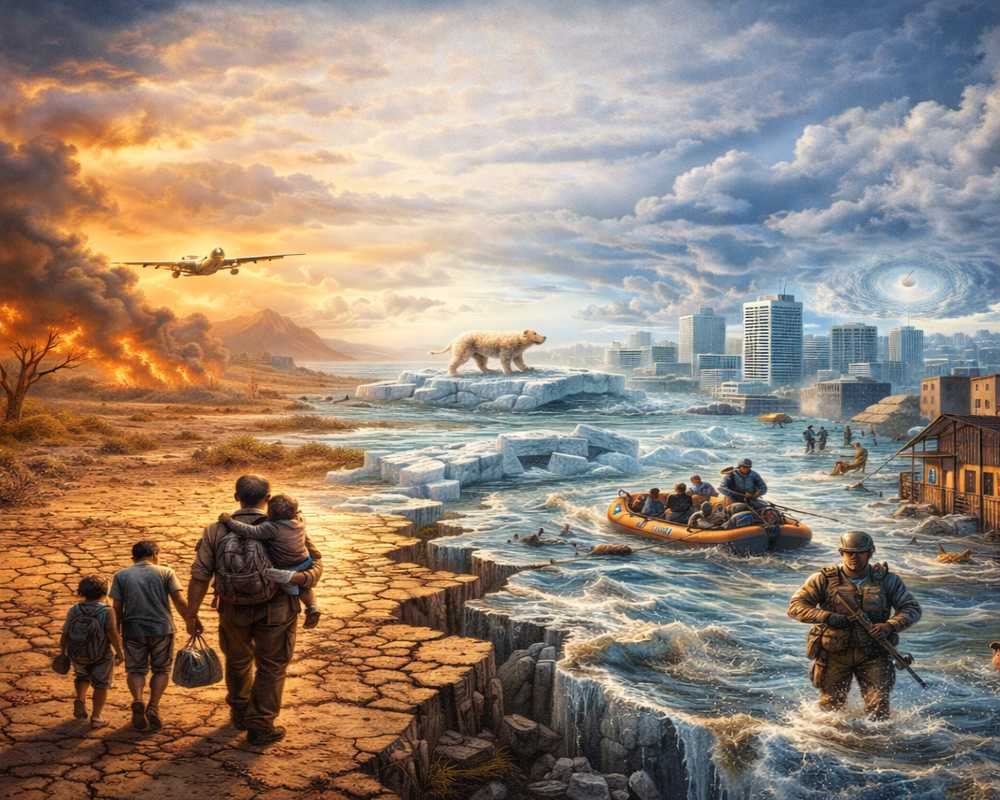
Wars are usually imagined as violent clashes between armies, fought with guns, tanks, and missiles. History textbooks describe battlefields, invasions, and treaties signed after destruction. Yet the most dangerous global conflict of the twenty-first century may unfold without a single formal declaration of war, without frontlines, and without conventional weapons. Climate change is emerging as the next global war—silent, borderless, and devastating.
Unlike traditional wars, climate change does not target one nation at a time. It affects every region, every economy, and every population, though not equally. Its weapons are heatwaves, floods, droughts, rising seas, and collapsing ecosystems. Its casualties include farmers, coastal communities, children, and future generations who had no role in causing it. This is a war humanity is fighting against itself—through unchecked consumption, short-term thinking, and political inaction.
A War Without Enemies—but Not Without Victims
Traditional wars have identifiable enemies. Climate change does not. There is no single aggressor, no opposing army to defeat. Yet there are clear victims. Small island nations face extinction as sea levels rise. Farmers lose livelihoods as rainfall patterns shift. Cities choke under heatwaves and air pollution. The poorest communities suffer first and worst, despite contributing least to the problem.
This imbalance makes climate change uniquely dangerous. Because there is no visible enemy, responsibility is easily denied or shifted. Governments delay action, corporations protect profits, and societies continue unsustainable lifestyles. Meanwhile, the damage accumulates quietly, relentlessly.
In this war, inaction itself becomes a weapon.
Climate Change as a Threat Multiplier
Climate change rarely acts alone. Instead, it intensifies existing problems—poverty, inequality, weak governance, and social division. Security experts increasingly describe it as a “threat multiplier.”
Droughts reduce food production, driving up prices and increasing hunger. Floods destroy infrastructure, displacing populations and straining governments. Heat stress reduces productivity and overwhelms healthcare systems. When resources become scarce, tensions rise.
History shows that scarcity often leads to conflict. Climate change does not cause wars directly, but it creates conditions where conflict becomes more likely. Fragile states become more unstable. Regions with existing tensions become flashpoints.
Water Scarcity: The Frontline of Climate Conflict
Water is already one of the most contested resources on Earth, and climate change is intensifying the struggle. Melting glaciers threaten river systems that supply millions. Changing rainfall patterns dry up reservoirs and aquifers. Extreme droughts push regions toward crisis.
Many major rivers cross national borders. As water becomes scarce, upstream and downstream countries face increasing tension. Decisions about dams, irrigation, and diversion take on geopolitical significance.
Water scarcity does not announce itself with explosions. It creeps into daily life—empty taps, failing crops, and desperate migration. Yet its long-term destabilizing power rivals that of armed conflict.
Food Insecurity: Hunger as a Silent Weapon
Climate change is reshaping global food systems. Rising temperatures reduce crop yields. Extreme weather destroys harvests. Pests and diseases spread into new regions. Fisheries decline as oceans warm and acidify.
Food insecurity fuels unrest. When people cannot afford or access basic nourishment, trust in institutions collapses. Protests erupt. Governments fall. In extreme cases, armed groups exploit desperation.
Hunger has always been a powerful force in human history. Climate change is turning it into a global destabilizer—a weapon that kills slowly but relentlessly.
Climate Migration: Borders Under Pressure
As environments become unlivable, people move. Climate-driven migration is no longer a future scenario; it is already happening. Coastal erosion, desertification, floods, and heatwaves push communities to seek safety elsewhere.
Unlike traditional refugees, climate migrants often have no legal recognition. They move internally or across borders, placing pressure on cities and neighboring countries. This movement can spark political backlash, xenophobia, and social tension.
When migration is framed as a security threat rather than a humanitarian challenge, societies drift toward conflict. Climate change turns borders into pressure points—not through invasion, but through human survival.
Economic Warfare Without Missiles
Climate change disrupts economies as effectively as war. Infrastructure damage, supply chain breakdowns, insurance losses, and reduced productivity weaken national economies. Developing countries suffer disproportionately, widening global inequality.
Entire industries face transformation or collapse. Agriculture, energy, tourism, and fisheries are all vulnerable. Economic instability undermines political stability, creating fertile ground for extremism and conflict.
This economic damage does not come from enemy attacks, but from systemic environmental stress—a war fought through markets, labor, and livelihoods.
Militaries Are Preparing—but Cannot Win
Ironically, some of the world’s most powerful military institutions now recognize climate change as a major security threat. Armed forces plan for disaster response, base flooding, and humanitarian crises. Navies prepare for rising seas. Militaries adapt.
Yet no army can defeat climate change. Weapons cannot stop glaciers from melting or oceans from warming. Military readiness may manage symptoms—disaster relief, emergency response—but it cannot address root causes.
This reality exposes a fundamental truth: the next global war cannot be won by force.
The Politics of Delay: A Strategic Failure
One of the most dangerous aspects of climate change is political delay. Leaders postpone action due to economic concerns, electoral cycles, or lobbying pressure. Short-term interests override long-term survival.
In traditional war, delay can be fatal. In the climate crisis, delay is catastrophic. Each year of inaction locks in higher temperatures, greater damage, and fewer options. The costs of adaptation and mitigation rise exponentially.
Political hesitation becomes a strategic failure—not against another nation, but against reality itself.
Inequality: The Moral Battlefield
Climate change exposes deep global injustice. Wealthy nations, historically responsible for the majority of emissions, have greater resources to adapt. Poorer nations, with minimal contribution, face the harshest impacts.
This imbalance fuels resentment and undermines international cooperation. Calls for climate justice grow louder as affected communities demand accountability, financing, and technology transfer.
Without fairness, global cooperation weakens. Without cooperation, climate action fails. Inequality becomes the moral battlefield of the climate war.
Information Warfare: Denial and Distraction
No modern war is fought without information warfare. Climate change is no exception. Misinformation, denial, and distraction delay action and confuse the public. Scientific consensus is undermined by doubt campaigns. Urgency is replaced with complacency.
When societies cannot agree on reality, collective action becomes impossible. Confusion serves those who benefit from the status quo, even as risks escalate.
In this war, truth itself is under attack.
Cooperation or Collapse
Despite its dangers, climate change also presents an unprecedented opportunity for cooperation. Unlike traditional wars, there is no advantage in another nation’s failure. One country’s emissions affect all others. One region’s collapse sends shockwaves globally.
Solutions exist: renewable energy, sustainable agriculture, efficient cities, conservation, and climate-resilient infrastructure. The challenge is not technological—it is political and ethical.
Climate change demands a shift from competition to cooperation, from national interest to shared survival.
Education: The Strongest Defense
The most powerful weapon against climate change is not military hardware, but educated minds. Public understanding drives political will. Informed citizens demand accountability, support sustainable policies, and change behavior.
Education builds resilience—social, economic, and environmental. It helps societies adapt, innovate, and cooperate. Without education, fear and misinformation dominate.
If climate change is a war, education is its strongest defense system.
Redefining Security in the Climate Age
Traditional security focuses on borders, armies, and deterrence. Climate change forces a redefinition. Security now includes food systems, water access, public health, ecosystems, and social cohesion.
A nation with powerful weapons but collapsing environments is not secure. A world with advanced militaries but destabilized climates is not safe.
True security in the twenty-first century is climate security.
Conclusion: A War Humanity Must Choose to End
Climate change is the first global war where all sides lose. There are no victors, only varying degrees of damage. It is fought not with bullets, but with emissions, policies, and choices. Its outcome depends on whether humanity can act collectively, ethically, and urgently.
This war does not demand soldiers—it demands responsibility. It does not require enemies—it requires cooperation. It does not end with surrender—it ends with transformation.
Climate change is the next global war without weapons.
Whether it becomes humanity’s greatest failure or its most powerful act of unity will define the future of world peace.
The battlefield is the planet.
The time is now.


