



In today’s competitive global economy, becoming a Corporate CEO or a top executive in a multinational company is not simply a matter of academic qualification, family background, or luck. It is the result of years of disciplined effort, continuous learning, ethical strength, and the ability to lead people through uncertainty. The corporate world has evolved dramatically. Companies now operate across borders, cultures, regulations, and technological landscapes. Leading such organizations requires more than intelligence — it requires character.
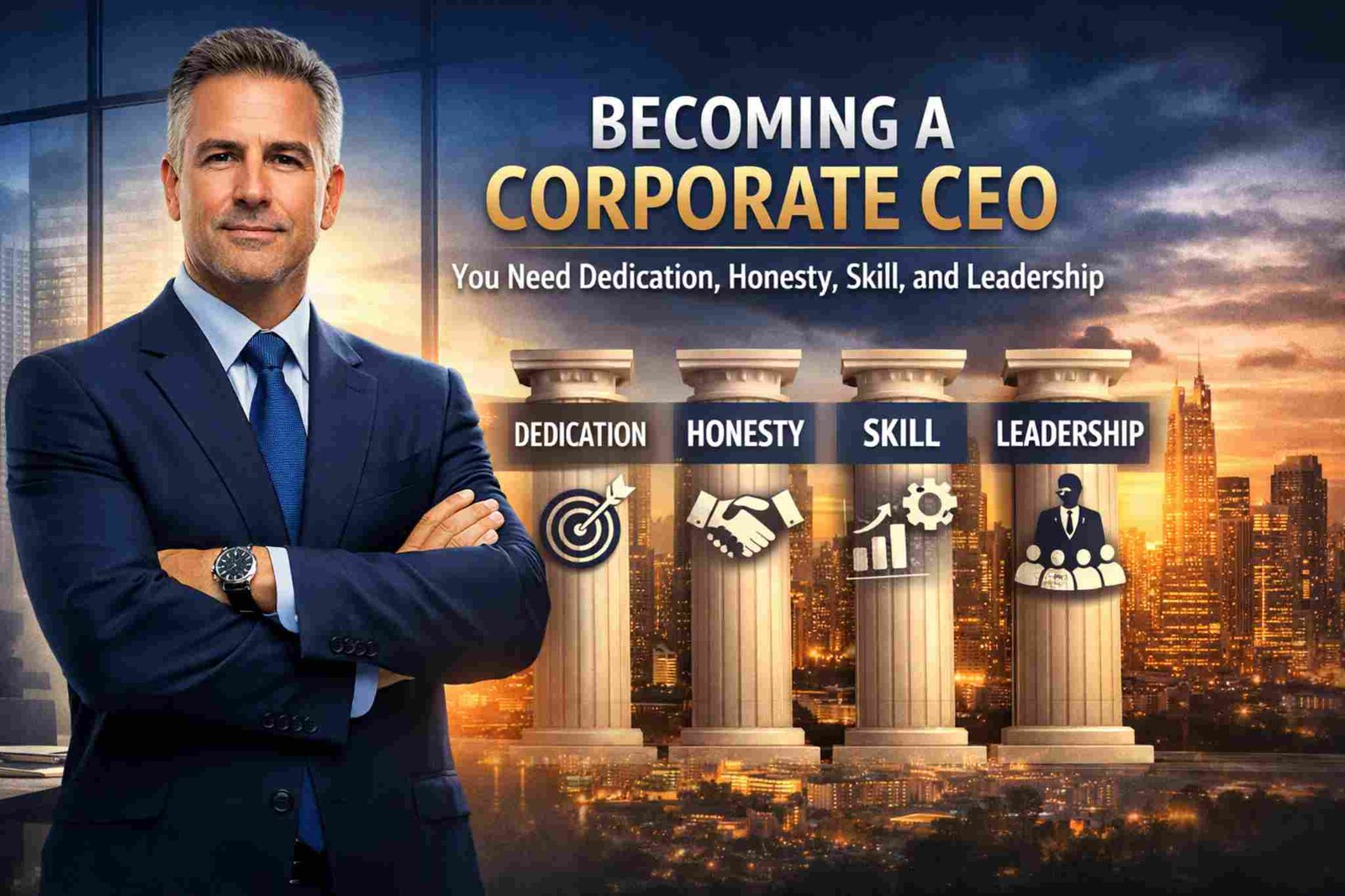
At the heart of successful corporate leadership lie four powerful pillars: Dedication, Honesty, Skill, and Leadership. These are not just motivational words. They are measurable, practical qualities that determine whether a person can be trusted with the responsibility of steering a complex organization.
This article explores why these four qualities are essential and how they shape the journey toward becoming a Corporate CEO.
1. Dedication: The Foundation of Long-Term Success
Every CEO’s journey begins long before they reach the boardroom. It begins with dedication — the commitment to excellence regardless of position or recognition.
Dedication means:
- Showing consistency even when results are not immediate
- Remaining committed during difficult economic or operational crises
- Continuously upgrading knowledge and professional competence
- Taking ownership of both success and failure
In multinational corporations, pressure is constant. There are quarterly targets, shareholder expectations, regulatory challenges, employee welfare responsibilities, and global competition. Only a deeply dedicated individual can sustain the mental strength required to handle such pressure.
Dedication also reflects discipline. A future CEO must develop habits of punctuality, preparation, structured thinking, and strategic planning. Leaders who lack dedication may achieve temporary success, but they struggle when complexity increases.
In reality, dedication is what transforms potential into performance.
2. Honesty: The Cornerstone of Corporate Trust
In the corporate world, trust is currency. Without trust, no organization can survive — no matter how advanced its technology or how large its capital.
Honesty in leadership means:
- Transparency in decision-making
- Ethical financial reporting
- Fair treatment of employees
- Compliance with laws and regulations
- Accountability in corporate governance
A CEO is responsible not only for profit but also for reputation. Corporate scandals around the world have shown how quickly companies collapse when top management compromises ethics. Investors withdraw, employees lose confidence, and customers shift to competitors.
Honesty creates long-term sustainability. It strengthens relationships with stakeholders — including shareholders, regulators, suppliers, employees, and society.
In multinational corporations, ethical responsibility becomes even more critical because companies operate across multiple legal systems and cultures. A leader must ensure that standards of integrity remain consistent everywhere.
Honesty is not weakness. It is strategic strength.
3. Skill: The Engine of Professional Competence
Dedication and honesty provide the moral framework, but skill provides execution capability.
A Corporate CEO must possess multidimensional skills, including:
Strategic Thinking
The ability to see long-term opportunities and threats. A CEO must analyze global trends, market shifts, technological disruptions, and geopolitical risks.
Financial Intelligence
Understanding balance sheets, cash flow, investment strategy, and risk management is essential. Corporate decisions involve millions or billions of dollars.
Operational Excellence
From manufacturing efficiency to service optimization, a CEO must understand how systems work. Leaders who understand processes can improve performance.
Communication Skill
A CEO communicates vision to employees, confidence to investors, and responsibility to regulators. Clear communication prevents misunderstanding and builds alignment.
Decision-Making Ability
Not all decisions are comfortable. Some require restructuring, cost reduction, or difficult negotiations. A skilled CEO makes informed, timely decisions under uncertainty.
Technological Awareness
In today’s era of digital transformation, artificial intelligence, ERP systems, automation, and data analytics are central to corporate survival. A modern CEO must understand technological integration.
Skill is not static. It requires lifelong learning. The global business environment changes rapidly. Leaders who stop learning become outdated.
4. Leadership: The Power to Inspire and Direct
Leadership is more than authority. It is influence.
A true corporate leader:
- Inspires employees to perform beyond minimum expectations
- Builds high-performance teams
- Encourages innovation
- Creates a culture of accountability
- Develops future leaders
Multinational companies operate with diverse workforces. Employees come from different cultures, educational backgrounds, and expectations. A CEO must unify them under a shared vision.
Leadership also means emotional intelligence. Understanding people’s motivations, fears, and aspirations helps build strong internal culture. Employees perform better when they trust and respect their leadership.
Effective leadership turns strategy into action.
5. Balancing Profit with Responsibility
Modern CEOs cannot focus only on profit. They must also consider environmental sustainability, workplace safety, and social responsibility.
Global corporations are increasingly evaluated on:
- Environmental impact
- Workplace safety standards
- Corporate governance
- Community contribution
- Ethical sourcing
A CEO must integrate economic goals with social responsibility. This requires balanced judgment and strong moral character.
Sustainable leadership builds long-term value, not just short-term financial gain.
6. Crisis Management: A True Test of Character
Every multinational company eventually faces crisis — economic downturns, supply chain disruptions, legal issues, or technological failures.
During crisis, four qualities become visible:
- Dedication keeps the leader focused
- Honesty ensures transparent communication
- Skill enables strategic problem-solving
- Leadership maintains employee morale
The real test of a CEO is not how they behave during growth, but how they respond during adversity.
History has shown that strong leaders transform crises into opportunities for improvement and innovation.
7. Building Experience Through Progressive Responsibility
Experience is not about years; it is about exposure.
Future CEOs often pass through roles such as:
- Operations management
- Project management
- Finance oversight
- Quality management systems
- International business coordination
- Strategic planning
Each stage builds understanding of corporate complexity. Leaders who understand multiple functions can make balanced decisions.
Experience also teaches humility. It shows that success is collective, not individual.
8. Vision: Seeing Beyond the Present
A Corporate CEO must have vision — the ability to imagine where the company should be in five, ten, or twenty years.
Vision requires:
- Market awareness
- Innovation mindset
- Global competitiveness analysis
- Risk forecasting
Without vision, companies become reactive rather than proactive.
A visionary CEO anticipates industry transformation and prepares the organization before disruption occurs.
9. The Role of Personal Discipline and Character
Behind every successful CEO is personal discipline.
This includes:
- Time management
- Continuous reading and research
- Health and mental fitness
- Ethical consistency
- Emotional control
Leadership begins with self-leadership. If a person cannot control personal habits, they cannot control an organization.
Character determines credibility. Credibility determines influence.
10. Developing the CEO Mindset
Becoming a Corporate CEO requires a mindset shift:
- From employee thinking to ownership thinking
- From short-term tasks to long-term strategy
- From personal success to organizational success
- From authority to responsibility
A CEO does not seek power; they accept responsibility.
The higher the position, the greater the accountability.
11. The Global Dimension of Multinational Leadership
Leading a multinational corporation requires cultural intelligence.
A CEO must:
- Respect diverse cultural norms
- Understand international regulations
- Manage cross-border supply chains
- Handle global competition
Global leadership requires adaptability. A rigid mindset cannot survive in multinational environments.
12. Continuous Improvement and Innovation
Successful CEOs promote continuous improvement culture.
They encourage:
- Process optimization
- Data-driven decisions
- Quality management systems
- Risk assessment frameworks
- Employee development programs
Innovation keeps corporations competitive.
A leader who resists change eventually leads decline.
13. Mentorship and Succession Planning
A strong CEO prepares the next generation of leaders.
Succession planning ensures business continuity. It reflects mature leadership thinking.
True leaders do not fear replacement; they prepare successors.
14. Ethical Leadership in the Modern World
Corporate leadership today is under global scrutiny. Transparency, compliance, and social responsibility are not optional.
Ethical leadership includes:
- Anti-corruption policies
- Compliance frameworks
- Fair labor practices
- Environmental responsibility
- Transparent governance
Companies led by ethical CEOs earn long-term respect.
15. Conclusion: The Integrated Path to Corporate Excellence
Becoming a Corporate CEO is not a shortcut journey. It is a disciplined progression built on Dedication, Honesty, Skill, and Leadership.
Dedication builds endurance.
Honesty builds trust.
Skill builds competence.
Leadership builds influence.
When these four qualities combine, they create sustainable corporate power.
A multinational CEO is not merely a title-holder. They are a guardian of corporate integrity, a strategist for future growth, a motivator of people, and a custodian of societal responsibility.
In a world of increasing complexity, only those who combine character with competence can rise to true corporate leadership.
The path is demanding — but for those who embrace dedication, honesty, skill, and leadership, the destination is not only professional success but meaningful impact.


