


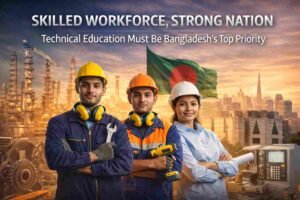
Bangladesh stands today at a historic turning point. With a population of nearly 180 million, the nation possesses one of the largest reservoirs of human resources in the world. Countries with far fewer people — such as Singapore, Qatar, the UAE, South Korea, and Japan — transformed their economies primarily through strategic investment in manpower development, skill-based training, and global workforce export policies.
Bangladesh, blessed with a huge youth population, has the opportunity to become a leading global supplier of skilled professionals, technicians, engineers, caregivers, digital workers, and industrial specialists. This can become the country’s number-one source of foreign exchange and sustainable development if planned properly.
This article explores why manpower development must become Bangladesh’s main development priority, how manpower export can reshape the economy, and what strategic steps are needed to ensure global competitiveness in the next decade.
1. Population: The Greatest Asset of Bangladesh
Bangladesh often sees its dense population as a burden—yet in the global economic context, population is power. Nations with small populations struggle to sustain industries, innovation, and economic growth. Bangladesh, on the other hand, has:
- A demographic dividend, with over 60% of citizens below 35 years.
- Millions of young people entering the workforce every year.
- Increasing literacy rates and rising interest in technical education.
- High adaptability to new technologies and global work cultures.
- Strong diaspora networks in Europe, the Middle East, Asia, and North America.
Instead of relying mainly on garments, remittances from low-skilled workers, and agricultural exports, Bangladesh can unlock massive new economic opportunities by upgrading the skill level of its entire workforce.
Countries like the Philippines earn billions every year from exporting nurses, teachers, seafarers, and overseas workers. Bangladesh can earn far more if it focuses on structured manpower development.
2. Why Manpower Development Should Be the Main National Priority
2.1. The World Is Facing a Massive Labour Shortage
Many developed countries are experiencing declining birth rates and rapidly aging populations. By 2035:
- Europe will need millions of foreign workers.
- Japan will continue importing caregivers and technical interns.
- Canada, Australia, and the USA will expand skilled migration.
- Gulf countries will continue depending on foreign manpower for construction, industry, hospitality, and energy sectors.
Bangladesh has the perfect demographic structure to meet this demand — but our workforce must be skilled, not just available.
2.2. Skilled manpower earns more foreign currency
Unskilled remittance earners typically earn USD 200–400 monthly.
Skilled workers earn USD 1,000–4,000 or more.
Imagine if just 1 million workers from Bangladesh upgraded to skilled labor:
- Monthly foreign income could grow by 3–4 times.
- National reserve could stabilize permanently.
- Middle-class expansion would accelerate.
- Poverty reduction would speed up dramatically.
2.3. Industry 4.0 demands skilled workers
Global industries are transforming through:
- Automation
- Robotics
- IoT
- AI
- Cloud computing
- Renewable energy
- Advanced manufacturing
Bangladesh must train youth for future skills so they can compete globally. Otherwise, opportunity will slip away.
2.4. At first, we Bangladeshis Must Avoid Telling Lies, Stop Making Fake Products, Overcome Laziness, and Practice Honesty for a Better Future
Bangladesh is a nation of talent, hard work, and potential, but to achieve true global respect, we must strengthen one core value: honesty. As citizens of a country with 180 million people, our actions represent not only ourselves but our nation as a whole. When we avoid telling lies, refuse to make fake or low-quality products, and practice truthfulness in every stage of life and career, we build a reputation that lasts beyond borders.
Honesty creates trust — trust in our products, our workforce, and our national character. Countries like Japan and Germany are admired worldwide because their people value truth, quality, and responsibility. If we adopt the same mindset, Bangladesh can become known for integrity, professionalism, and excellence.
A truthful society creates stronger businesses, fairer markets, better governance, and more opportunities for skilled manpower abroad. When employers around the world know that Bangladeshis are honest, reliable, and hardworking, they will prefer hiring from our nation.
By choosing honesty in our education, workplaces, factories, businesses, and daily interactions, we not only improve ourselves but also uplift Bangladesh’s global image. A truthful nation is a respected nation — and that respect will open doors for our future generations.
3. The Future of Manpower Export: Sectors Bangladesh Should Target
3.1. Skilled Industrial Workers
Bangladesh can become a top exporter of:
- Electricians
- Plumbers
- Welders
- CNC operators
- Machine technicians
- Fabrication specialists
- HVAC technicians
- Automobile mechanics
- Solar energy technicians
These skills are in high demand in GCC countries, Europe, and Southeast Asia.
3.2. Healthcare Professionals
Countries like Japan, Germany, and the UK urgently need:
- Nurses
- Caregivers
- Physiotherapy assistants
- Medical technicians
Bangladesh can build training centres aligned with international standards to supply tens of thousands of healthcare professionals every year.
3.3. IT and Digital Workers
Digital Bangladesh has created a new tech-savvy youth generation. They can be trained as:
- Software developers
- UI/UX designers
- Digital marketers
- Cybersecurity technicians
- Data entry and remote support professionals
- AI and machine learning beginners
- Cloud technicians
With global remote work rising, Bangladesh can become a major exporter of online digital services.
3.4. Construction and Mega Project Workforce
Huge opportunities in:
- Saudi Vision 2030
- Qatar expansion
- UAE infrastructure
- African development boom
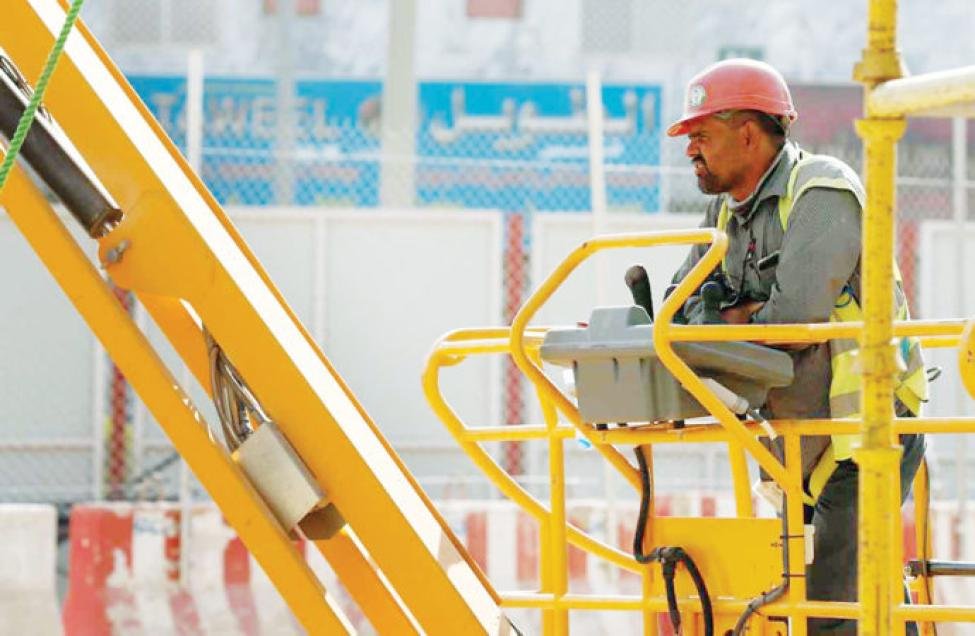
Bangladesh can send trained workers for high-paying construction roles if we can certify them with recognized international standards.
3.5. Seafarers and Marine Manpower
Bangladesh already has strong maritime potential. Expanding:
- Marine engineering
- Seafaring
- Ship electricians
- Deck and engine crew
…can significantly boost remittance inflow.
4. Why Bangladesh Must Shift from Low-Skilled to High-Skilled Export
Low-skilled manpower has several limitations:
- Low salary
- High job insecurity
- Frequent exploitation
- Slower career growth
- Limited remittance contribution
In contrast, high-skilled manpower enjoys:
- Higher salaries (2x–10x more)
- Permanent migration opportunities
- Better work conditions
- Greater global acceptance
- Ability to support families more strongly
- Increased tax contribution to Bangladesh
A structured national strategy to move from labor export to skill export will transform the nation within 10–20 years.
5. How Bangladesh Can Build a Global-Standard Skilled Workforce
5.1. National Skills Training Centers in Every District
Bangladesh must establish at least one Technical Skill Development Center in each district, focusing on:
- Electrical trade
- Mechanical trade
- IT and digital
- Healthcare and caregiving
- Industrial machine operation
- Hospitality & tourism
These centres must follow:
- Japan TITP standards
- Germany vocational standards
- GCC technical certification
- International maritime standards
5.2. English Language Training and Communication Skills
Global employers prioritize communication.
Bangladesh should include:
- English speaking
- Business communication
- Basic computer literacy
…in every skill training program.
5.3. Government-to-Government (G2G) Recruitment Programs
Bangladesh should expand G2G manpower export agreements with:
- Japan
- Germany
- Romania
- Malaysia
- Saudi Arabia
- Qatar
- South Korea
These programs reduce exploitation and increase safety.
5.4. International Certification Systems
Workers should receive globally recognized certifications like:
- OSHA
- IOSH
- ISO-based competency
- NCCER
- JITCO/Japan TITP
- German BQF vocational certification
This will make Bangladeshi workers more competitive.
5.5. Modern Upgradation of Existing TVET Institutes
Bangladesh has many polytechnic and technical schools, but many lack modern equipment. Upgradation is essential in:
- Mechatronics labs
- Robotics & automation labs
- CNC & fabrication systems
- Renewable energy training units
- Industrial simulation systems
6. Economic Benefits of Becoming a Manpower Export Powerhouse
If implemented properly, Bangladesh can:
6.1. Triple Its Remittance Income
Currently Bangladesh earns around USD 22–24 billion through remittance — mostly from low-skilled jobs.
With skilled manpower export, this can reach USD 60–70 billion annually.
6.2. Strengthen Foreign Currency Reserves
A strong remittance flow ensures:
- Stable currency
- Lower inflation
- Better import capacity
- Reduced economic vulnerability
6.3. Reduce Unemployment and Underemployment
Millions of youths are unemployed or stuck in low-paying local jobs.
Skilled manpower export gives them:
- High-income opportunities
- Global exposure
- Better quality of life
6.4. Accelerate Middle-Class Growth
A skilled workforce earns more, saves more, and invests more.
This boosts:
- Housing
- Education
- Healthcare
- Small businesses
6.5. Support National Infrastructure Development
Remittance-funded development is visible across Bangladesh in:
- Roads
- Houses
- Schools
- Mosques
- Hospitals
More skilled remittance means more development.
7. Challenges Bangladesh Must Address
7.1. Lack of Modern Training Facilities
Many existing technical institutes are outdated.
Massive upgrading is necessary.
7.2. Middlemen Exploitation
High migration cost reduces earnings.
Strong regulation is needed.
7.3. Weak Quality Control in Training
Training must be standardized with uniform national competency tests.
7.4. Limited Access to Information
Many rural youths don’t know about global opportunities or how to apply.
7.5. Language Barriers
English, Japanese, Korean, and Arabic language training must be integrated.
8. Strategic Vision: Making Bangladesh the “Skills Capital of Asia”
To achieve this vision, Bangladesh should implement the following national policies:
8.1. “Skill Bangladesh 2041” Masterplan
A long-term roadmap focusing on:
- Training 20 million youths
- Exporting 1 million skilled workers annually
- Establishing 200+ global-standard training institutes
- Integrating AI and digital skills
- Building smart certification systems
8.2. Priority Investment in TVET
Allocate national budget for:
- Machine labs
- IT training labs
- Vocational colleges
- International accreditation
8.3. Partnerships with Global Employers
Bangladesh must form agreements with:
- Japanese industry groups
- German vocational authorities
- GCC construction giants
- European caregiving companies
8.4. Encouraging Female Workforce Participation
Women can be trained in:
- Nursing
- Sewing and fashion design
- Digital freelancing
- Caregiving
- Hospitality
This will boost economic empowerment.
9. The Social Impact of Skilled Manpower Development
9.1. Poverty Reduction
A single skilled worker abroad can uplift an entire family.
9.2. Reduction of Crime and Drug Abuse
Employment opportunities reduce frustration among youths.
9.3. More Educated Future Generation
Higher income means better schooling for children.
9.4. Stronger National Image
Bangladesh will be known not only for garments but for a world-class workforce.
10. Conclusion: The Future Belongs to a Skilled Nation
Bangladesh has 180 million people — a powerful resource that many countries can only dream of. To transform this population into economic strength, the nation must prioritize:
- Skill development
- Technical training
- Language training
- Digital education
- International certification
- Safe and structured manpower export
If Bangladesh upgrades 20–30 million workers to skilled status in the next 10–20 years, the country will move from a developing nation to a high-income nation.
Manpower development is not just an economic strategy — it is the path to national prosperity, stability, and global respect.


