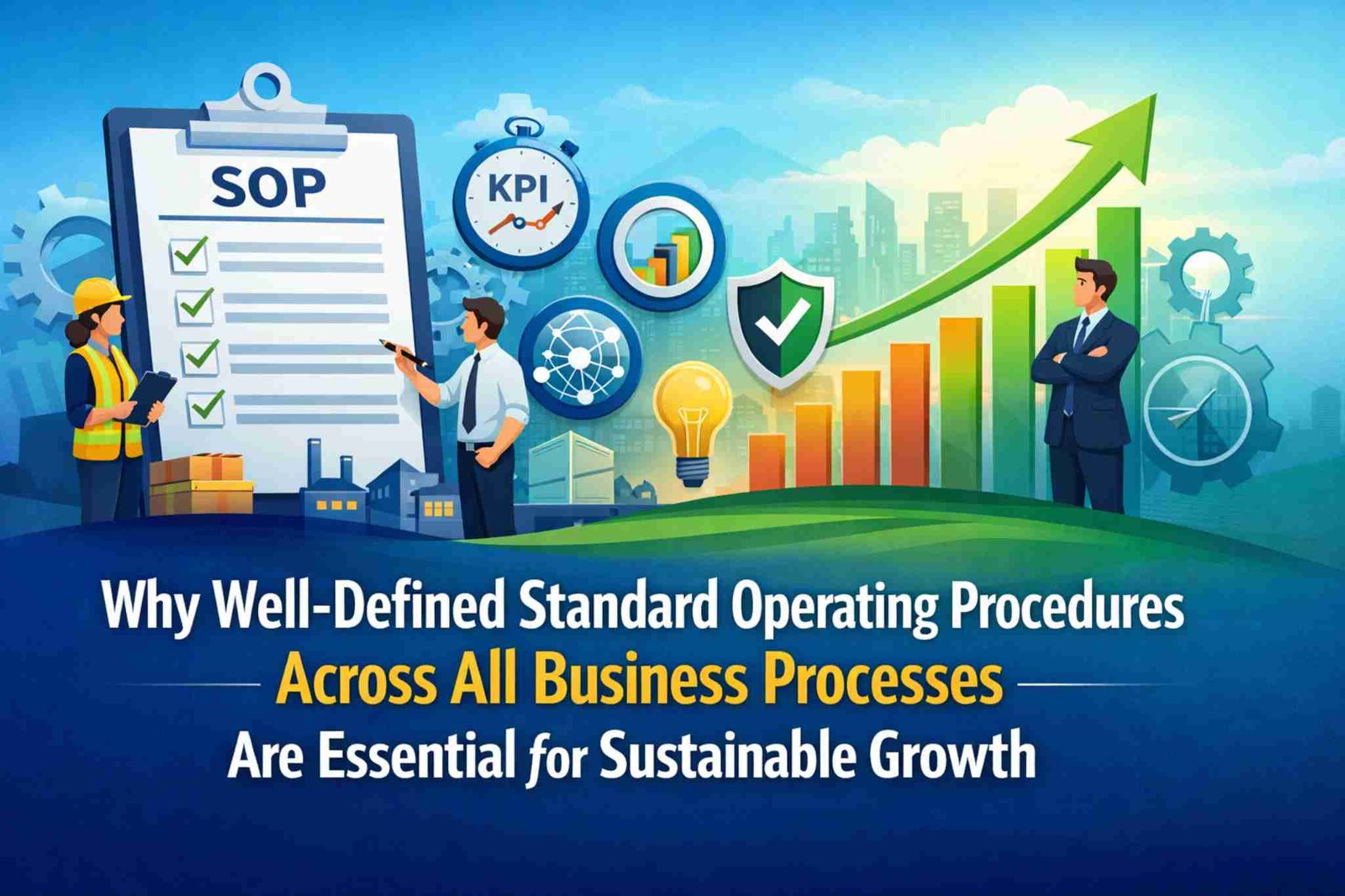
Sustainable business growth is not achieved through ambition alone. Many organizations grow rapidly in their early stages but struggle to maintain performance, quality, and profitability as operations become more complex. The most common reason behind this struggle is not a lack of market demand or resources—it is the absence of clearly defined and consistently followed
Standard Operating Procedures (SOPs).
Standard Operating Procedures are often misunderstood as bureaucratic paperwork or compliance-driven documentation. In reality, SOPs are the backbone of operational excellence. They define how work is done, who does it, when it is done, and what standards must be met. Businesses that invest time in developing well-structured SOPs across all processes build a system that supports efficiency, quality, accountability, and long-term sustainability.
This article explores why well-defined SOPs across all business processes are essential for sustainable growth and how they transform organizations from reactive, people-dependent systems into stable, scalable, and resilient enterprises.
Understanding SOPs Beyond Documentation
An SOP is a documented set of step-by-step instructions that describe how a routine or critical task should be performed. However, a well-defined SOP is more than a simple instruction manual. It includes:
- Clear objectives of the process
- Defined roles and responsibilities
- Process flow and sequence of activities
- Quality and safety requirements
- Records and controls
- References to policies, standards, and regulations
When SOPs are properly designed and implemented, they become living tools that guide daily operations and decision-making rather than documents that sit unused in files.
SOPs as the Foundation of Process Standardization
One of the most critical benefits of SOPs is standardization. Without SOPs, processes are executed based on individual habits, experience, or personal judgment. This leads to variation, inconsistency, and unpredictable outcomes.
Standardized processes ensure that:
- Tasks are performed the same way every time
- Quality remains consistent regardless of who performs the work
- Errors and deviations are minimized
- Best practices are embedded into daily operations
For sustainable growth, consistency is non-negotiable. Customers expect the same quality today as they will tomorrow. SOPs make this consistency possible.
Reducing Dependency on Individuals
Many growing businesses unknowingly become dependent on a few key individuals who “know how everything works.” While experience and expertise are valuable, over-dependence on individuals creates serious risks, including:
- Operational disruption when employees leave
- Knowledge loss
- Difficulty in delegation
- Power imbalance and internal conflicts
Well-defined SOPs convert individual knowledge into organizational knowledge. When processes are documented, trained, and followed, the business no longer relies on memory or personal style. This protects continuity and ensures stability during employee turnover, expansion, or restructuring.
Enabling Scalable Growth
Growth brings complexity. New employees, departments, locations, customers, and regulations add layers to operations. Without SOPs, growth often results in confusion, delays, quality issues, and rising costs.
SOPs enable scalability by:
- Making onboarding faster and more effective
- Allowing new teams to perform at expected standards
- Supporting expansion into new markets or locations
- Ensuring control even as volume increases
A business without SOPs may grow in size, but not in maturity. A business with SOPs grows in a controlled, sustainable manner.
Improving Efficiency and Reducing Costs
Inefficiency is one of the biggest hidden barriers to sustainable growth. Poorly defined processes lead to duplication of work, unnecessary steps, excessive approvals, and rework.
Well-defined SOPs help organizations:
- Identify non-value-adding activities
- Eliminate waste in time, materials, and effort
- Reduce defects and reprocessing
- Optimize resource utilization
When processes are clearly documented and analyzed, inefficiencies become visible. This allows management to improve workflows systematically rather than relying on guesswork.
Enhancing Quality and Customer Satisfaction
Quality is not achieved by inspection alone; it is built into the process. SOPs define quality requirements at every stage of operation, ensuring that standards are maintained consistently.
By following SOPs:
- Products and services meet defined specifications
- Errors are prevented rather than corrected later
- Customer complaints are reduced
- Brand reputation is strengthened
Satisfied customers lead to repeat business, referrals, and long-term growth. SOPs play a direct role in protecting and enhancing customer trust.
Supporting Compliance and Risk Management
Modern businesses operate in environments governed by laws, regulations, and international standards. Compliance failures can result in fines, legal action, loss of certification, or reputational damage.
SOPs are essential for:
- Meeting regulatory and legal requirements
- Demonstrating compliance during audits
- Ensuring health, safety, and environmental controls
- Managing operational and business risks
In management systems such as ISO 9001, ISO 14001, and ISO 45001, SOPs form the core of documented information. They translate policy commitments into actionable practices.
Strengthening Internal Control and Accountability
Without defined procedures, accountability becomes unclear. When something goes wrong, organizations struggle to identify responsibility or root causes.
SOPs clearly define:
- Who is responsible for each task
- What authority and limits apply
- What records must be maintained
- What controls are in place
This clarity improves discipline, transparency, and trust within the organization. Employees understand expectations, and management can monitor performance objectively.
Facilitating Training and Skill Development
Training without SOPs is inconsistent and often ineffective. Different trainers explain tasks differently, leading to confusion and variation in performance.
SOPs provide a structured foundation for:
- Employee training and induction
- Skill development programs
- Refresher training
- Cross-functional learning
New employees become productive faster, and experienced employees have a reference point to maintain standards. This supports continuous competence development, which is essential for long-term growth.
Enabling Measurement and Continuous Improvement
A process that is not defined cannot be measured, and a process that is not measured cannot be improved. SOPs define the baseline for performance measurement.
With SOPs in place, organizations can:
- Set meaningful KPIs
- Monitor process performance
- Conduct root cause analysis
- Implement corrective and preventive actions
This creates a culture of continuous improvement rather than reactive problem-solving. Sustainable growth depends on the ability to adapt, improve, and evolve systematically.
Freeing Leadership to Focus on Strategy
In organizations without SOPs, managers spend most of their time firefighting—solving daily operational issues, clarifying instructions, and correcting mistakes.
When SOPs are well-defined and followed:
- Day-to-day operations become predictable
- Managers can delegate with confidence
- Leadership focuses on strategy, innovation, and growth
This shift from operational chaos to strategic leadership is a defining characteristic of sustainable organizations.
SOPs as a Cultural Tool
Beyond processes, SOPs influence organizational culture. They promote discipline, professionalism, fairness, and transparency. When everyone follows the same rules and standards, favoritism decreases and teamwork improves.
A strong SOP-driven culture:
- Encourages accountability
- Reduces internal conflicts
- Builds confidence among employees
- Aligns behavior with organizational values
Culture plays a critical role in long-term success, and SOPs help embed the right culture into daily operations.
Common Mistakes in SOP Implementation
While SOPs are powerful tools, poor implementation can limit their effectiveness. Common mistakes include:
- Writing SOPs only for audits
- Making SOPs too complex or theoretical
- Not training employees on SOPs
- Failing to review and update SOPs
- Ignoring feedback from process users
To support sustainable growth, SOPs must be practical, user-friendly, regularly reviewed, and actively used.
Conclusion
Well-defined Standard Operating Procedures across all business processes are not optional for organizations seeking sustainable growth. They provide structure, consistency, efficiency, and control in an increasingly complex business environment.
SOPs transform businesses from person-dependent systems into process-driven organizations. They protect quality, reduce risk, enable scalability, and support continuous improvement. Most importantly, they allow leadership to focus on long-term vision rather than daily operational issues.
In a competitive and uncertain world, sustainable growth belongs to organizations that build strong systems—not those that rely on individual effort alone. SOPs are the foundation of those systems, and investing in them is an investment in the future of the business.
-Md Khairul Alom
