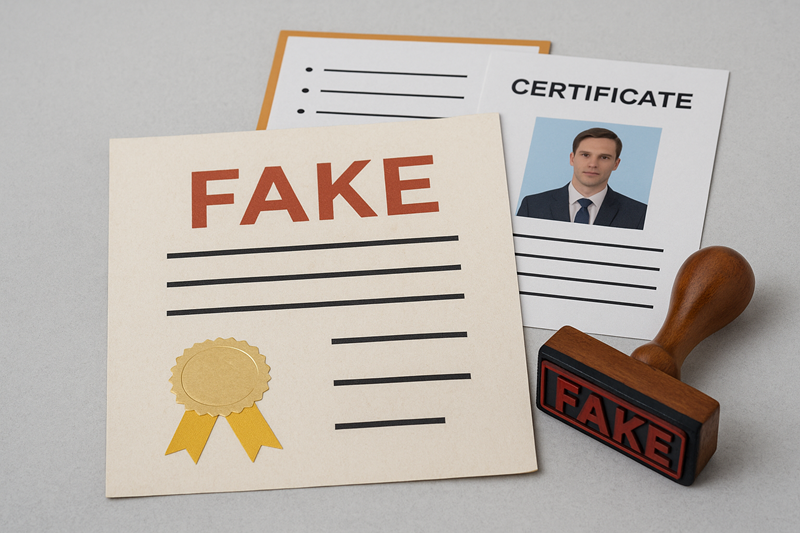
A Deep Analysis of the Social, Economic, and Moral Damage Caused by Falsified Credentials
A nation does not rise only through buildings, highways, or economic zones. It rises through the integrity, honesty, skills, and competence of its people. When individuals acquire education, training, and experience through legitimate hard work, they contribute positively to national development. But when shortcuts become normal—fake degrees, fake certificates, and fake work experience—this not only destroys personal character but also harms the entire nation.
In many developing countries, including Bangladesh and South Asia, the problem of falsified documents is widespread. Whether for jobs, promotions, migration, or social prestige, thousands of people resort to falsified academic transcripts, training certificates, skill credentials, and experience letters. At first, it may feel like an easy way to secure a better job or a higher position. But the long-term damage is deep, destructive, and sometimes irreversible.
A nation where honesty erodes does not just lose its image—it loses its strength.
This article explores how fake qualifications destroy:
- the economy,
- industries,
- institutions,
- trust,
- global reputation, and
- the moral foundation of society.
1. Fake Qualifications Destroy the Foundation of Meritocracy
Meritocracy means rewarding people based on skill, knowledge, and competence, not connections or fake certificates.
When fake degrees enter the system:
- Real talent is pushed aside.
- Skilled people become demotivated.
- Mediocre or unqualified people get powerful positions.
- Productivity decreases.
- Innovation stops.
This creates a national culture where hard work feels useless and shortcuts become “normal.”
A country where real talent cannot rise will never compete globally.
2. Fake Certifications Reduce Skill Quality in Every Industry
A certificate is not just a piece of paper—it is a promise of competence.
When someone uses:
- Fake ISO training certificate
- Fake IT course certificate
- Fake medical license
- Fake engineering or technical diploma
- Fake RMG compliance course
- Fake accountant or HR certificate
- Fake safety training credentials
They enter a job without real knowledge.
This leads to:
- frequent errors
- accidents
- wastage of resources
- low-quality products
- operational failures
- safety hazards
- customer dissatisfaction
Factories lose buyers.
Companies lose clients.
The entire industry becomes known for poor quality.
3. Fake Work Experience Damages Trust and Professional Standards
Experience letters show that someone has real, hands-on practical exposure.
But fake experience creates a chain of disasters:
- Employers hire people who cannot perform.
- Senior managers cannot guide teams properly.
- Wrong decisions get implemented.
- Projects fail.
- Companies lose money.
One fake experience letter can disrupt the efficiency of an entire department.
It becomes worse when unskilled people reach leadership positions—they make decisions that affect hundreds of workers and millions of dollars. The result is institutional collapse.
4. Fake Healthcare Professionals Put Lives at Risk
Nothing is more dangerous than fake:
- doctors
- nurses
- lab technicians
- pharmacists
- dentists
A fake medical degree can kill a patient.
Incorrect diagnosis, wrong medicine, mishandled equipment—the consequences are deadly.
When one person with fake medical credentials harms a patient, the whole healthcare system loses credibility. Families suffer. Society loses trust.
A nation cannot progress when basic healthcare becomes unreliable.
5. Fake Engineers and Technicians Endanger Public Safety
Engineering errors can cause:
- building collapse
- electricity failures
- industrial accidents
- fire outbreaks
- bridge failures
- gas pipeline explosions
When an engineer or technician gets a job with fake credentials, the danger is not only financial—it is life-threatening.
One fake engineer can cause:
- loss of hundreds of lives
- billions in damage
- national embarrassment
Public infrastructure becomes unsafe, and foreign investors lose confidence.
6. Fake Teachers and Trainers Destroy the Next Generation
Teachers shape the future of a nation.
When teachers themselves are unqualified:
- students learn incorrect concepts
- they develop weak foundations
- they lose confidence
- they cannot compete globally
- the country produces low-skilled graduates
Fake trainers in factories also harm production and safety.
When teachers cheat the system, they do not just destroy their career—they destroy the future of thousands of children.
7. Fake Certifications Damage Bangladesh’s Global Image
When people from a country are caught using fake papers abroad:
- visas get stricter
- immigration officers become suspicious
- overseas job opportunities decrease
- foreign employers avoid hiring from that country
- international students lose scholarships
- expatriates face humiliation
Even a few cases of document forgery can make the whole nation look dishonest.
It becomes harder for real, talented individuals to succeed because they get judged based on the unethical actions of others.
8. Fake Credentials Create a Culture of Dishonesty
When society tolerates fake degrees and fake experience letters, dishonesty becomes “acceptable.” People begin to believe:
- “Everyone is doing it, so I will too.”
- “Shortcut is smarter than hard work.”
- “Why struggle when fake papers can get results?”
This destroys:
- national ethics
- family values
- social discipline
- workplace culture
- respect for education
The youth lose guidance, and corruption spreads into every sector.
9. Fake Documents Reduce National Productivity and GDP
Productivity is the engine of economic growth.
Unskilled or fake-qualified workers:
- work slowly
- make more mistakes
- use resources inefficiently
- reduce output
- increase wastage
- harm exports
- weaken global competitiveness
A nation full of fake professionals cannot produce high-quality goods.
Poor quality leads to:
- cancelled export orders
- buyer complaints
- financial losses
- reduced GDP
- unemployment
The economy becomes fragile, unreliable, and unstable.
10. Fake Experience Promotes Corruption in Recruitment
Fake documents survive only when:
- employers ignore verification
- HR managers take bribes
- institutions operate without accountability
This creates a corrupted system where the honest job seeker suffers.
Companies end up selecting unqualified candidates due to internal corruption.
This not only harms the organization—it destroys national progress.
11. Fake Degrees Affect National Safety and Infrastructure
When unskilled people build power plants, roads, buildings, electrical systems, or bridges, the whole nation becomes unsafe.
Imagine:
- a building collapsing because the engineer was fake
- a fire breaking out because a technician lacked real training
- a bridge cracking because calculations were wrong
This is not just economic loss—it is a threat to public safety and national stability.
12. Fake Certifications Hurt Migration and Overseas Job Opportunities
Countries like Japan, South Korea, Singapore, Qatar, Europe, and Canada expect genuine documentation.
When people use fake papers:
- entire migration programs get cancelled
- future applicants face stricter rules
- employers stop trusting workers from that country
Thus, the dishonest actions of a few close doors for millions.
13. Fake Documents Destroy the Value of Real Education
When fake and real qualifications are treated the same:
- students lose motivation to study
- parents lose trust in education
- institutions lose credibility
- degrees lose value
- the entire education system weakens
A country can only rise when its education system is respected, protected, and trusted.
14. Fake Certifications Undermine National Development Goals
Every country has development goals:
- skilled workforce
- strong industries
- high-quality exports
- safe infrastructures
- globally respected professionals
Fake qualifications directly attack these goals.
Without real skills, no nation can achieve long-term growth.
15. Fake Credentials Cause Mental Breakdown and Death Among Overseas Workers
One of the most tragic consequences of fake degrees and fake work experience happens when people go abroad for jobs using falsified documents prepared by agents or brokers. Many workers do not have the real skills required for the job, yet they are sent overseas with certificates that claim they are:
- professional electricians
- experienced welders
- skilled machine operators
- trained safety officers
- certified drivers
- qualified technicians
But when they reach countries like Saudi Arabia, Qatar, Kuwait, Oman, UAE, Malaysia, Japan, or South Korea, the reality hits them painfully.
They cannot absorb the pressure of a job they are not trained for.
This leads to:
- extreme stress
- fear of getting caught
- inability to perform the job
- humiliation from supervisors
- panic attacks
- anxiety
- mental collapse
Many workers break down and cannot survive the psychological pressure.
Some even lose their lives.
It is heartbreaking but true:
Every year, hundreds of Bangladeshi workers die abroad because they cannot withstand the tension, fear, and pressure of fake credentials.
When a worker with fake experience is assigned to risky tasks like:
- high-rise construction
- electrical installation
- welding and cutting
- heavy machine operation
- chemical factory jobs
- scaffolding
- forklift driving
- crane operation
They may fail to follow safety procedures or cannot understand instructions. This leads to fatal accidents.
Why do they die?
- They are afraid to admit they don’t know the job.
- They work in fear of being deported.
- They cannot sleep due to anxiety.
- Their heart cannot take the stress.
- They collapse under pressure.
Many return home in a coffin — leaving behind families, children, and parents who depended on them.
Brokers create these tragedies.
Unscrupulous brokers and agents:
- create fake experience letters
- print false certificates
- lie about job requirements
- trick innocent people
- send them abroad unprepared
They earn money, but the worker pays the ultimate price — sometimes with their life.
This creates an international reputation crisis.
When foreign employers see Bangladeshi workers:
- collapsing
- unable to do the job
- causing accidents
- needing constant supervision
They think Bangladesh sends unskilled workers, and then:
- salaries become lower
- job openings reduce
- visa categories get restricted
- employers prefer workers from other countries
Thus, the actions of brokers and fake documents harm the entire nation.
Real Skill Saves Life — Fake Credentials Destroy It
If workers were properly trained:
- they would work confidently
- earn more
- stay healthy
- support their families
- bring honor to their country
But when they go abroad with fake credentials:
- they suffer
- their families suffer
- the country loses reputation
- sometimes they never return alive
This point is essential to understanding how deeply fake qualifications damage society.
16. How to Solve This National Problem
1. Strong Document Verification
Employers must verify:
- degrees
- transcripts
- training certificates
- experience letters
2. Strict Punishment for Forgery
Fraud must have consequences.
3. Promote Skill-Based Education
Encourage:
- vocational training
- real practical skills
- industry-based training programs
4. Strengthen University & Training Center Quality
Stop institutions from selling certificates without training.
5. Create National Awareness
Teach people that:
Success built on dishonesty never lasts.
6. Encourage Moral Education
Build a society where honesty is a core value.
Conclusion
Fake degrees, certifications, and experience letters may seem like shortcuts, but in reality, they are weapons against national progress. They weaken industries, destroy meritocracy, reduce productivity, and damage global reputation. They create a society where dishonesty becomes normal and real talent gets ignored.
A nation rises through hard work, honesty, skill, discipline, and genuine learning—not through shortcuts.
If we want a strong Bangladesh and a respected global identity, we must eliminate fake qualifications and build a culture of truth, skill, and integrity.
