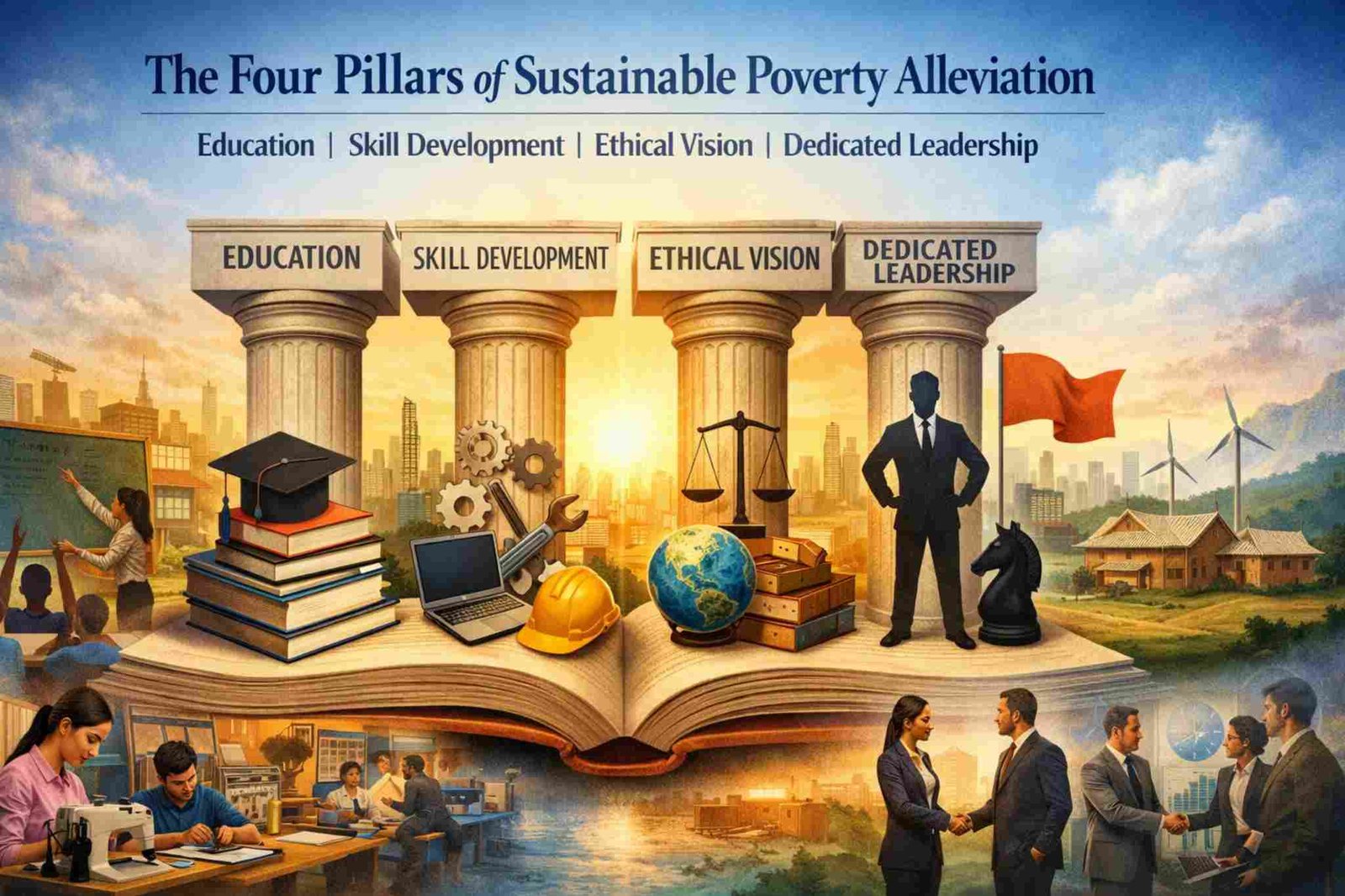
Poverty is not merely the absence of money. It is the absence of opportunity, access, confidence, structure, and vision. Around the world, nations struggle to reduce poverty despite foreign aid, welfare programs, and short-term economic interventions. Yet history repeatedly shows that sustainable poverty alleviation does not come from charity alone. It comes from strengthening people and systems.
To eradicate poverty in a lasting way, societies must build on four interconnected pillars: Education, Skill Development, Ethical Vision, and Dedicated Leadership. When these four elements work together, they transform individuals into productive citizens, communities into economic engines, and nations into stable, prosperous societies.
Pillar One: Education — Building the Foundation of Opportunity
Education is the first and most powerful weapon against poverty. It builds awareness, critical thinking, confidence, and the ability to make informed decisions. A person who can read, analyze, calculate, and reason is far less vulnerable to exploitation and misinformation.
In many developing nations, poverty persists because access to quality education remains unequal. Rural communities often lack adequate schools, trained teachers, and modern learning resources. Girls’ education, in particular, has proven to be one of the strongest drivers of economic growth. Educated women marry later, have healthier children, and contribute directly to household income.
However, education must go beyond memorization. Modern economies require analytical skills, problem-solving ability, digital literacy, and financial awareness. Education must prepare students not just to pass examinations but to participate meaningfully in the workforce.
Investment in education yields long-term economic returns. Studies consistently show that each additional year of schooling increases individual earning potential and national GDP. Countries that prioritize education build human capital — the true wealth of a nation.
Yet education alone is not enough.
Pillar Two: Skill Development — Turning Knowledge into Income
If education builds awareness, skill development builds income. Many graduates remain unemployed not because they lack degrees, but because they lack market-relevant skills. Poverty cannot be eliminated unless people possess competencies aligned with industry demands.
Technical and vocational education and training (TVET) systems play a critical role in this transformation. Training in electrical systems, manufacturing technology, software development, construction management, garment production, renewable energy, and logistics can directly connect individuals to employment opportunities.
Skill development bridges the gap between theory and practice. It transforms academic knowledge into productive capability. A skilled technician, programmer, machinist, welder, or quality inspector can generate stable income and contribute to national industrial growth.
In export-driven economies, skilled labor strengthens competitiveness. Manufacturing industries thrive when workers understand process control, quality standards, safety systems, and efficiency methods. Small and medium enterprises grow when entrepreneurs possess financial literacy, marketing skills, and operational knowledge.
Moreover, skill development reduces dependency. Instead of relying on government assistance or foreign aid, skilled individuals create value. They build businesses, employ others, and expand local economies.
However, skills must be guided by something deeper — ethical direction.
Pillar Three: Ethical Vision — Integrity as a Development Multiplier
Poverty is often not caused solely by lack of resources, but by misuse of resources. Corruption, weak governance, lack of transparency, and short-term political thinking drain national wealth and widen inequality.
An ethical vision ensures that development is inclusive, transparent, and sustainable. It means leaders prioritize long-term national interest over personal gain. It means public funds are used efficiently for infrastructure, education, healthcare, and industry. It means policies are implemented consistently and fairly.
Without integrity, even the best economic plans collapse. Foreign investment declines in corrupt environments. Skilled professionals migrate to countries where systems are fair. Citizens lose trust in institutions.
Ethical governance strengthens economic stability. It builds investor confidence, attracts international partnerships, and encourages entrepreneurship. When people trust the system, they are more willing to innovate, invest, and cooperate.
Ethical vision also promotes social justice. Poverty often persists because marginalized groups lack access to opportunity. Inclusive policies that support women, youth, rural communities, and small entrepreneurs create balanced development.
In essence, ethical leadership multiplies the impact of education and skills. It ensures that opportunity is not captured by a few, but distributed fairly.
Pillar Four: Dedicated Leadership — Turning Vision into Action
Vision without action is merely aspiration. Policies without implementation remain on paper. Sustainable poverty alleviation requires leaders who are not only visionary but disciplined, persistent, and accountable.
Dedicated leadership operates at every level — national, institutional, corporate, and community. It involves strategic planning, measurable targets, monitoring systems, and continuous improvement.
Effective leaders understand that poverty reduction requires structured systems. They design long-term economic roadmaps. They monitor performance indicators. They invest in human capital. They reform outdated systems. They encourage innovation and entrepreneurship.
Dedicated leaders do not seek short-term popularity. They prioritize sustainable impact. They build institutions that function beyond individual personalities.
For example, nations that achieved rapid poverty reduction — such as South Korea and Singapore — invested heavily in education, industrial skills, transparent governance, and disciplined policy execution. Their leaders combined strategic vision with relentless implementation.
Dedicated leadership also cultivates resilience. Economic crises, climate challenges, and global disruptions test national systems. Strong leadership ensures stability and adaptation during uncertainty.
The Interconnection of the Four Pillars
These four pillars are not isolated strategies. They are interdependent.
- Education creates informed citizens.
- Skill development creates employable professionals.
- Ethical vision ensures fairness and sustainability.
- Dedicated leadership ensures execution and accountability.
Remove one pillar, and the system weakens. Education without skills creates unemployment. Skills without ethics create exploitation. Ethics without leadership create stagnation. Leadership without education leads to poor decision-making.
When all four pillars align, poverty reduction becomes sustainable rather than temporary.
From Poverty to Productivity: A Systemic Approach
Sustainable poverty alleviation requires systemic reform rather than fragmented programs. Governments must integrate education policy with industrial policy. Training institutions must collaborate with industry. Governance systems must incorporate transparency and performance measurement.
Private sector involvement is equally important. Businesses must invest in workforce training and fair employment practices. Corporate social responsibility initiatives should focus on empowerment rather than charity.
Community participation strengthens implementation. When citizens actively engage in local development, accountability increases and corruption decreases.
Technology can also accelerate progress. Digital platforms expand access to education, remote work opportunities, and entrepreneurship. Financial technology improves access to banking and microfinance services.
The Role of Youth and Women in Poverty Reduction
Youth populations represent immense potential. With proper education and skills, young people become drivers of innovation and economic expansion. Without opportunity, however, they become vulnerable to unemployment and social instability.
Women’s empowerment is equally transformative. When women receive education and access to employment, family income rises, health improves, and poverty declines significantly. Gender-inclusive development multiplies economic growth.
Therefore, poverty alleviation strategies must prioritize inclusive human capital development.
Long-Term National Planning and Policy Stability
Short-term political cycles often disrupt long-term poverty reduction efforts. Sustainable progress requires policy continuity beyond election cycles. National development plans must focus on industrialization, infrastructure, renewable energy, agricultural modernization, and digital transformation.
Monitoring mechanisms should measure progress in education quality, employment rates, income growth, and governance transparency. Data-driven policymaking improves efficiency and accountability.
Transforming Mindset: From Dependency to Empowerment
A crucial but often overlooked element in poverty alleviation is mindset. Sustainable progress requires shifting from dependency culture to productivity culture. Individuals must see themselves as contributors rather than recipients.
Education fosters awareness. Skills foster confidence. Ethical governance fosters trust. Dedicated leadership fosters discipline. Together, they transform mindset and behavior.
Conclusion: Building a Poverty-Free Future
Poverty is not inevitable. It is a challenge that can be addressed through structured, ethical, and sustained effort.
The four pillars — Education, Skill Development, Ethical Vision, and Dedicated Leadership — provide a comprehensive framework for sustainable poverty alleviation. Education builds capacity. Skills create income. Ethics ensure fairness. Leadership guarantees execution.
Nations that invest in people, strengthen governance, and maintain long-term commitment will gradually eliminate poverty. Those that rely solely on temporary aid or political rhetoric will continue to struggle.
The path forward is clear. Empower minds. Develop skills. Govern with integrity. Lead with dedication.
When these pillars stand strong together, poverty does not merely decrease — it disappears.
