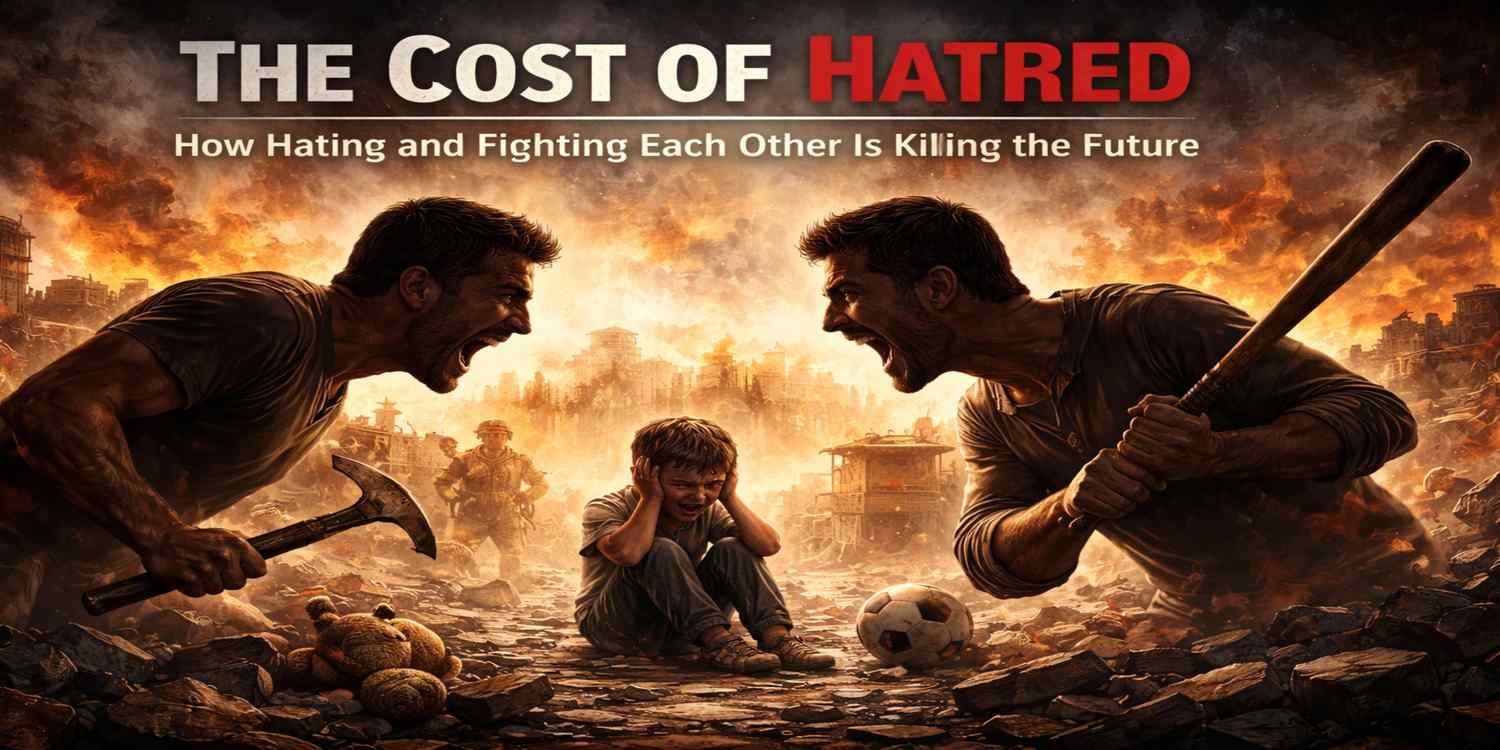
Hatred is one of the most powerful and destructive forces humanity has ever created. It begins quietly—in fear, misunderstanding, wounded pride, or inherited prejudice—but it rarely stays small. Once normalized, hatred grows into division, division turns into conflict, and conflict eventually consumes lives, societies, and futures. While humanity faces unprecedented global challenges, we continue to waste our energy fighting one another. The cost of this behavior is staggering, and the bill is being paid by future generations.
The truth is uncomfortable but undeniable: hating and fighting each other is killing the future—socially, economically, environmentally, and morally.
Hatred Is Learned, Not Natural
Human beings are not born hating one another. Children do not instinctively divide the world by race, religion, nationality, or ideology. Hatred is taught—through words spoken at home, messages spread by media, selective history, political propaganda, and social conditioning.
When children grow up surrounded by hostility, they internalize fear as normal and aggression as acceptable. They learn that dominance matters more than understanding and that winning is more important than coexistence. This cycle repeats across generations, creating societies permanently trapped in conflict.
Hatred survives because it is passed down, not because it is inevitable.
The Psychological Cost of Hatred
Hatred damages not only its targets but also those who carry it. A hateful mind lives in constant tension—alert, suspicious, defensive. This state erodes mental health, increasing stress, anxiety, depression, and emotional exhaustion.
Communities consumed by hostility experience higher levels of trauma, especially among children. Growing up amid conflict leaves lasting psychological scars—fear, aggression, emotional numbness, and difficulty trusting others. These wounds do not disappear when wars end or conflicts cool; they linger in classrooms, workplaces, and families.
A future shaped by traumatized minds cannot be a healthy one.
How Hatred Destroys Social Fabric
Society functions on trust. Trust allows people to cooperate, trade, innovate, and support one another. Hatred tears this trust apart.
When groups begin to see each other as enemies rather than neighbors, social bonds weaken. Dialogue is replaced by suspicion. Differences become threats. Communities fragment into hostile camps, each convinced of its own moral superiority.
This breakdown of social cohesion makes societies fragile. Once divided, even small crises can trigger violence or collapse. A society that hates itself cannot build a stable future.
The Economic Cost of Fighting Each Other
Conflict is expensive—far more expensive than cooperation.
Wars drain national budgets, diverting funds away from education, healthcare, infrastructure, and innovation. Entire generations lose opportunities as resources are spent on weapons instead of schools, hospitals, and sustainable development.
Even outside of war, hatred damages economies. Discrimination limits talent. Social unrest discourages investment. Brain drain accelerates as skilled individuals flee unstable environments.
The irony is cruel: societies destroy their own economic future while claiming to protect it.
Hatred and the Theft of Childhood
Perhaps the most tragic cost of hatred is paid by children. Children raised in hostile environments inherit fear instead of hope. They witness violence before learning compassion and learn survival before learning purpose.
Instead of dreaming about contributing to the world, many children grow up focused on escaping it. Lost childhoods mean lost potential—scientists, artists, teachers, and leaders who never get the chance to exist.
A future that robs its children of peace is a future already in decline.
Environmental Destruction Fueled by Conflict
Hatred does not only harm people; it destroys the planet.
Wars pollute land, air, and water. Bombed cities leave toxic debris. Forests are cleared for military advantage. Environmental regulations are ignored during conflict, accelerating ecological damage.
At a time when humanity must unite to address climate change, we remain distracted by hostility. While we fight each other, ecosystems collapse, biodiversity disappears, and natural disasters grow more severe.
Nature does not choose sides—but it punishes division with equal force.
Technology Without Humanity Becomes a Weapon
Technological progress should be a tool for human advancement, but hatred turns innovation into instruments of harm. The same intelligence that could cure diseases is often redirected toward more efficient destruction.
Artificial intelligence, surveillance systems, cyber warfare, and autonomous weapons raise ethical questions humanity is unprepared to answer in a divided world. When hatred drives innovation, technology amplifies cruelty rather than compassion.
A future guided by hostile intelligence is not progress—it is regression.
The Political Industry of Hatred
Hatred is often cultivated deliberately. It is profitable. It mobilizes votes, consolidates power, and distracts people from accountability. Leaders who cannot unite often divide instead.
By framing opponents as enemies, political systems maintain control while avoiding meaningful solutions. Citizens are encouraged to fight each other rather than question systems that fail them.
This manipulation poisons democracy, weakens institutions, and replaces governance with perpetual conflict. A future built on manipulated anger cannot sustain freedom or justice.
Hatred Creates Endless Cycles of Revenge
Hatred does not end with victory. Every act of violence creates new grievances, new victims, and new reasons for retaliation. Revenge becomes normalized, passed from one generation to the next as inherited pain.
History shows that conflicts rarely end through force alone. They end through dialogue, reconciliation, and shared acknowledgment of suffering. Without these, hatred simply changes form and continues its destructive path.
A future trapped in revenge is a future without healing.
The Moral Cost: Losing Our Humanity
Perhaps the greatest cost of hatred is moral. When hatred becomes normal, cruelty feels justified. Dehumanization becomes easy. Suffering becomes invisible—especially when it belongs to “the other.”
Societies that accept hatred slowly lose empathy. Violence becomes language. Indifference replaces responsibility. The line between right and wrong blurs.
When humanity loses its moral compass, progress becomes meaningless. Technology, wealth, and power mean nothing without compassion to guide them.
Cooperation: The Only Antidote to Hatred
Hatred thrives on isolation. Cooperation dismantles it.
When people work together—across cultures, beliefs, and borders—they discover shared needs and common fears. Cooperation does not require agreement on everything; it requires recognition of shared humanity.
History’s greatest achievements—from scientific breakthroughs to humanitarian advances—were born from collaboration. Peace is not passive; it is an active process of choosing dialogue over dominance.
Cooperation is not weakness. It is courage in action.
Reclaiming the Future Through Empathy
Empathy is the foundation of a sustainable future. It allows people to understand experiences beyond their own and to see conflict through a human lens rather than an ideological one.
Empathy does not excuse injustice, but it opens pathways to resolve it without destruction. It transforms enemies into participants in dialogue and victims into voices for change.
Teaching empathy—in homes, schools, and institutions—is one of the most powerful investments humanity can make in its future.
Education as Resistance Against Hatred
Education shapes worldview. When education emphasizes critical thinking, ethics, emotional intelligence, and global responsibility, it becomes a shield against hatred.
Students must learn not only history, but the consequences of repeating it. Not only technology, but responsibility. Not only competition, but collaboration.
An educated generation that values humanity over hostility can break cycles that centuries of conflict failed to end.
Choosing the Future Over Fear
Hatred is easy. It simplifies complex problems into enemies. Cooperation is harder—it demands patience, humility, and courage.
But the choice is clear. Humanity can continue fighting each other and watch the future shrink, or it can confront hatred honestly and replace it with cooperation.
The future is not something we inherit. It is something we create—every day, through our choices.
Conclusion: The Price Is Too High
The cost of hatred is too high to ignore. It steals peace from minds, stability from societies, opportunity from children, health from the planet, and meaning from progress.
If humanity continues to hate and fight itself, the future will not collapse suddenly—it will erode slowly, painfully, and irreversibly.
But there is still time.
By choosing empathy over ego, cooperation over conflict, and humanity over hostility, we can reclaim a future worth inheriting.
Because the greatest threat to humanity is not difference.
It is hatred.
And the greatest hope for the future is not dominance.
It is unity.
-By Engr. Md Khairul Alom
