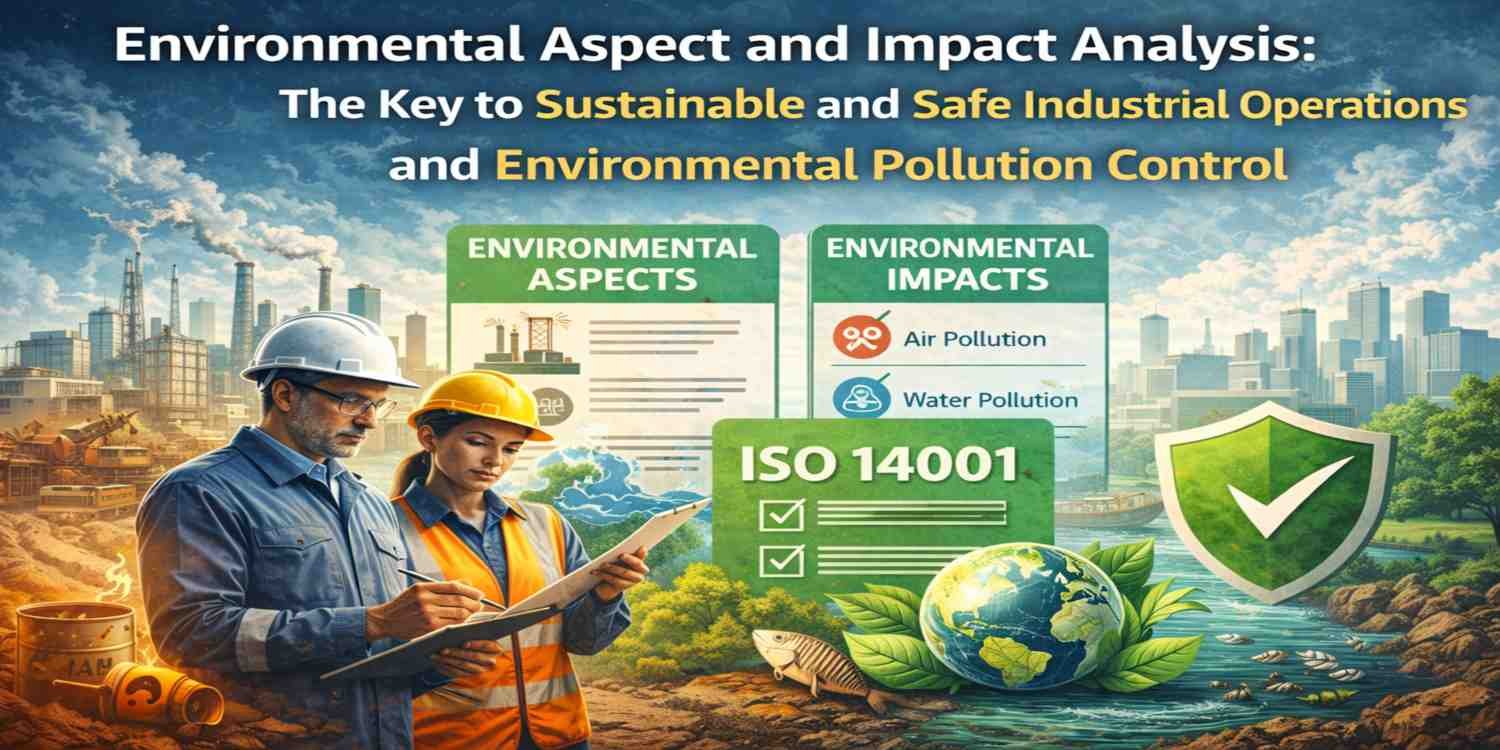
Industrial development has played a vital role in economic growth, employment generation, and technological advancement across the world. However, alongside these benefits, industrial activities have also contributed significantly to environmental pollution, resource depletion, climate change, and public health risks. Air emissions, wastewater discharge, solid and hazardous waste, noise pollution, excessive energy use, and chemical contamination remain major concerns in industrial operations.
In today’s environmentally conscious and regulation-driven world, industries can no longer afford reactive environmental management. Preventing pollution at the source and ensuring long-term sustainability require a systematic, structured, and proactive approach. This is where Environmental Aspect and Impact Analysis, as required under ISO 14001 Environmental Management System (EMS), becomes the cornerstone of sustainable and safe industrial operations.
Environmental aspect and impact analysis enables organizations to identify how their activities interact with the environment, evaluate associated risks, and implement effective control measures to minimize environmental damage. When applied correctly, it becomes the most powerful tool for environmental pollution control and sustainable industrial growth.
Understanding Environmental Aspects and Impacts
What Is an Environmental Aspect?
An environmental aspect is any element of an organization’s activities, products, or services that can interact with the environment. Environmental aspects arise from routine operations, non-routine activities, emergency situations, and even outsourced or contractor-controlled processes.
Common industrial environmental aspects include:
- Air emissions from boilers, generators, furnaces, and production processes
- Wastewater discharge from washing, dyeing, cooling, or chemical processes
- Solid waste generation (scrap, packaging waste, sludge)
- Hazardous waste and chemical handling
- Energy consumption
- Water consumption
- Noise and vibration
- Use of raw materials and natural resources
What Is an Environmental Impact?
An environmental impact is any change to the environment—positive or negative—that results from an environmental aspect. Impacts may affect air, water, soil, ecosystems, biodiversity, climate, and human health.
Examples of environmental impacts include:
- Air pollution and greenhouse gas emissions
- Water pollution and aquatic ecosystem damage
- Soil contamination
- Noise disturbance to surrounding communities
- Depletion of natural resources
- Health hazards to workers and nearby residents
Understanding the link between aspects and impacts allows industries to shift from damage control to pollution prevention.
Why Environmental Aspect and Impact Analysis Is Critical
Environmental aspect and impact analysis is the foundation of ISO 14001:2015. Without proper identification and evaluation of aspects and impacts, environmental management becomes fragmented and ineffective.
This analysis is critical because it:
- Identifies sources of pollution before damage occurs
- Prioritizes significant environmental risks
- Supports compliance with environmental laws and regulations
- Guides the setting of environmental objectives and targets
- Enables pollution prevention rather than end-of-pipe treatment
- Supports sustainable decision-making
In essence, you cannot control what you have not identified.
ISO 14001 and Environmental Aspect–Impact Analysis
ISO 14001:2015 requires organizations to identify environmental aspects and determine those that have or can have significant environmental impacts, considering:
- Normal operating conditions
- Abnormal conditions
- Emergency situations
- Past, present, and future activities
The standard emphasizes life-cycle thinking, encouraging organizations to consider environmental impacts not only during production but also during raw material sourcing, transportation, product use, and disposal.
Key Steps in Environmental Aspect and Impact Analysis
1. Identification of Activities, Products, and Services
The first step is mapping all organizational activities, processes, products, and services, including:
- Production operations
- Utility operations (boilers, generators, compressors)
- Maintenance activities
- Storage and transportation
- Administrative and support functions
This process ensures that no potential environmental interaction is overlooked.
2. Identification of Environmental Aspects
Each activity is analyzed to identify associated environmental aspects. For example:
- Boiler operation → fuel consumption, air emissions
- Chemical storage → risk of spills and leaks
- Washing process → wastewater generation
- Cutting operations → solid waste and noise
This step requires technical knowledge, site observation, and worker involvement.
3. Identification of Environmental Impacts
For each environmental aspect, corresponding impacts are identified. For instance:
- Air emissions → air pollution, climate change
- Wastewater discharge → water pollution
- Chemical spills → soil and groundwater contamination
This connection between cause (aspect) and effect (impact) forms the basis of pollution control.
4. Evaluation of Significance
Not all environmental aspects carry equal risk. ISO 14001 requires organizations to determine significant environmental aspects using defined criteria, such as:
- Severity of impact
- Frequency of occurrence
- Legal and regulatory requirements
- Quantity of emissions or waste
- Stakeholder concerns
- Probability of accidents or emergencies
Significance evaluation helps organizations prioritize resources where environmental risk is highest.
5. Establishing Controls for Significant Aspects
Once significant aspects are identified, organizations must implement operational controls, such as:
- Engineering controls (filters, scrubbers, effluent treatment plants)
- Administrative controls (procedures, work instructions)
- Monitoring and measurement systems
- Emergency preparedness plans
- Training and awareness programs
This step directly contributes to environmental pollution control.
Pollution Control Through Aspect and Impact Management
Air Pollution Control
By identifying emission sources, industries can implement:
- Cleaner fuels
- Energy-efficient equipment
- Emission control devices
- Preventive maintenance
Aspect analysis ensures emissions are reduced at the source rather than treated after release.
Water Pollution Prevention
Aspect–impact analysis identifies wastewater sources and contamination risks, leading to:
- Wastewater segregation
- Effluent treatment plants (ETP)
- Water reuse and recycling
- Reduced chemical discharge
This protects aquatic ecosystems and community water sources.
Solid and Hazardous Waste Management
Identifying waste-related aspects allows industries to:
- Minimize waste generation
- Improve segregation and recycling
- Ensure safe hazardous waste handling
- Prevent illegal dumping
Effective waste management reduces environmental and legal risks.
Energy and Resource Conservation
Energy and resource use are major environmental aspects. Through analysis, organizations can:
- Reduce energy consumption
- Improve energy efficiency
- Minimize raw material wastage
- Lower carbon footprint
This supports both environmental protection and cost reduction.
Supporting Sustainable Industrial Operations
Environmental aspect and impact analysis contributes directly to sustainability by:
- Reducing pollution and environmental degradation
- Preserving natural resources
- Enhancing regulatory compliance
- Supporting corporate environmental responsibility
- Improving community relations
- Strengthening long-term business viability
Sustainability is no longer optional; it is essential for survival in a competitive and regulated industrial environment.
Role of Employee Awareness and Participation
Employees play a crucial role in environmental protection. ISO 14001 emphasizes training and awareness so that workers:
- Understand environmental aspects of their jobs
- Follow operational controls
- Report environmental incidents and near misses
- Contribute to improvement initiatives
A well-informed workforce significantly reduces environmental risks.
Monitoring, Measurement, and Continuous Improvement
Environmental management is not static. ISO 14001 requires organizations to:
- Monitor emissions, effluents, and waste
- Conduct internal environmental audits
- Investigate environmental incidents
- Implement corrective and preventive actions
Aspect and impact analysis must be reviewed periodically to reflect process changes, new equipment, or regulatory updates.
Legal Compliance and Risk Reduction
Environmental regulations are becoming stricter worldwide. Failure to control environmental impacts can result in:
- Legal penalties and fines
- Production shutdowns
- Reputational damage
- Loss of customer confidence
Environmental aspect and impact analysis helps organizations stay compliant and reduce legal exposure.
Integration with Other Management Systems
ISO 14001 can be integrated with:
- ISO 9001 (Quality Management)
- ISO 45001 (Occupational Health and Safety)
- ISO 50001 (Energy Management)
Integrated systems enhance operational efficiency, risk management, and sustainability performance.
Conclusion: A Strategic Tool for Environmental Protection
Environmental aspect and impact analysis is not just an ISO 14001 requirement—it is a strategic tool for environmental protection, pollution control, and sustainable industrial development. By systematically identifying environmental interactions, evaluating risks, and implementing effective controls, industries can significantly reduce their environmental footprint while improving operational efficiency and compliance.
In an era of climate change, environmental activism, and regulatory scrutiny, industries must move beyond reactive pollution control. Proactive environmental aspect and impact analysis empowers organizations to protect the environment, safeguard communities, and ensure long-term business sustainability.
Sustainable and safe industrial operations are achievable only when environmental risks are identified early, managed effectively, and continuously improved—and environmental aspect and impact analysis is the key that unlocks this future.
