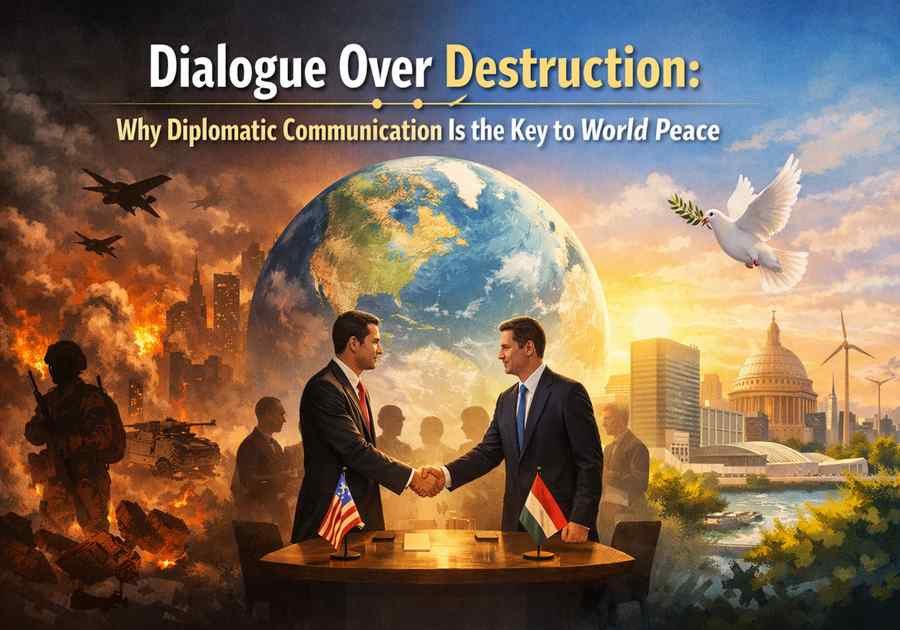
In a world marked by rapid technological progress and unprecedented global connectivity, the persistence of war, violence, and armed conflict appears tragically paradoxical. Humanity possesses the knowledge, resources, and communication tools necessary to resolve disputes peacefully, yet destruction continues to dominate international relations. History repeatedly demonstrates that wars rarely bring lasting solutions; instead, they leave behind broken societies, economic devastation, and deep psychological scars. Against this backdrop, one truth becomes increasingly clear: dialogue over destruction is not merely an idealistic slogan but a practical necessity, and diplomatic communication is the most powerful key to achieving sustainable world peace.
The Cost of Destruction
War is often justified as a means to secure national interests, defend sovereignty, or restore order. However, the real cost of destruction goes far beyond battlefield casualties. Armed conflicts devastate infrastructure, disrupt education and healthcare systems, displace millions of civilians, and push entire regions into cycles of poverty and instability. Children grow up in environments of fear, normalizing violence and inheriting unresolved grievances that fuel future conflicts.
Moreover, modern warfare has expanded its destructive capacity. Advanced weapons, cyber warfare, and economic sanctions can cripple societies without a single bullet being fired. These methods, while sometimes seen as alternatives to direct combat, still cause immense human suffering. The long-term consequences—trauma, hatred, and mistrust—outlive any short-term political gains. Destruction, therefore, is not a solution but a multiplier of problems.
Dialogue as a Human Tool
Dialogue is one of humanity’s oldest and most powerful tools. Long before the invention of weapons, humans used conversation to settle disputes, establish norms, and build communities. Dialogue allows individuals and nations to express concerns, clarify intentions, and seek common ground. Unlike violence, which silences voices, dialogue amplifies them.
At its core, dialogue is about recognition—the acknowledgment that the other party has legitimate interests, fears, and aspirations. This recognition does not require agreement, but it creates space for understanding. When parties engage in dialogue, they shift from seeing each other as enemies to viewing each other as stakeholders in a shared reality. This mental shift is essential for peace.
The Role of Diplomatic Communication
Diplomatic communication transforms dialogue into structured, purposeful engagement. Diplomacy provides formal and informal channels through which states can manage conflicts, negotiate agreements, and prevent misunderstandings from escalating into violence. It includes negotiations, treaties, back-channel communications, confidence-building measures, and multilateral forums.
Effective diplomacy relies on several key principles:
- Respect and Equality – Treating all parties, regardless of size or power, with dignity.
- Transparency and Honesty – Reducing suspicion by clearly communicating intentions.
- Patience and Persistence – Recognizing that peace processes take time.
- Compromise and Flexibility – Accepting that absolute victories are rare in diplomacy.
When these principles are upheld, diplomatic communication becomes a stabilizing force in international relations.
Preventing Conflict Through Communication
Many wars begin not with deliberate aggression but with miscommunication, misperception, or lack of communication altogether. Historical evidence shows that unresolved tensions, when ignored, gradually harden into hostility. Diplomatic dialogue serves as an early warning system, allowing nations to address grievances before they erupt into violence.
Regular communication between rival states helps manage crises. Hotlines, diplomatic missions, and international mediators reduce the risk of accidental escalation. Even during periods of intense rivalry, maintaining dialogue channels can prevent conflicts from spiraling out of control. Silence, on the other hand, creates a vacuum often filled by fear and speculation.
Dialogue During Conflict
One of the greatest misconceptions about diplomacy is that dialogue is only possible in times of peace. In reality, dialogue is most crucial during conflict. Negotiations during wars can lead to ceasefires, humanitarian corridors, prisoner exchanges, and eventually peace agreements. Even limited communication can reduce civilian suffering and build trust incrementally.
Dialogue during conflict does not mean surrender or weakness. On the contrary, it reflects strategic wisdom. It recognizes that no conflict is resolved solely on the battlefield and that lasting peace requires political solutions. Many successful peace processes began with secret or informal talks at the height of violence, proving that dialogue remains possible even in the darkest moments.
The Psychological Power of Dialogue
Beyond political outcomes, dialogue has profound psychological effects. Violence dehumanizes; dialogue humanizes. When opposing sides communicate, they begin to see each other as people rather than abstract enemies. This humanization reduces hatred and opens the door to reconciliation.
Dialogue also helps address historical grievances. Many conflicts are rooted in past injustices, colonial legacies, or unresolved trauma. Diplomatic communication allows these issues to be acknowledged and addressed, preventing them from being passed from one generation to the next. Truth commissions, apologies, and reparative dialogues are powerful examples of how communication can heal deep wounds.
Multilateral Dialogue and Global Peace
In an interconnected world, conflicts rarely remain confined to national borders. Refugee flows, economic disruptions, and security threats affect entire regions. Multilateral dialogue—through international organizations and regional forums—plays a crucial role in managing these complexities.
Global challenges such as climate change, terrorism, pandemics, and cyber threats cannot be solved through unilateral action or force. They require cooperation, information sharing, and collective decision-making. Diplomatic communication enables countries with diverse interests to coordinate responses and share responsibility for global stability.
The Limits of Force
While some argue that force is sometimes necessary to deter aggression, history shows that reliance on force alone rarely produces durable peace. Military victories often fail to address underlying causes of conflict such as inequality, exclusion, and political repression. In many cases, the use of force intensifies resistance and radicalization.
Diplomacy does not deny the existence of power but redefines it. True power lies not in the ability to destroy but in the capacity to persuade, negotiate, and build alliances. Nations that invest in diplomacy enhance their moral authority and international credibility, strengthening their long-term security.
Education and a Culture of Dialogue
For dialogue to become a global norm, it must be cultivated at all levels of society. Education plays a critical role in promoting communication skills, critical thinking, and respect for diversity. Teaching young people how to resolve conflicts peacefully prepares future leaders to prioritize dialogue over violence.
Media and civil society also influence the culture of dialogue. Responsible journalism can reduce polarization by presenting balanced perspectives, while grassroots initiatives can foster people-to-people communication across borders. When societies value dialogue internally, they are more likely to support diplomatic approaches externally.
Challenges to Diplomatic Communication
Despite its importance, diplomacy faces significant challenges. Mistrust, power imbalances, domestic political pressures, and ideological rigidity can hinder dialogue. In some cases, leaders exploit nationalism and fear to justify aggression, undermining diplomatic efforts.
However, these challenges do not diminish the value of dialogue; they underscore its necessity. Overcoming these obstacles requires commitment, leadership, and public support. Diplomatic failures should lead to reflection and reform, not abandonment of dialogue.
Dialogue as a Moral Responsibility
Beyond strategic considerations, dialogue is a moral responsibility. Every life lost to war represents a failure of communication. Choosing dialogue affirms the value of human life and dignity. It reflects the belief that differences, however deep, can be addressed without resorting to destruction.
World peace is not a utopian dream but a continuous process of managing differences through communication. It does not require the absence of conflict but the presence of mechanisms to resolve it peacefully.
Conclusion: Choosing Dialogue Over Destruction
The choice between dialogue and destruction defines the future of humanity. Destruction may offer the illusion of quick solutions, but it leaves behind lasting harm. Dialogue, though often slow and complex, builds foundations for enduring peace.
Diplomatic communication is not a sign of weakness but of wisdom. It transforms conflicts into conversations, enemies into interlocutors, and fear into understanding. In a world facing shared challenges and interconnected destinies, dialogue over destruction is not just the key to world peace—it is the only sustainable path forward.
If humanity is to survive and prosper, it must learn, again and again, to speak before it strikes, to listen before it condemns, and to negotiate before it destroys. World peace begins with a conversation—and it is a conversation the world must never stop having.
