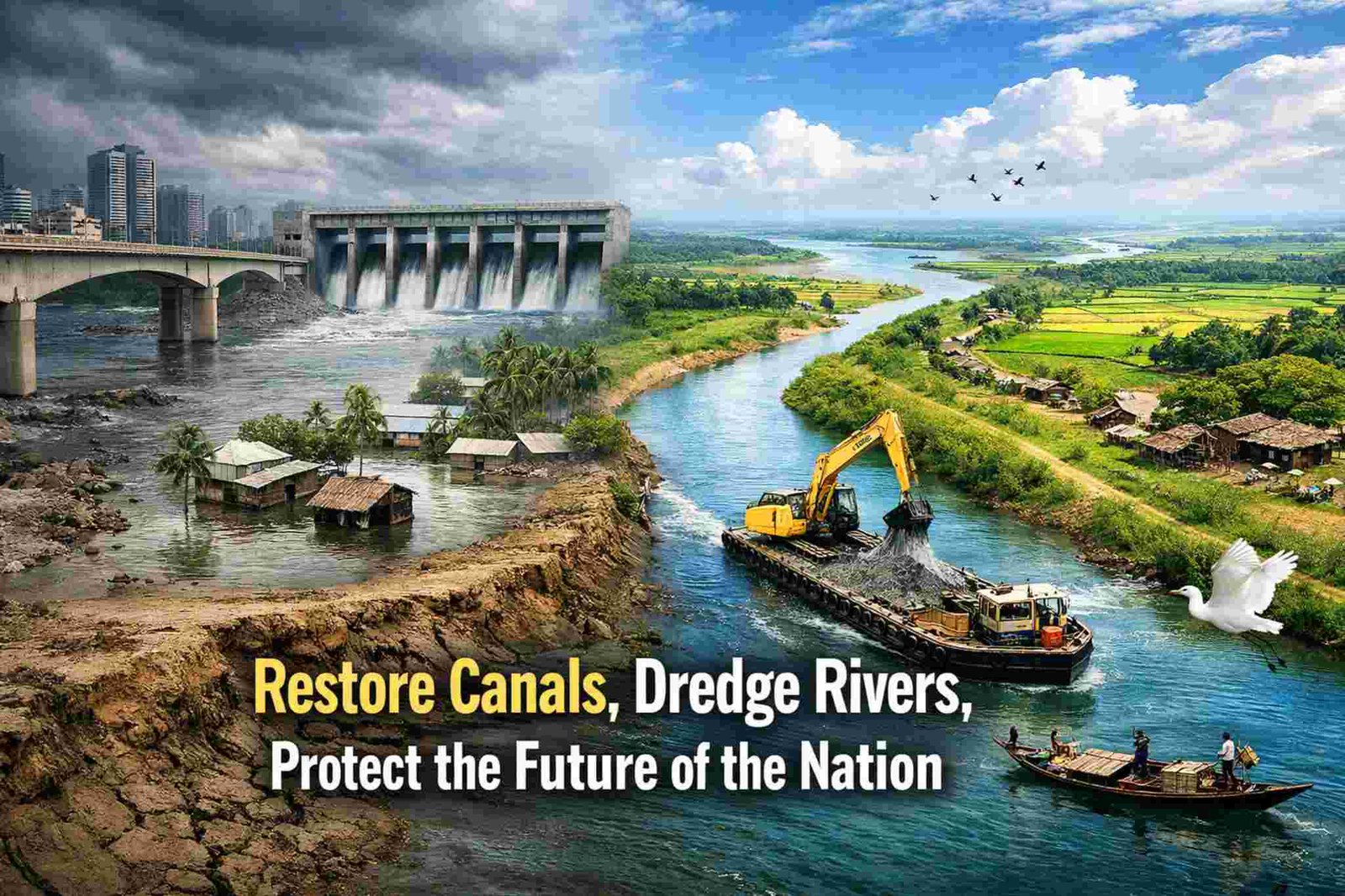
Introduction: A River Nation at a Crossroads
Bangladesh is not merely a country with rivers — it is a river civilization. Born in the vast delta formed by the mighty Ganges River, Brahmaputra River, and Meghna River, the land itself is shaped, nourished, and protected by water. For centuries, natural rivers and interconnected canals carried monsoon water safely to the sea, recharged groundwater, supported agriculture, sustained fisheries, and balanced ecological systems.
But today, the natural flow of these rivers is increasingly obstructed. Unplanned bridges, poorly designed dams, embankments, encroachments, and urban development have narrowed channels and disrupted hydrological balance. At the same time, thousands of canals that once acted as drainage arteries have disappeared due to land filling and real estate expansion.
The consequences are visible: severe waterlogging, intensified flooding, river erosion, sediment accumulation, declining fish production, and growing environmental vulnerability. The solution is not more obstruction. The solution is restoration. Bangladesh must stop obstructing natural river flow and instead prioritize canal revival, scientific dredging, and ecosystem-based planning to secure its future.
The Natural Logic of Rivers
Rivers are not just streams of water flowing from one point to another. They are dynamic systems governed by gravity, sediment transport, seasonal variation, and tidal interaction. In deltaic regions like Bangladesh, rivers spread across floodplains during the monsoon and recede during the dry season. This natural expansion and contraction maintain soil fertility and prevent extreme pressure buildup.
Historically, Bengal’s river network was interlinked with canals and wetlands that functioned as natural overflow basins. During heavy rainfall, excess water moved into these canals and lowlands before gradually draining to the Bay of Bengal. This reduced sudden flooding and allowed water to disperse safely.
When bridges are constructed without adequate span, when piers are placed too densely, or when embankments block lateral flow, the river’s velocity changes. Sediment accumulates upstream, narrowing the channel further. Water level rises, pressure increases, and flood risk multiplies.
The problem is not infrastructure itself — bridges and dams are sometimes necessary. The problem is unplanned and excessive obstruction without comprehensive hydrological assessment.
The Cost of Ignoring Natural Flow
1. Urban Waterlogging
Cities such as Dhaka and Chattogram frequently experience severe waterlogging after moderate rainfall. The root cause is not simply heavy rain — it is blocked drainage. Canals that once carried rainwater to surrounding rivers have been filled or encroached upon. Concrete surfaces prevent infiltration, while narrowed rivers cannot carry sudden discharge.
Water stagnation damages property, disrupts transportation, spreads disease, and reduces productivity.
2. Increased Flood Severity
When riverbeds are not dredged and canals are not restored, sediment accumulates. During monsoon season, even normal rainfall can cause rivers to overflow. Floods that were once manageable become destructive.
The economic cost includes:
- Crop loss
- Infrastructure damage
- Housing destruction
- Loss of working days
- Relief and rehabilitation expenses
Preventive river restoration is far less expensive than post-disaster recovery.
3. Ecological Decline
Obstructed rivers lose biodiversity. Fish breeding grounds disappear when natural flow patterns are altered. Wetlands dry up or become polluted. Aquatic ecosystems collapse when oxygen levels decline due to stagnant water.
Bangladesh once had one of the richest inland fisheries in the world. River mismanagement is steadily reducing that heritage.
The Disappearance of Canals: A Silent Crisis
In many districts, historical canals that once connected rivers have vanished under real estate development. In urban areas, canal land has been illegally occupied. These canals were not accidental features — they were engineered by nature and sometimes enhanced by human settlement over centuries.
Their disappearance has three major impacts:
- Loss of Natural Drainage Capacity
- Reduction of Groundwater Recharge
- Increased Flood Peak Intensity
Reviving canals is not merely environmental activism; it is infrastructure recovery.
Dredging: A Strategic National Investment
Scientific dredging removes accumulated sediment from riverbeds, increasing depth and flow capacity. However, dredging must be planned carefully — not as a short-term political project, but as a long-term hydrological strategy.
Proper dredging can:
- Increase navigability for trade
- Reduce flood pressure
- Improve irrigation
- Restore fish habitats
- Strengthen riverbanks
Sediment extracted from dredging can even be used for controlled land development or embankment strengthening if managed properly.
In a delta country like Bangladesh, sediment management is not optional — it is essential.
Bridges and Dams: Planning with Responsibility
Bridges are vital for connectivity. Dams are sometimes required for water regulation. But each structure must undergo rigorous environmental and hydrological impact assessment.
Before constructing any new bridge, authorities should ask:
- Does this obstruct natural floodplain spread?
- Are pier designs optimized to reduce sediment trapping?
- Has long-term sediment transport been modeled?
- What is the cumulative impact of multiple bridges along the same river?
A single bridge may not create disaster. But dozens of poorly spaced structures along one river can gradually choke it.
Development without environmental foresight becomes self-destructive.
River Restoration as National Security
Bangladesh faces climate change threats including sea-level rise, cyclones, and unpredictable rainfall. In such a context, healthy rivers act as natural shock absorbers. They distribute excess water, dilute salinity, and protect agricultural land.
When rivers lose capacity, disaster vulnerability increases. Therefore, river restoration is not just environmental policy — it is national security policy.
A secure nation ensures:
- Food security
- Water security
- Infrastructure resilience
- Ecological stability
All of these depend on functioning river systems.
Policy Recommendations for a Sustainable Future
1. National Canal Restoration Program
Identify and map all historical canals. Legally protect and excavate them. Remove illegal encroachments.
2. Mandatory River Impact Assessment
Before building bridges or dams, require independent hydrological modeling.
3. Continuous Dredging Master Plan
Instead of emergency dredging, implement scheduled sediment management.
4. River Health Index
Develop measurable indicators for river flow, depth, biodiversity, and sediment load.
5. Integrated Urban Drainage Design
Urban planning must reconnect cities to surrounding rivers through open canals.
Economic Benefits of Restoration
River restoration generates employment through dredging, excavation, environmental engineering, and infrastructure upgrading. Improved navigation boosts trade. Agriculture benefits from better irrigation and reduced crop damage. Fisheries recover.
The long-term return on investment far exceeds the cost.
Flood prevention alone can save billions in disaster response.
Moral and Cultural Responsibility
Rivers are not obstacles to development. They are the foundation of our civilization. Historically, settlements flourished along riverbanks because rivers provided transportation, food, fertile soil, and communication.
To block and narrow them recklessly is to ignore the wisdom of geography.
Respecting rivers is respecting the land itself.
Conclusion: A Call for Intelligent Development
Bangladesh stands at a critical moment. The path of unplanned construction and canal destruction leads to increasing floods, waterlogging, ecological loss, and economic vulnerability.
The alternative path is intelligent restoration:
- Stop obstructing natural river flow unnecessarily.
- Restore disappeared canals.
- Implement scientific dredging.
- Plan bridges and dams with long-term hydrological understanding.
A river-friendly development strategy does not reject infrastructure — it harmonizes it with nature.
To protect the future of the nation, we must allow our rivers to breathe, flow, and function as they were meant to.
A country built by rivers can only be secured by restoring them.
