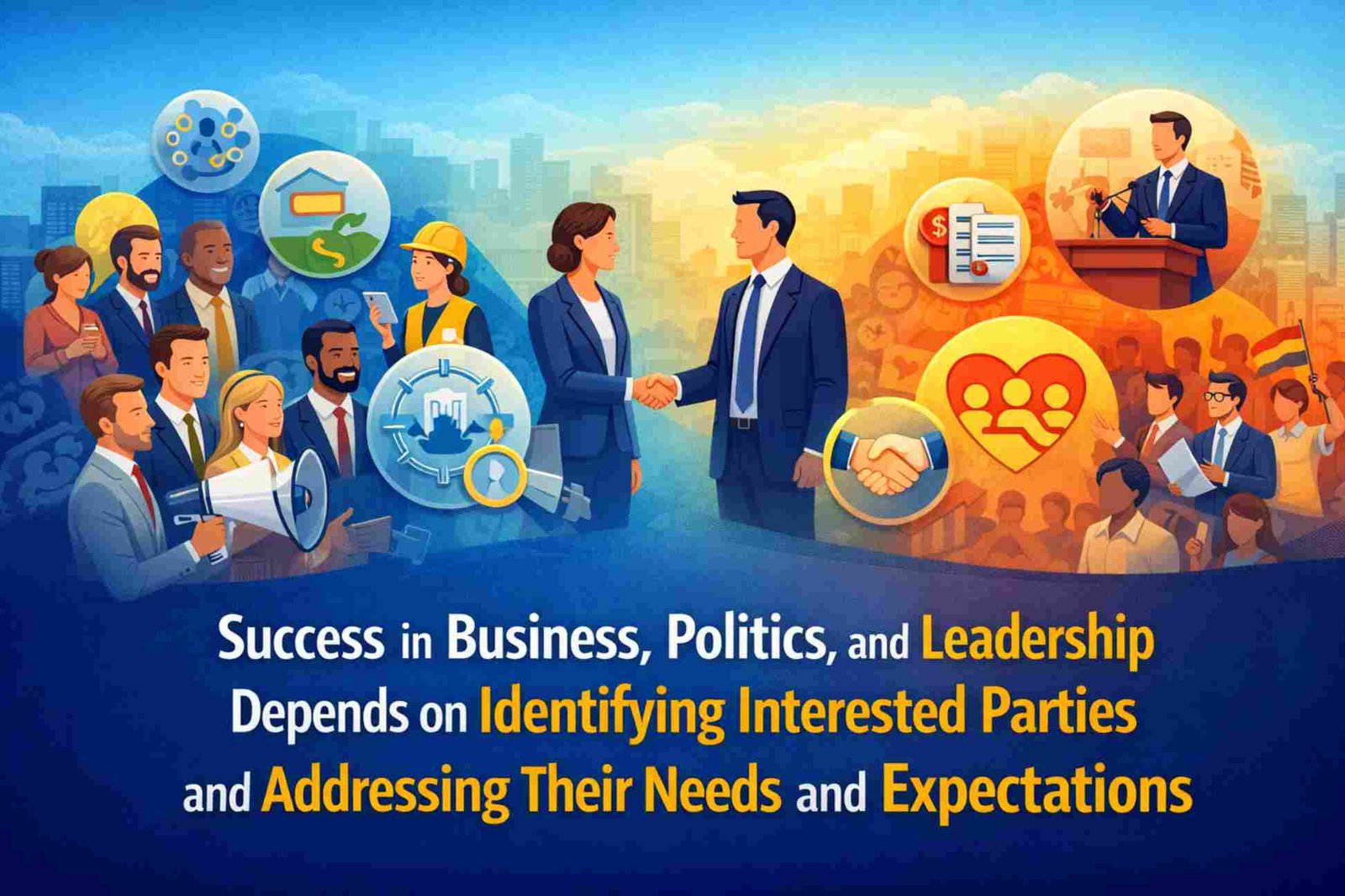
Success is rarely accidental. Whether in business, politics, or leadership roles, long-term success is shaped by the ability to understand people, systems, and relationships. Organizations collapse, governments fail, and leaders lose credibility not because they lack intelligence or ambition, but because they ignore the people who influence or are affected by their decisions. These people are known as interested parties—also commonly referred to as stakeholders.
Identifying interested parties and understanding their needs and expectations is not a soft skill or a theoretical exercise. It is a strategic necessity. In today’s interconnected and transparent world, decisions made in isolation quickly lead to resistance, conflict, reputational damage, or failure. Leaders who succeed consistently are those who listen, analyze, prioritize, and respond to stakeholder needs in a balanced and ethical way.
This article explores why identifying interested parties and addressing their needs and expectations is essential for success in business, politics, and leadership, and how this principle forms the foundation of sustainable performance, trust, and legitimacy.
Understanding Interested Parties
Who Are Interested Parties?
Interested parties are individuals or groups that can affect, or are affected by, the actions, decisions, or performance of an organization or leader. They exist in every sector and at every level of responsibility.
In business, interested parties include:
- Customers
- Employees
- Shareholders and investors
- Suppliers and contractors
- Regulators and authorities
- Communities and society
- Media and advocacy groups
In politics, interested parties include:
- Citizens and voters
- Political parties
- Government institutions
- Civil society organizations
- International bodies
- Media
- Business and labor groups
In leadership roles, interested parties may include:
- Teams and subordinates
- Senior management or governing bodies
- Clients or beneficiaries
- Partners and collaborators
- The public or community
Ignoring any key interested party creates imbalance, resistance, and eventual failure.
Why Identifying Interested Parties Is Critical
Power, Influence, and Impact
Not all interested parties have the same level of influence, but each has the potential to affect outcomes. Some stakeholders can directly stop a project, damage reputation, withdraw support, or influence public opinion.
Successful leaders identify:
- Who holds power
- Who influences others
- Who is affected most by decisions
- Who can create risk or opportunity
This awareness allows leaders to make informed, strategic decisions rather than reactive ones.
Preventing Conflict and Resistance
Many conflicts arise not from bad intentions but from poor stakeholder understanding. When people feel ignored, threatened, or misunderstood, resistance grows.
Identifying interested parties early helps:
- Anticipate objections and concerns
- Address issues before they escalate
- Build cooperation instead of opposition
- Reduce costly delays and disputes
In both business and politics, proactive engagement is far more effective than damage control.
Understanding Needs and Expectations
Needs vs. Expectations
A need is something essential—such as safety, fair compensation, legal compliance, or basic services. An expectation reflects what stakeholders believe should happen based on promises, standards, culture, or past experience.
For example:
- Employees need fair wages; they expect respect and career growth.
- Customers need quality products; they expect reliability and transparency.
- Citizens need governance; they expect honesty and accountability.
Leaders who fail to understand this difference often meet minimum requirements while still losing trust.
The Dynamic Nature of Expectations
Stakeholder expectations are not static. They evolve due to:
- Social and cultural change
- Economic conditions
- Technological advancement
- Political and environmental pressures
What was acceptable yesterday may be unacceptable today. Successful leaders continuously monitor and reassess expectations to stay relevant and credible.
Success in Business Through Stakeholder Understanding
Customer-Centered Growth
Businesses exist because of customers. Understanding customer needs and expectations drives:
- Product and service quality
- Innovation
- Brand loyalty
- Market competitiveness
Companies that ignore customer feedback eventually lose relevance, regardless of short-term profits.
Employee Engagement and Performance
Employees are not just resources; they are stakeholders with expectations of fairness, safety, growth, and respect. Businesses that fail to address these expectations face:
- High turnover
- Low productivity
- Poor morale
- Reputational damage
Organizations that actively engage employees create cultures of ownership and long-term performance.
Investor and Shareholder Confidence
Investors expect transparency, ethical behavior, and sustainable returns. Leaders who ignore these expectations may face:
- Loss of funding
- Shareholder activism
- Legal or regulatory scrutiny
Balancing short-term profitability with long-term sustainability is key to maintaining investor trust.
Success in Politics Through Stakeholder Awareness
Legitimacy and Public Trust
Political power is rooted in public trust. Leaders who fail to understand citizens’ needs and expectations quickly lose legitimacy.
Citizens expect:
- Fair governance
- Transparency
- Responsiveness
- Accountability
Ignoring these expectations leads to protests, political instability, and loss of authority.
Policy Effectiveness
Policies designed without stakeholder input often fail in implementation. Understanding affected groups ensures that policies are:
- Practical
- Inclusive
- Socially acceptable
- Sustainable
Successful political leaders engage stakeholders before, during, and after decision-making.
Managing Diverse and Conflicting Interests
Politics involves competing interests. Leaders succeed not by pleasing everyone, but by:
- Understanding all perspectives
- Communicating trade-offs honestly
- Making balanced, ethical decisions
- Building consensus where possible
This requires strong stakeholder mapping and engagement.
Leadership Success Across All Roles
Influence Without Authority
Many leadership roles rely more on influence than formal power. Understanding stakeholder expectations allows leaders to:
- Motivate teams
- Build alliances
- Gain cooperation
- Drive change
Leaders who listen gain influence; those who ignore voices lose it.
Ethical Leadership and Responsibility
Leadership carries responsibility beyond personal success. Ethical leaders consider:
- Social impact
- Long-term consequences
- Fairness and justice
- Sustainability
Addressing stakeholder needs ethically strengthens credibility and legacy.
Risk Management and Opportunity Creation
Reducing Risks
Unaddressed stakeholder concerns often become risks:
- Legal disputes
- Reputational crises
- Operational disruptions
- Political backlash
Identifying and engaging interested parties transforms hidden risks into manageable ones.
Creating Opportunities
Stakeholders are also sources of opportunity:
- Employees provide innovation
- Customers provide insights
- Communities provide social license
- Partners provide growth potential
Leaders who engage stakeholders unlock value beyond traditional metrics.
Structured Approaches to Stakeholder Identification
Successful organizations and leaders use structured tools such as:
- Stakeholder mapping
- Power-interest matrices
- SWOT and PESTLE analysis
- Surveys and consultations
- Risk and opportunity registers
These tools help prioritize stakeholders and align actions with expectations.
Integrating Stakeholder Needs into Decision-Making
Identifying stakeholders is only the first step. Success comes from integration:
- Aligning strategies with stakeholder priorities
- Embedding expectations into policies and SOPs
- Communicating decisions transparently
- Monitoring satisfaction and feedback
This integration ensures decisions are practical, accepted, and sustainable.
Common Mistakes Leaders Make
Despite its importance, many leaders fail due to:
- Treating stakeholder analysis as a formality
- Listening only to powerful voices
- Ignoring long-term social impact
- Failing to communicate decisions clearly
- Not revisiting stakeholder expectations regularly
Avoiding these mistakes separates effective leaders from ineffective ones.
Long-Term Benefits of Addressing Interested Parties
Leaders and organizations that consistently address stakeholder needs achieve:
- Sustainable growth
- Strong reputation and trust
- Reduced conflict and resistance
- Higher engagement and loyalty
- Greater resilience during crises
These benefits compound over time, creating lasting success.
Conclusion
Success in business, politics, and leadership is not determined solely by intelligence, authority, or ambition. It is determined by the ability to understand and balance the needs and expectations of interested parties. Leaders who ignore stakeholders may achieve temporary success, but they rarely sustain it.
Identifying interested parties, listening to their concerns, and responding thoughtfully builds trust, legitimacy, and resilience. In an era of transparency, accountability, and rapid change, stakeholder-centered leadership is no longer optional—it is essential.
Those who master this principle do not merely succeed; they endure, inspire, and lead responsibly into the future.
–Md Khairul Alom
