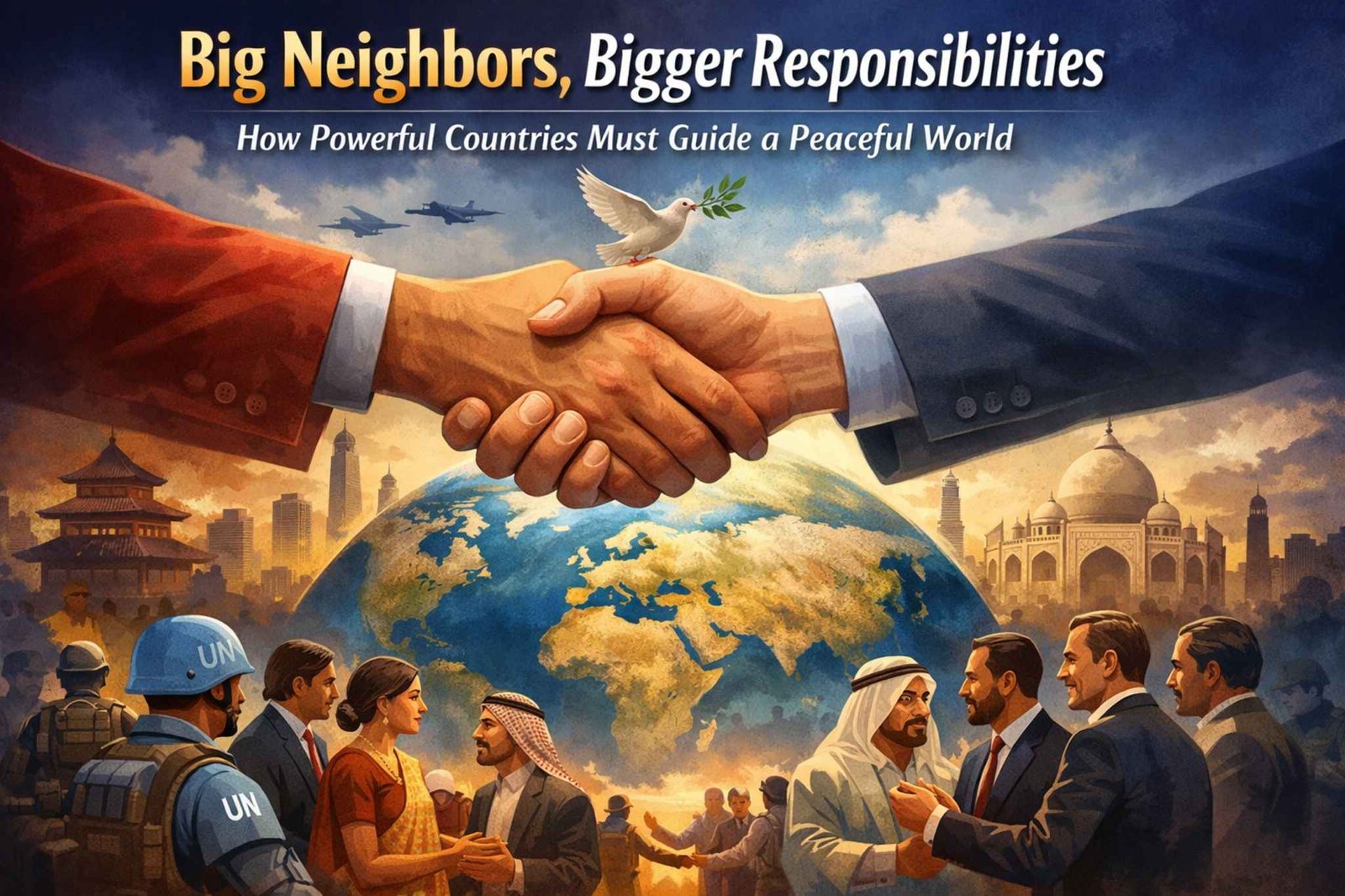
In an increasingly interconnected world, power no longer exists in isolation. A country’s size, economy, military strength, or political influence does not merely define its status—it defines its responsibility. History repeatedly shows that when powerful neighboring countries act with wisdom, restraint, and empathy, regions flourish. When they act with arrogance, fear, or domination, instability spreads far beyond borders. Today, more than ever, big neighbors carry bigger responsibilities—not just to their immediate surroundings, but to the peace of the entire world.
This article explores why powerful countries must act as guardians of peace rather than sources of pressure, how regional power dynamics shape global stability, and what moral, political, and strategic responsibilities come with strength.
1. Power and Geography: An Unequal Reality
Geography is unfair by nature. Some countries are blessed with vast land, abundant resources, large populations, strategic locations, or historical influence. Others are smaller, resource-limited, or geopolitically vulnerable. When such unequal neighbors coexist, a natural imbalance of power emerges.
But imbalance does not justify exploitation.
Powerful neighbors influence:
- Trade routes and access to markets
- Energy and water security
- Migration and labor flows
- Regional security and defense
- Political stability and diplomacy
Because of this influence, their decisions can uplift or suffocate surrounding nations. A single policy shift, border tension, or economic sanction by a big neighbor can destabilize millions of lives overnight.
True leadership begins with acknowledging this imbalance—and choosing responsibility over dominance.
2. The Difference Between Power and Leadership
Power is the ability to impose will.
Leadership is the ability to inspire trust.
Many conflicts arise when powerful countries confuse the two.
A dominant neighbor may believe:
- Military superiority ensures security
- Economic pressure ensures obedience
- Political interference ensures influence
In reality, such approaches create:
- Resentment instead of respect
- Resistance instead of cooperation
- Long-term instability instead of peace
History teaches a clear lesson: no region becomes peaceful through fear alone. Peace is built through dialogue, fairness, and mutual benefit. Leadership means using power to stabilize, not intimidate.
3. Why Regional Peace Matters to the Whole World
In the modern era, regional conflicts never stay regional.
A dispute between neighboring countries can quickly escalate into:
- Refugee crises affecting multiple continents
- Disruptions in global supply chains
- Energy price shocks
- Extremism and transnational crime
- Proxy conflicts involving global powers
The world learned this repeatedly—from border wars to civil conflicts fueled by external interference. When powerful neighbors fail to act responsibly, the cost is paid globally.
Thus, guiding regional peace is not charity—it is strategic necessity.
4. Economic Responsibility: Growth Without Exploitation
Large economies often dominate regional trade. This dominance can either become a ladder for shared prosperity or a tool of economic coercion.
Responsible economic leadership means:
- Fair trade agreements, not exploitative ones
- Infrastructure cooperation without debt traps
- Supporting regional supply chains, not monopolizing them
- Encouraging local industries instead of crushing them
When big neighbors grow together with smaller ones, regions become resilient. When growth is one-sided, resentment builds—and resentment eventually destabilizes markets.
Sustainable peace is impossible without economic dignity.
5. Security Responsibility: Protection, Not Provocation
Military strength is one of the clearest symbols of power. Unfortunately, it is also the most misused.
Powerful neighbors often justify military expansion or aggressive postures as “defensive.” Yet, for smaller neighbors, such actions feel like intimidation.
A responsible security approach includes:
- Transparency in defense policies
- Confidence-building measures
- Respect for sovereignty
- Commitment to peaceful dispute resolution
Security built on fear is fragile. Security built on trust lasts.
True strength is not shown by how often weapons are displayed—but by how rarely they are needed.
6. Political Responsibility: Non-Interference and Respect
Political interference is one of the most damaging behaviors powerful neighbors engage in. Manipulating elections, backing factions, or influencing internal politics of smaller countries destroys democratic institutions and social cohesion.
Responsible neighbors understand:
- Political stability cannot be imposed
- Sovereignty must be respected
- Internal problems require internal solutions
Supporting democracy means supporting processes, not outcomes.
A peaceful world cannot exist where strong countries treat weaker neighbors as chessboards for strategic games.
7. Moral Responsibility: The Ethics of Strength
Beyond strategy and economics lies a deeper question: What is the moral purpose of power?
Power without ethics becomes oppression.
Power with ethics becomes protection.
Big neighbors shape regional values. Their behavior sets examples—good or bad. When powerful countries normalize aggression, others follow. When they normalize restraint, dialogue, and justice, peace becomes contagious.
Moral responsibility includes:
- Protecting human rights beyond borders
- Avoiding collective punishment
- Prioritizing humanitarian concerns
- Acting with empathy, not arrogance
History remembers not who was strongest—but who was just.
8. Environmental Responsibility: Shared Planet, Shared Burden
Environmental crises do not respect borders. Rivers, air, oceans, and climate systems connect neighbors inseparably.
Large industrial or resource-heavy countries often:
- Control upstream water sources
- Produce disproportionate emissions
- Exploit shared ecosystems
Responsible neighbors must:
- Share water resources fairly
- Cooperate on climate action
- Protect cross-border ecosystems
- Support vulnerable countries facing climate disasters
Environmental negligence by powerful countries creates insecurity that no army can stop.
Peace in the 21st century depends as much on climate cooperation as on diplomacy.
9. Soft Power Over Hard Power
In today’s world, influence is shifting. Culture, education, technology, and values now shape power more effectively than weapons.
Big neighbors can guide peace by:
- Promoting educational exchange
- Supporting regional research and innovation
- Encouraging cultural understanding
- Investing in people, not just projects
Soft power builds admiration, not fear. Admiration is far more stable than control.
10. Learning From Failure: When Power Ignores Responsibility
History is full of examples where powerful neighbors ignored responsibility—and paid the price:
- Endless conflicts draining resources
- Hostile borders lasting generations
- Economic stagnation due to instability
- Loss of global credibility
Every time power chose domination, it created enemies. Every time it chose cooperation, it created allies.
The lesson is clear: short-term control leads to long-term chaos.
11. The Role of Global Institutions and Regional Cooperation
While big neighbors hold primary responsibility, regional and global institutions play a supporting role. Cooperation frameworks help:
- Resolve disputes peacefully
- Encourage dialogue
- Create accountability
However, institutions only work when powerful countries respect them—not manipulate them.
Leadership means strengthening international norms, not bypassing them.
12. A New Definition of Strength
In a rapidly changing world, the definition of strength must evolve.
True strength today means:
- The ability to prevent conflict
- The wisdom to compromise
- The courage to admit mistakes
- The patience to build trust
Powerful neighbors must realize that peace is not weakness—it is the highest form of strategic intelligence.
Conclusion: The World Needs Responsible Giants
The future of global peace will not be decided only by distant superpowers—it will be shaped daily by neighboring countries and how they treat each other.
Big neighbors cannot escape their responsibility. Their choices ripple outward, shaping regions, continents, and generations. They can either become sources of fear—or anchors of stability.
A peaceful world does not ask powerful countries to become smaller.
It asks them to become wiser.
Because in the end, the true measure of power is not how much territory a nation controls—but how much peace it creates.
