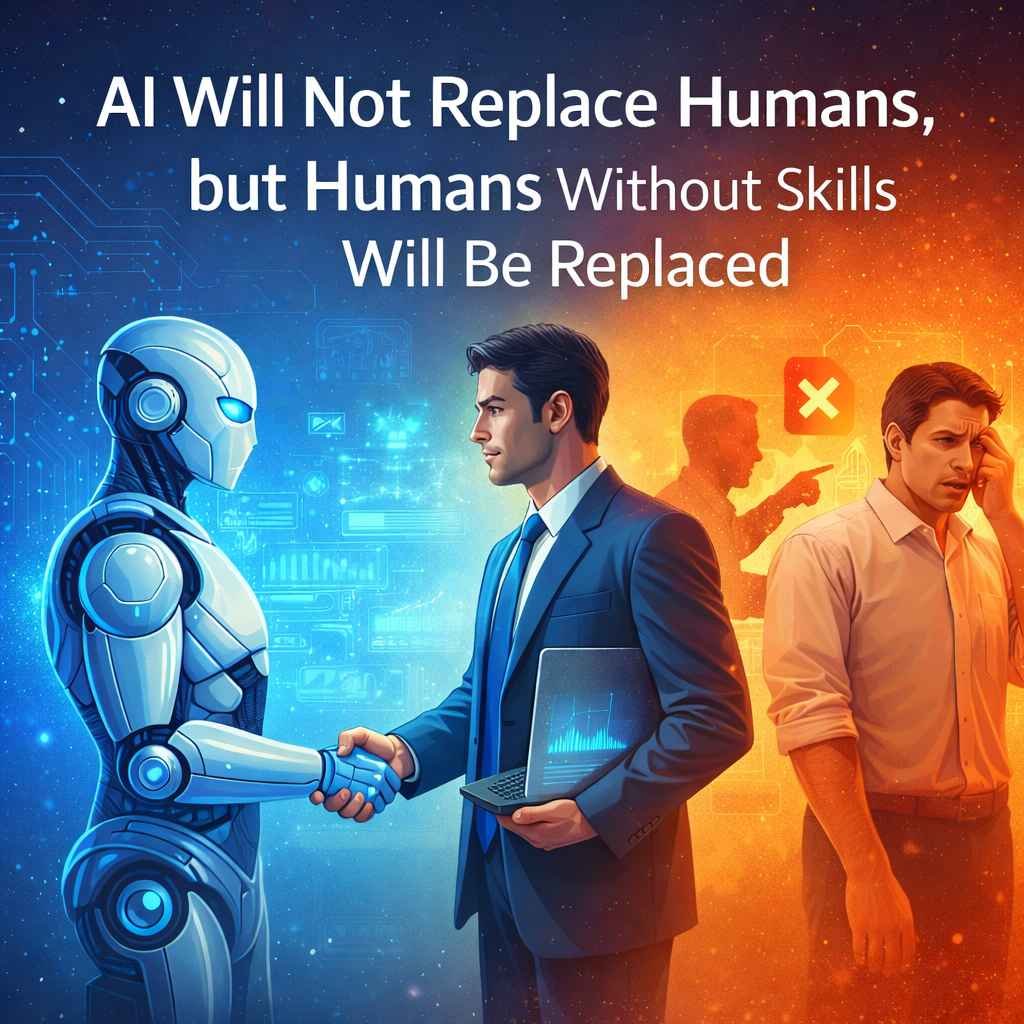
For centuries, every major technological shift has arrived with a familiar fear: machines will take our jobs. From the spinning jenny to electricity, from computers to the internet, each wave of innovation unsettled societies before eventually expanding human capability. Artificial Intelligence (AI) is the latest—and most powerful—chapter in this story. Yet the real threat today is not that AI will replace humans. The deeper risk is that humans who stop learning, adapting, and developing skills will be replaced—by other humans who use AI better.
AI is not an independent conqueror. It is a tool—extraordinarily capable, yes—but still dependent on human intent, design, judgment, and values. The future belongs not to machines alone, but to skilled humans working with machines. Understanding this distinction is essential for workers, educators, policymakers, and societies preparing for the decades ahead.
1. Technology Has Always Changed Work—Not Ended It
History offers perspective. When machines entered agriculture, many feared mass unemployment. Instead, productivity increased, food became cheaper, and new industries emerged. When computers arrived in offices, typists feared extinction. Instead, computers created entire sectors—from software engineering to digital marketing.
What changed was not the existence of work, but the nature of work.
AI follows the same pattern, only faster. It automates tasks, not human purpose. Repetitive, rule-based activities are easiest to automate. But work that requires judgment, creativity, empathy, ethics, and complex decision-making remains deeply human.
The lesson from history is clear: those who adapt skills thrive; those who resist change struggle.
2. What AI Actually Replaces: Tasks, Not People
A common misconception is that AI replaces jobs. In reality, it replaces tasks within jobs.
Consider a doctor. AI can analyze scans faster and detect patterns invisible to the human eye. But it cannot:
- Sit with a patient in fear
- Weigh ethical trade-offs in treatment
- Understand cultural and emotional contexts
- Take responsibility for life-altering decisions
Similarly, in law, AI can review documents and summarize cases, but it cannot replace human judgment, moral reasoning, or advocacy. In education, AI can personalize learning materials, but it cannot replace mentorship, inspiration, and character building.
Jobs evolve. Roles shift. Humans who upgrade skills remain relevant.
3. The Real Divide: Skilled vs Unskilled, Not Human vs Machine
The future workforce will not be divided between humans and machines. It will be divided between:
- Humans who use AI effectively
- Humans who do not
This is a crucial distinction.
A worker who understands how to collaborate with AI—by asking the right questions, validating outputs, and applying results creatively—becomes more productive and valuable. A worker who refuses to learn, relying only on outdated routines, becomes vulnerable.
AI amplifies human capability. It rewards:
- Critical thinking
- Domain expertise
- Adaptability
- Continuous learning
It penalizes stagnation.
4. Skills That Will Matter More Than Ever
In an AI-driven world, certain skills grow in importance rather than disappear.
a) Cognitive Skills
- Critical thinking
- Problem framing
- Systems thinking
- Decision-making under uncertainty
AI can generate answers, but humans must decide which questions matter and which answers to trust.
b) Creative Skills
- Original thinking
- Design
- Storytelling
- Innovation
AI recombines existing data. Humans imagine what does not yet exist.
c) Social and Emotional Skills
- Communication
- Leadership
- Empathy
- Negotiation
Trust, motivation, and collaboration remain human strengths.
d) Ethical and Moral Judgment
- Responsibility
- Values-based decisions
- Accountability
AI lacks conscience. Humans must provide it.
e) Learning Skills
- Learning how to learn
- Adapting quickly
- Updating skills continuously
In a fast-changing world, learning speed becomes more important than existing knowledge.
5. Education Must Shift: From Memorization to Mastery
One of the greatest dangers is applying old education models to a new technological reality.
If education continues to focus on rote memorization—facts that AI can retrieve instantly—it prepares students for irrelevance. Instead, education must emphasize:
- Understanding concepts
- Applying knowledge
- Thinking critically
- Solving real problems
- Ethical reasoning
Teachers will not be replaced by AI, but teachers who refuse to evolve may be. The role of educators must shift from information delivery to guidance, mentorship, and intellectual development.
6. AI as a Skill Multiplier, Not a Skill Substitute
AI does not eliminate the need for skill—it magnifies the gap between skilled and unskilled people.
A skilled engineer using AI designs faster and better systems. An unskilled user copies outputs without understanding them. A skilled writer uses AI to research and refine ideas. An unskilled writer depends on generic text without originality.
This creates a new reality:
- AI raises the ceiling for excellence
- AI lowers the floor for entry-level output
But long-term success belongs to those who combine human expertise with machine efficiency.
7. Responsibility Still Belongs to Humans
No matter how advanced AI becomes, responsibility does not disappear.
When an AI system fails:
- Humans designed it
- Humans trained it
- Humans deployed it
- Humans benefited from it
Accountability cannot be automated. Societies will still need humans to:
- Regulate technology
- Set ethical boundaries
- Protect rights
- Balance efficiency with justice
AI can advise, but humans must decide.
8. Fear Is Natural—but Misplaced
Fear often comes from misunderstanding. AI appears intelligent because it processes language, images, and data at scale. But it does not understand in the human sense. It does not possess:
- Consciousness
- Intent
- Moral awareness
- Responsibility
Treating AI as an enemy distracts from the real challenge: human readiness.
The question is not, Will AI replace us?
The question is, Are we preparing ourselves to remain valuable?
9. The Cost of Inaction
Those who ignore skill development face real risks:
- Job displacement
- Wage stagnation
- Reduced opportunities
- Loss of professional relevance
This is not cruelty; it is reality. Economic systems reward contribution. As contribution standards rise, skills must rise too.
However, this does not mean people are disposable. It means societies must:
- Invest in reskilling
- Support lifelong learning
- Make education accessible
- Encourage adaptability
Replacing humans is not progress. Empowering humans is.
10. A Shared Responsibility: Individuals, Institutions, Governments
The transition to an AI-driven world cannot be left to individuals alone.
Individuals must:
- Take ownership of learning
- Stay curious
- Adapt proactively
Institutions must:
- Update training systems
- Encourage innovation
- Value skills over rigid credentials
Governments must:
- Invest in education and reskilling
- Create fair transition policies
- Ensure technology benefits society broadly
The future is not predetermined. It is shaped by choices.
11. Redefining Human Value in the Age of AI
For too long, human worth has been tied to repetitive productivity. AI forces a rethinking of value. Human worth increasingly lies in:
- Creativity
- Judgment
- Ethics
- Care
- Purpose
This is not a loss. It is an elevation.
If AI handles routine tasks, humans can focus more on:
- Solving meaningful problems
- Building relationships
- Creating value beyond efficiency
The danger is not replacement. The danger is failing to rise to this opportunity.
Conclusion: The Future Belongs to the Prepared Human
AI will not replace humans. It will replace complacency.
Those who invest in skills, curiosity, ethics, and adaptability will not only survive—they will lead. Those who refuse to evolve may find themselves sidelined, not by machines, but by other humans who learned to work with them.
The message is not fear—it is responsibility. The future of work is not a battle between humans and AI. It is a test of whether humans are willing to grow.
And growth, unlike automation, has always been a human choice.
